THE ELUSIVE ORIGINS: TRACING THE FIRST FAIRIES
Delve into the shadowed realms where reality blurs with fantasy as we unravel the complex tapestry of fairy lore throughout human history. From their enigmatic origins in ancient folklore to their evolution in Victorian literature and their contemporary manifestations in roleplaying games, discover how these mercurial beings have captivated our collective imagination for millennia.
The concept of fairies has no single point of origin, instead emerging from a complex tapestry of cultural beliefs spanning continents and millennia. These enigmatic beings appear in various forms across Celtic, Germanic, Slavic, and French folklore, each tradition contributing unique elements to our understanding of the fae. The earliest recorded mention of fairy-like entities dates back to 1000 BCE in Homer’s “The Iliad,” where he wrote of “watery fairies dance in mazy rings,” suggesting that even in ancient Greece, concepts of magical, otherworldly beings existed. These early manifestations would later influence what we now recognize as fairies.
The etymology of the word “fairy” itself reveals much about their conceptual evolution. Derived from the Early Modern English “faerie,” the term has Latin roots in “fata” meaning fate, connecting these beings to concepts of destiny and supernatural influence. During the Middle Ages, “fairie” was used adjectively, meaning “enchanted” (as in “fairie knight” or “fairie queene”), before eventually becoming a generic term for various enchanted creatures. This linguistic journey mirrors the evolution of fairy concepts themselves—from powerful, fate-controlling entities to the more familiar diminutive beings of later folklore.
Explanations for fairy origins within folklore are as varied as the cultures that birthed them. Some traditions cast them as fallen angels occupying a middle ground between heaven and hell, neither wholly good nor evil. Others viewed them as nature spirits, ancient deities diminished by the rise of Christianity, or the spirits of the dead lingering in our world. The Celts believed fairies were the remnants of the Tuatha Dé Danann, a supernatural race who inhabited Ireland before being driven underground by human settlers. This particular origin story would become one of the most influential in later fantasy literature and gaming.
What unites these diverse origin myths is the positioning of fairies as liminal beings—existing at the threshold between worlds, between life and death, between divine and mortal. This liminality would become central to their enduring appeal in fantasy literature and roleplaying games, where they often represent the mysterious “other” that exists just beyond human perception.
THE TUATHA DÉ DANANN: IRELAND’S DIVINE ANCESTORS
No exploration of fairy origins would be complete without examining the Tuatha Dé Danann, perhaps the most influential fairy ancestors in Western mythology. Their name translates to “the folk of the goddess Danu,” and in Irish mythology, they were a supernatural race with godlike powers. These beings were described as kings, queens, druids, bards, warriors, healers, and craftsmen possessing supernatural abilities—they could control weather, shapeshift, and were immune to aging and sickness.
The Tuatha Dé Danann were not originally conceived as the diminutive winged creatures of later fairy lore. Rather, they were powerful, human-sized beings of extraordinary beauty and magical prowess. Their mythology tells of their arrival in Ireland on a magical cloud, bringing with them four magical treasures: the Stone of Fal, the Spear of Lugh, the Sword of Nuada, and the Cauldron of Dagda. These treasures would later inspire countless magical artifacts in fantasy literature and roleplaying games.
According to legend, when the Milesians (ancestors of the modern Irish) defeated the Tuatha Dé Danann, the latter retreated into the sidhe—the ancient burial mounds and hills of Ireland. There, they continued to exist in a parallel realm, occasionally interacting with the human world. This concept of a hidden fairy realm existing alongside our own would become a foundational element in fantasy worldbuilding.
The transformation of the Tuatha Dé Danann from gods to fairies represents a fascinating example of mythological evolution. As Christianity spread through Ireland, these once-revered deities were recontextualized as supernatural beings of lesser status—powerful, but not divine. Medieval Irish manuscripts, written by Christian monks, often acknowledged that at least some of the Tuatha Dé Danann had once been gods, while carefully recasting them as magical beings rather than deities worthy of worship. This demotion from gods to fairies would be mirrored in other European cultures as Christianity supplanted pagan beliefs.
MEDIEVAL FAIRIES: DANGEROUS AND UNPREDICTABLE
The fairies of medieval Europe bore little resemblance to the benevolent, diminutive creatures of later Victorian imagination. These were dangerous, unpredictable beings capable of both blessing and cursing humans according to their inscrutable whims. Medieval fairy lore was filled with warnings about fairy abductions, curses, and tricks. These beings were believed to steal human children, replacing them with changelings—fairy substitutes left in the cradle. They could lead travelers astray with will-o’-the-wisps, spoil food, sour milk, and bring misfortune to those who offended them.
Protection against fairies was a serious concern in medieval communities. Iron was considered particularly effective, as fairies were believed to be unable to tolerate this metal. Other protective measures included carrying specific herbs, wearing clothes inside out, or placing scissors, pins, or other iron implements near cradles to prevent child abduction. These protective practices reveal the genuine fear these beings inspired in medieval populations.
The medieval period also saw the development of the concept of fairy courts, particularly in Scottish folklore. The Seelie Court represented the more benevolent fairies, while the Unseelie Court housed malevolent ones. However, even the Seelie fairies could be dangerous if offended, and interactions with either court were fraught with peril for unwary humans. This court structure would later influence fantasy literature and roleplaying games, where fairy realms are often divided into Summer and Winter Courts or similar opposing factions.
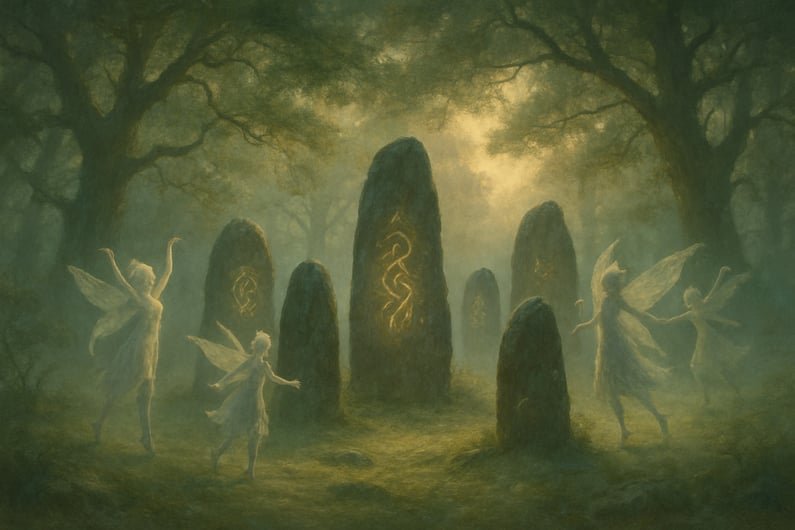
During this period, fairies were frequently associated with specific natural features—fairy rings (circular patterns of mushrooms), certain trees, stones, or bodies of water. Fairy rings were particularly significant in folklore, believed to mark locations where fairies danced in circles. Entering such rings was considered dangerous, as it might result in being whisked away to the fairy realm or being cursed. The scientific explanation—that fairy rings are formed by the outward growth of fungal mycelium—did nothing to diminish their mystical associations in folklore.
SHAKESPEARE’S TRANSFORMATION: FAIRIES ON THE ELIZABETHAN STAGE
William Shakespeare played a pivotal role in transforming the public perception of fairies, particularly through his works “A Midsummer Night’s Dream” and “The Tempest”. Prior to Shakespeare, fairies in English folklore were often portrayed as dangerous, demonic entities associated with the devil. Shakespeare reimagined them as more human-like beings capable of mischief but also of goodwill and merriment.
Shakespeare’s fairies, particularly Oberon, Titania, and Puck, became archetypes that would influence fairy depictions for centuries to come. His portrayal of Puck (also known as Robin Goodfellow) as a mischievous but ultimately harmless sprite helped shift the cultural perception of fairies away from the dangerous entities of medieval folklore toward more benign, even playful beings. This transformation reflected broader cultural changes during the Renaissance, as supernatural beliefs began to be viewed through a more literary and less literal lens.
Shakespeare also popularized the concept of diminutive fairies. While earlier folklore often depicted fairies as human-sized or capable of changing their size at will, Shakespeare’s description of Queen Mab in “Romeo and Juliet” as tiny enough to ride in a hazelnut shell helped establish the image of miniature fairies that would later dominate Victorian fairy art. This reimagining of fairy size would have profound implications for later fantasy literature, where fairy size often determines their role and abilities within the narrative.
By “commercializing, shrinking, and then disembodying his fairies,” Shakespeare not only transformed fairy lore but also commented on the social conditions of Elizabethan England. His fairy characters served as vehicles for social critique, particularly regarding the excesses of the nobility and the growing disconnect between humans and nature. This use of fairy characters as metaphorical devices for social commentary would become a common technique in later fantasy literature.
VICTORIAN FAIRY RENAISSANCE: THE BIRTH OF MODERN FAIRY IMAGERY
The Victorian era witnessed an unprecedented fascination with fairies, transforming them from the fearsome entities of folklore into the delicate, winged beings that dominate popular imagination today. This period saw fairies appear everywhere—in art, music, literature, and even scientific discourse. The Victorian fairy obsession was partly a reaction to rapid industrialization and urbanization, representing a nostalgic yearning for a simpler, more magical past.
Victorian fairy art established the now-familiar image of fairies as diminutive, beautiful beings with insect-like wings. Artists like Richard Dadd, Joseph Noel Paton, and Edward Robert Hughes created elaborate fairy paintings that depicted these creatures amid lush natural settings. These artistic representations were heavily influenced by Shakespeare’s works, particularly “A Midsummer Night’s Dream,” which experienced a revival during this period.
The Victorian fascination with fairies extended beyond art into pseudoscientific inquiry. Some anthropologists speculated about the existence of “lost tribes” of fairies in unexplored regions of the world, while others searched for evidence of fairies in the fossil record. Even Sir Arthur Conan Doyle, creator of the rational detective Sherlock Holmes, became convinced of the reality of fairies after viewing the Cottingley Fairy photographs—images later revealed to be an elaborate hoax.
Victorian children’s literature played a crucial role in cementing the modern conception of fairies. Works like Charles Kingsley’s “The Water Babies” and J.M. Barrie’s “Peter Pan” introduced generations of children to fairy characters who were magical, mischievous, but ultimately benevolent. Tinker Bell from “Peter Pan” became particularly influential, establishing the archetype of the tiny, jealous fairy that would appear in countless later works.
The Victorian era also saw the development of “scientific fairy tales” that used fairy imagery to explain natural phenomena to children. Lucy Rider Meyer’s “Real Fairy Folks” illustrated chemical concepts through fantastical text and beautiful line drawings, depicting oxygen and hydrogen atoms as fairies holding hands to form water molecules. This merging of scientific education with fairy imagery reflected the Victorian attempt to reconcile enchantment with an increasingly scientific worldview.
J.R.R. TOLKIEN: RECLAIMING THE ANCIENT ELVES
J.R.R. Tolkien’s approach to fairy beings marked a significant departure from Victorian sentimentality, instead drawing inspiration from older, more complex folkloric traditions. Tolkien disliked the diminutive, flower-dwelling fairies of Victorian literature, preferring the term “elf” to describe the fair folk in his works. His elves were tall, immortal beings of great beauty and power—closer to the Tuatha Dé Danann of Irish mythology than to Tinker Bell.
In his influential essay “On Fairy-Stories,” Tolkien argued that fairies were not inherently small creatures, but could appear so if they wished. He rejected the Victorian tendency to associate fairies primarily with nature and flowers, instead emphasizing their connection to art, craft, and magic. For Tolkien, Faërie (his preferred spelling) was not merely a place but “the realm in which fairies have their being”—a concept that encompassed magic, wonder, and enchantment.
Tolkien’s elves in “The Lord of the Rings” and “The Silmarillion” became tremendously influential in fantasy literature and roleplaying games. His portrayal of elves as ancient, wise beings with a deep connection to nature but also skilled in crafts and magic established a template that countless fantasy authors and game designers would follow. The division between “high elves” and “wood elves” in many fantasy settings can be traced directly to Tolkien’s work.
Interestingly, in Tolkien’s earlier writings, particularly “The Book of Lost Tales,” he used terms like “fairy” and “gnome” more freely. The Noldor elves were initially called “Gnomes,” while “fairy” was used as a generic term for various elvish peoples. As his legendarium evolved, Tolkien refined his terminology, eventually settling on “elf” as the preferred term. This evolution reflects Tolkien’s scholarly approach to mythology and his desire to create a coherent, internally consistent fantasy world.
Tolkien’s work represents a bridge between ancient fairy lore and modern fantasy. By drawing on pre-Victorian fairy traditions while creating a thoroughly modern mythology, he helped establish many of the conventions that would define fairy-like beings in fantasy literature and roleplaying games for generations to come.
FAIRIES IN ROLEPLAYING GAMES: FROM D&D TO DIGITAL WORLDS
The transition of fairies from literature to roleplaying games began with Dungeons & Dragons in the 1970s, which incorporated elements from folklore, mythology, and fantasy literature into its game mechanics. D&D’s approach to fairies was heavily influenced by Tolkien, with elves portrayed as a playable race distinct from the smaller, more mischievous fairy creatures that populated the game’s monster manuals. This distinction between elves and fairies would become standard in many roleplaying games.
In D&D, fairies are typically categorized as “fey” creatures—a broad classification that includes sprites, pixies, dryads, nymphs, and other beings from folklore. These creatures are associated with natural environments, particularly forests, and often possess innate magical abilities. The game mechanics reflect folkloric traditions, with fairies being vulnerable to cold iron and having powers of illusion, enchantment, and nature magic.
The concept of fairy courts also appears in many roleplaying games, usually as the Seelie (Summer) and Unseelie (Winter) Courts. These courts represent opposing aspects of fairy nature—the Seelie associated with light, growth, and benevolence (though still dangerous), and the Unseelie with darkness, decay, and malevolence. This dualistic structure provides rich storytelling opportunities and has become a standard feature in games featuring fairy realms.
Modern digital roleplaying games have further expanded fairy representation. In World of Warcraft, fairy-like beings appear in various forms, from the nature-oriented Night Elves to more traditional winged fairies. The game incorporates elements of Celtic mythology, particularly through characters like Freya, who is associated with life and nature in a manner reminiscent of fairy queens from folklore.
Pathfinder RPG offers a particularly detailed treatment of fairy creatures, categorizing them as “fey” and dividing them into numerous subtypes including gremlins, nymphs, redcaps, rusalkas, satyrs, and sprites. Each type has distinct abilities and characteristics drawn from various folkloric traditions. The game’s lore connects these beings to “the First World,” a primordial realm of pure magic that exists parallel to the material world—a concept reminiscent of the fairy otherworlds of Celtic mythology.
Smaller, indie roleplaying games have also embraced fairy themes, often focusing on the experience of being a fairy rather than encountering them as NPCs. Games like “Fairies of the Mistglade” offer tiered difficulty levels that allow even young children to engage with fairy roleplaying, emphasizing storytelling and problem-solving over combat. These games often highlight the more whimsical aspects of fairy lore while still acknowledging the potential for mischief and danger.
FAIRY TYPES ACROSS CULTURES: A GLOBAL PERSPECTIVE
While European fairy traditions have dominated fantasy literature and roleplaying games, fairy-like beings exist in mythologies worldwide, each with distinctive characteristics that occasionally influence modern fantasy. Japanese folklore features yōsei, fairy-like beings associated with natural elements. Unlike their Western counterparts, yōsei are not typically depicted with wings but share the association with nature and magical abilities. In anime and manga, these traditional concepts often blend with Western fairy imagery to create unique interpretations.
Chinese mythology includes several fairy-like entities, including the Zhinü (the “Weaving Maid”), who features in the romantic legend of the Cowherd and Weaver Girl. Chinese fairies are often associated with celestial bodies and immortality, reflecting Taoist influences. Xiwangmu, the “Queen Mother of the West,” rules over a fairy realm and possesses peaches of immortality—a concept that has influenced some fantasy works set in East Asian-inspired settings.
In Philippine mythology, the diwata are nature spirits similar to fairies. These beings can be benevolent or malevolent and are often associated with specific natural features such as trees, mountains, or bodies of water. The Malaysian pari-pari and Indonesian peri are described as motherly creatures who help those with good hearts, showing how fairy concepts can vary significantly across cultures.
African fairy traditions include the Aziza, beneficent fairy beings from Dahomey (modern Benin), and the Yumboes of Senegalese mythology. These traditions have been less frequently incorporated into mainstream fantasy and roleplaying games, representing an untapped resource for future creative works.
The cross-cultural study of fairy-like beings reveals both surprising similarities and significant differences. Common themes include associations with nature, magical abilities, and ambivalent relationships with humans. However, the specific forms, powers, and moral alignments of these beings vary widely, reflecting the diverse cultural contexts from which they emerge.
FAIRY PROTECTION AND INTERACTION: FOLKLORE MEETS GAMEPLAY
Folklore surrounding protection against fairies has influenced how these beings are portrayed in fantasy literature and roleplaying games. Traditional protective measures—such as cold iron, salt, bells, or wearing clothing inside out—often appear as game mechanics or plot devices. In many roleplaying games, weapons made of cold iron deal additional damage to fairy creatures, directly translating folkloric vulnerability into gameplay.
The concept of fairy rings has particular significance in both folklore and fantasy gaming. In traditional beliefs, these mushroom circles marked places where fairies danced, and stepping inside one could result in being transported to the fairy realm or being forced to dance until exhaustion. In roleplaying games, fairy rings often serve as portals between worlds or as magical locations where spells are enhanced.
Changelings—fairy substitutes left in place of stolen human children—represent another folkloric concept that has found its way into fantasy gaming. In traditional beliefs, changelings were often used to explain developmental disabilities or failure to thrive in infants. Modern fantasy has reinterpreted this concept, sometimes portraying changelings as victims themselves or exploring the experience of being caught between human and fairy worlds.
The rules governing fairy interaction in folklore—such as never thanking a fairy, never eating fairy food, or never giving your true name—frequently appear in fantasy narratives. These taboos create tension and conflict when human characters unwittingly violate fairy etiquette. In roleplaying games, knowledge of these rules often becomes valuable in-game information that players can use to navigate encounters with fairy beings.
The concept of fairy gifts and bargains—often beautiful but ultimately dangerous or double-edged—has become a staple of fantasy storytelling. In roleplaying games, magical items of fairy origin typically come with strings attached or unexpected consequences, reflecting the ambiguous nature of fairy benevolence in folklore. This creates interesting gameplay dynamics where players must weigh the benefits of fairy magic against its potential costs.
FAIRIES IN MODERN FANTASY LITERATURE: EVOLUTION AND INNOVATION
Contemporary fantasy literature has both embraced traditional fairy lore and reimagined it for modern audiences. Authors like Holly Black, Sarah J. Maas, and Laini Taylor have created complex fairy worlds that draw on folklore while introducing innovative elements. These modern interpretations often explore themes of identity, power, and moral ambiguity through fairy characters who are far more nuanced than their folkloric predecessors.
Urban fantasy has been particularly influential in bringing fairy beings into contemporary settings. Works in this genre typically place fairy courts and kingdoms in hidden corners of modern cities, creating a juxtaposition between ancient magic and urban life. This approach allows authors to explore how traditional fairy values and powers might adapt to (or conflict with) modern technology and social structures.
The “fairycore” aesthetic that has emerged in recent years represents yet another evolution in how we imagine fairies. Characterized by ethereal imagery, soft pastel colors, and naturalistic themes, fairycore draws on Victorian fairy art while incorporating contemporary sensibilities. This aesthetic has influenced not only literature but also fashion, music, and digital art, demonstrating the continuing cultural relevance of fairy imagery.
In children’s and young adult literature, fairies continue to serve important narrative functions. From Artemis Fowl’s technologically advanced fairy civilization to the complex fairy politics of Holly Black’s Folk of the Air series, these works use fairy characters to explore complex themes in accessible ways. The moral ambiguity of fairies—neither wholly good nor wholly evil—makes them particularly useful for exploring ethical nuances in literature aimed at younger readers.
The evolution of fairies in modern fantasy literature reflects broader cultural shifts in how we relate to the supernatural. As society has become more secular and scientifically oriented, fairies have transformed from beings that were genuinely feared or revered into metaphorical devices for exploring human psychology and social dynamics. Yet they retain their connection to mystery and magic, fulfilling a persistent human need for enchantment in an increasingly disenchanted world.
CONCLUSION: THE ENDURING ENCHANTMENT
From their ancient origins in pre-Christian mythology to their current incarnations in digital roleplaying games, fairies have demonstrated remarkable adaptability across time and media. Their evolution reflects changing human relationships with nature, magic, and the unknown. As beings that exist at the boundaries—between worlds, between moral categories, between nature and culture—fairies continue to fascinate us precisely because they resist simple categorization.
The journey of fairies from folklore to fantasy literature to roleplaying games represents more than just the repurposing of traditional motifs. It demonstrates how mythic archetypes can be continuously reinvented to address contemporary concerns while maintaining connections to ancient wisdom. In roleplaying games, fairies offer players the opportunity to engage directly with these mythic elements, creating new stories that both honor and transform folkloric traditions.
As digital technology advances, fairy representations continue to evolve. In video games like Final Fantasy, fairies appear as helpful companions, healing entities, or powerful elemental beings. These digital incarnations maintain core characteristics from folklore—their connection to nature, their magical abilities, their moral ambiguity—while adapting to new narrative contexts and gameplay mechanics.
The persistence of fairy imagery across cultures and throughout history suggests that these beings fulfill a fundamental human need. Whether as explanations for natural phenomena, embodiments of moral lessons, or simply as vehicles for wonder and enchantment, fairies help us navigate the boundaries between the known and unknown. In a world increasingly dominated by scientific rationalism, they remind us of the power of imagination and the enduring human desire for magic.
As we continue to create and recreate fairy narratives in literature and games, we participate in a tradition that stretches back to our earliest ancestors. The whispers of the fae folk echo through time, inviting us to step beyond the veil of ordinary perception and glimpse, if only briefly, the extraordinary possibilities that lie just beyond our everyday understanding of the world.
LINKS & SOURCES
Delve into the shadowed realms where reality blurs with fantasy as we unravel the complex tapestry of fairy lore throughout human history. From their enigmatic origins in ancient folklore to their evolution in Victorian literature and their contemporary manifestations in roleplaying games, discover how these mercurial beings have captivated our collective imagination for millennia.
The Origins and History of Fairies
https://www.historic-uk.com/CultureUK/The-Origins-of-Fairies/
Fairy | Origins, Beliefs & Legends | Britannica
https://www.britannica.com/art/fairy
Tuatha Dé Danann – Wikipedia
https://en.wikipedia.org/wiki/Tuatha_D%C3%A9_Danann
Fairies in Literature: From Shakespeare to Modern Fantasy
https://breakingac.com/news/2025/jan/23/fairies-in-literature-from-shakespeare-to-modern-fantasy/