1. Introduction: The Geopolitics of a Dead God
In the landscape of modern epic fantasy, few entities command the narrative gravity of Snaka, the Serpent Father of John Gwynne’s Bloodsworn Saga. He is a figure defined not by his presence, but by the cataclysmic shadow of his absence. To speak of Snaka is not merely to discuss a character in a dramatis personae; it is to discuss the very tectonic plates upon which the saga rests. He is the “Prime Mover” of Vigrið, a deity whose death three centuries prior to the events of The Shadow of the Gods did not liberate the world, but rather imprisoned it in a cycle of scavenging and sorrow.
This report serves as a definitive “deep dive,” written from the perspective of a lore-keeper dissecting the forbidden history of the Battle-Plain. It explores the paradox of Snaka: the Sage-Creator who birthed a pantheon, and the Rebel-Destroyer who sought to consume it. Through a synthesis of textual evidence, mythological parallels, and critical analysis, this document maps the contours of the Serpent God—from the marrow of his bones that form the mountains to the venomous legacy of his bloodline.
The Bloodsworn Saga—comprising The Shadow of the Gods, The Hunger of the Gods, and The Fury of the Gods—presents a world where the divine is biological, tangible, and terrifyingly mortal. Gwynne, a master of Norse-inspired fantasy, subverts the trope of the ethereal deity. In Vigrið, gods bleed, rot, and can be mined for resources. Snaka stands at the apex of this grim hierarchy. As the “Father of All,” his narrative arc creates a theological vacuum that sucks every protagonist—Orka, Varg, Elvar—into its orbit. Understanding Snaka is the key to decoding the intricate magic system of Seiðr, the socio-political structures of Snakavik, and the ultimate thematic arguments Gwynne posits regarding power, grief, and the cost of vengeance.
1.1 The SEO of Myth: Why Snaka Matters
In the “Search Engine Optimization” of Vigrið’s history, Snaka is the supreme keyword. Every conflict in the trilogy traces back to him. The “Tainted” are persecuted because they carry the echo of the gods’ power—power that originates from Snaka’s initial act of creation. The primary antagonist, Lik-Rifa, is his daughter, driven by a patricidal and fratricidal history that began with Snaka’s hunger. Even the geography is a search result for his death: the Boneback Mountains are his vertebrae; Snakavik is his skull. This report will demonstrate that Snaka is not just a backstory element but the active antagonist of the world’s history, a leviathan whose resurrection in the final volume was both inevitable and doomed by the very nature of the violence he spawned.
2. The Archetype of the Ouroboros: Mythological Origins
John Gwynne’s Vigrið is a love letter to Norse mythology, but it is written in blood and ash rather than ink. To understand Snaka, one must first understand the ancient archetypes Gwynne deconstructs and reassembles. Snaka is a composite deity, stitching together the scales of Jörmungandr, the primal body of Ymir, and the devouring hunger of Kronos.
2.1 The Inversion of Jörmungandr
The most immediate parallel is Jörmungandr, the Midgard Serpent of Norse eddas. Like Jörmungandr, Snaka is a serpent of “monstrous” proportions, large enough to encircle or crush the world.2 Both entities are associated with the end of the world (Ragnarök/Guðfalla) and possess venom capable of poisoning the sky.
However, Gwynne introduces a critical “Rebel” inversion. In Norse myth, Jörmungandr is the offspring of Loki, a child of chaos destined to fight Thor. In the Bloodsworn Saga, Snaka is the Father. He is the progenitor, the “Eldest,” the source from which the Wolf (Ulfrir), the Dragon (Lik-Rifa), and the Eagle (Orna) sprang. This shift changes the theological weight of the character. Snaka is not a monster invading the gods’ realm; he is the realm. He represents the primordial authority against which his children must rebel. This aligns him more closely with the Greek Titan Kronos, who devoured his children to prevent them from usurping him. The lore of the Guðfalla, where Snaka was “in a feeding frenzy, eating every living thing he could,” mirrors Kronos’s consumption of the Olympians.
2.2 The Ymir Principle: Corpse-Geography
In the Prose Edda, Odin and his brothers slay the giant Ymir and fashion the world from his corpse: his skull becomes the sky, his blood the oceans. Snaka is the Ymir of Vigrið, but the transformation is localized and horrific.
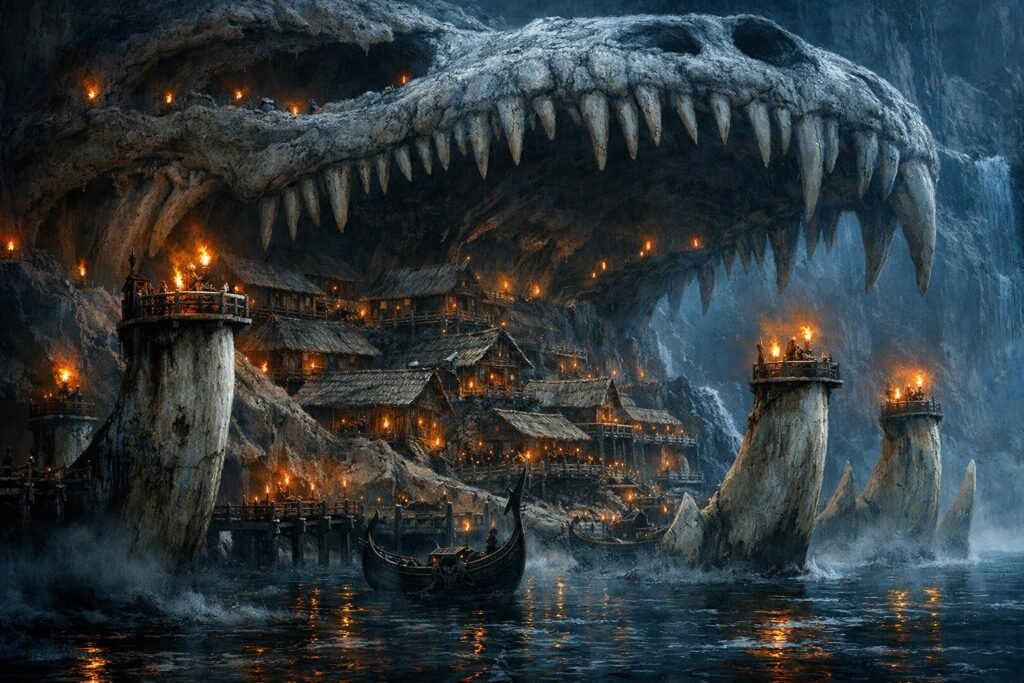
- The Skull: The city of Snakavik is built within the curves of his jaw and cranial cavity. The Jarls sit upon thrones carved from his bone. This is a literalization of living in the shadow of the past.5
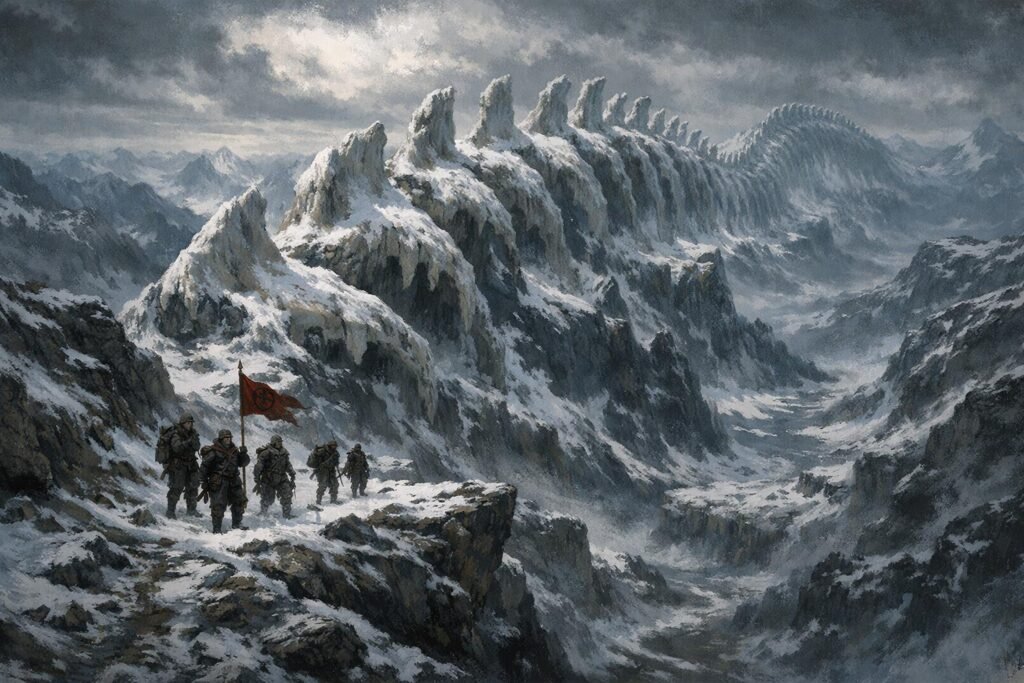
- The Vertebrae: The “Boneback Mountains” are explicitly identified as the rest of his body.5
- The Soil: The earth covering these bones is described as the “ruptured” land heaved up by his death throes.2
This “Ymir Principle” dictates the economy of the saga. If the land is made of god-corpse, then mining is a theological act. The extraction of “god-bone” and “god-teeth” to fuel magic is a form of desecration that has become normalized industry.
2.3 The Sister in the Shadows: Skuugar and Duality
A deep dive into the lore reveals that Snaka was not alone. Snippets and community analysis point to a sister, potentially named Skuugar, who represented “Unmaking”. If Snaka is the Creator (who later consumes), his sister represents the Void. This dualism—Creation vs. Unmaking—suggests a balance that was lost. Snaka’s descent into madness and gluttony may have been a reaction to the loss or conflict with this sibling, adding a layer of tragedy to his monstrous nature. This duality also hints at why Snaka’s children (Lik-Rifa, Ulfrir) are so polarized; they inherit different fragments of this fractured divine psyche.
3. The History of the Guðfalla: The War of the Kin
The history of Vigrið is bisected by a single event: The Guðfalla, or “God-Fall.” This was the Ragnarök of Gwynne’s world, occurring 300 years prior to the events of the books. It was not a war between gods and giants, but a civil war within the divine family.
3.1 The Frenzy of the Father
The conflict began with “jealousy and murder”. Lik-Rifa (Dragon) believed her sister Orna (Eagle) was plotting against her. Rotta (Rat) fueled this paranoia. This sparked a “blood feud” that drew in every deity.
- The Trigger: Lik-Rifa murdered the daughter of Orna and Ulfrir, performing the “blood-eagle” on her.
- The Escalation: The war spread, destroying realms and shattering the land.
- Snaka’s Intervention: The Father did not intervene to make peace. Instead, he “entered the blood-fray and consumed his children”.
This moment is critical to understanding Snaka’s psychology. He viewed his children’s war not as a tragedy, but as a dinner bell. He “loved his creations, when he was not feasting on them”. This paradox—love and hunger—defines the divine nature in the saga. It is a raw, animalistic divinity, stripped of moral righteousness.
3.2 The Death of the Serpent
The Guðfalla ended only when the children turned on the Father. It took the combined might of the surviving gods—Lik-Rifa, Ulfrir, Orna, Berser, and Rotta—to slay Snaka.
- The Mechanism: The lore implies he was “slain by his children,” overwhelmed by their numbers and ferocity.
- The Aftermath: His fall “shattered the world,” crushing realms and allowing the sea to rush in.2 This created the fractured coastline of Vigrið. The surviving gods, exhausted and wounded, eventually faded or were imprisoned/slept, leaving humanity to pick through the wreckage.
3.3 The Human Interregnum
For 300 years, Snaka was dead. Yet, his presence dictated human evolution. The “Tainted”—humans carrying the blood of the gods—became the new resource. Because the gods were dead, their power could only be accessed through these living vessels or through the “relics” (bones) left behind. The entire mercenary economy of the Bloodsworn and the Battle-Grim is built on the scarcity of power caused by Snaka’s death.
4. The Taxonomy of the Divine: Snaka’s Lineage
Snaka is the root of the evolutionary tree of Vigrið’s pantheon. His children represent different aspects of the predatory instinct, differentiated by their totem animals and the “gifts” they bestow upon their human descendants.
Table 4.1: The Pantheon of Vigrið
| Deity | Animal Totem | Role/Nature | Tainted Descendants | Eye Color | Magic/Ability | Status (Pre-Fury) |
| Snaka | Serpent | The Father/Creator | Seiðr-Witches | Varied/None | Seiðr Magic, Fire, Serpent Charm | Dead |
| Lik-Rifa | Dragon | The Destroyer/Daughter | Dragon-Born | Red | Fire, Strength, Flight (Wings) | Resurrected |
| Ulfrir | Wolf | The Hunter | Ulfheðnar | Amber/Yellow | Speed, Pack Tactics, Frenzy | Alive/Bound |
| Berser | Bear | The Warrior | Berserkir | Green | Brute Strength, Size, Rage | Dead |
| Orna | Eagle | The Watcher | Eagle-Tainted | Gold Flecks | Enhanced Vision, Precision | Dead |
| Rotta | Rat | The Trickster | Rat-Tainted | Unknown | Stealth, Intelligence, Poison | Alive/Hiding |
| Svin | Boar | The Charger | Boar-Tainted | Black (Inky) | Durability, Tusks | Dead |
| Hundur | Hound | The Tracker | Hound-Tainted | Unknown | Scent, Tracking | Dead |
| Fjalla | Goat | The Climber | Goat-Tainted | Unknown | Agility, climbing | Dead |
4.2 The Unique Status of Snaka’s Kin
While the Berserkir and Ulfheðnar are defined by physical prowess (claws, teeth, muscle), Snaka’s descendants are defined by metaphysical prowess. They are the Seiðr-witches.
- The Sage aspect: They are the keepers of lore, the readers of runes.
- The Rebel aspect: They wield the power of the Father, which is often forbidden or feared even among other Tainted.
- Rarity: Unlike the Wolf-tainted, who form entire warbands, Seiðr-witches appear less frequently and are often high-value captives used for their utility (opening Vaesen pits, navigating magical storms) rather than frontline combat.
5. The Mechanics of Magic: Seiðr vs. Galdur
The distinction between Seiðr (Snaka’s magic) and Galdur (Learned magic) is the central axis of the saga’s “hard” magic system. Gwynne treats magic not as a mystical cheat code but as a technology with strict rules, costs, and inputs.
5.1 Seiðr: The Blood-Code
Seiðr is genetic. It is the ability to interface with the world’s operating system using the “root access” granted by Snaka’s blood.
- The Programming Language: Seiðr is described in terms of runes. “Icy rune-spells were being cast… intercepted by runes of fire”.
- Elemental Dominance: Snaka’s blood grants specific affinity for fire and ice. This is significant because Lik-Rifa (Dragon) also commands fire. This suggests that the Dragon inherited her thermal capabilities directly from the Serpent Father.
- Serpent Charming: A niche but potent ability. Snaka’s kin can control snakes, a literal manifestation of their lineage.
- The Cost: High-level Seiðr requires immense focus and often blood sacrifice or the use of catalysts (god-teeth). It is physically draining, contrasting with the adrenaline-fueled stamina of the physical Tainted.
5.2 Galdur: The Open-Source Alternative
Galdur is the democratization of magic. It is practiced by humans (like Skalk) who do not have god-blood but have learned to manipulate the ambient magic using tools.
- Tools: Galdurmen use carved runes, often on bone or wood. They hack the system from the outside.
- Limitations: Galdur is slower and requires preparation. A Seiðr-witch can cast instinctively; a Galdurman needs to “write” the spell.
- The Social Divide: Galdurmen often look down on the Tainted, viewing themselves as scholars and the Tainted as beasts. Skalk’s interactions with Vol highlight this class struggle.
6. The Narrative Climax: The Resurrection and the Betrayal
The narrative engine of The Bloodsworn Saga drives relentlessly toward one question: What happens if the gods come back? In The Shadow of the Gods and The Hunger of the Gods, this is a threat. In The Fury of the Gods, it becomes a reality.
6.1 The Resurrection of Snaka
The resurrection is orchestrated by Lik-Rifa and Rotta. They do not want a father; they want a weapon.
- The Ritual: It involves the “Heart” of the god and massive Seiðr workings. It is not a gentle awakening but a violent tearing of the veil between life and death.
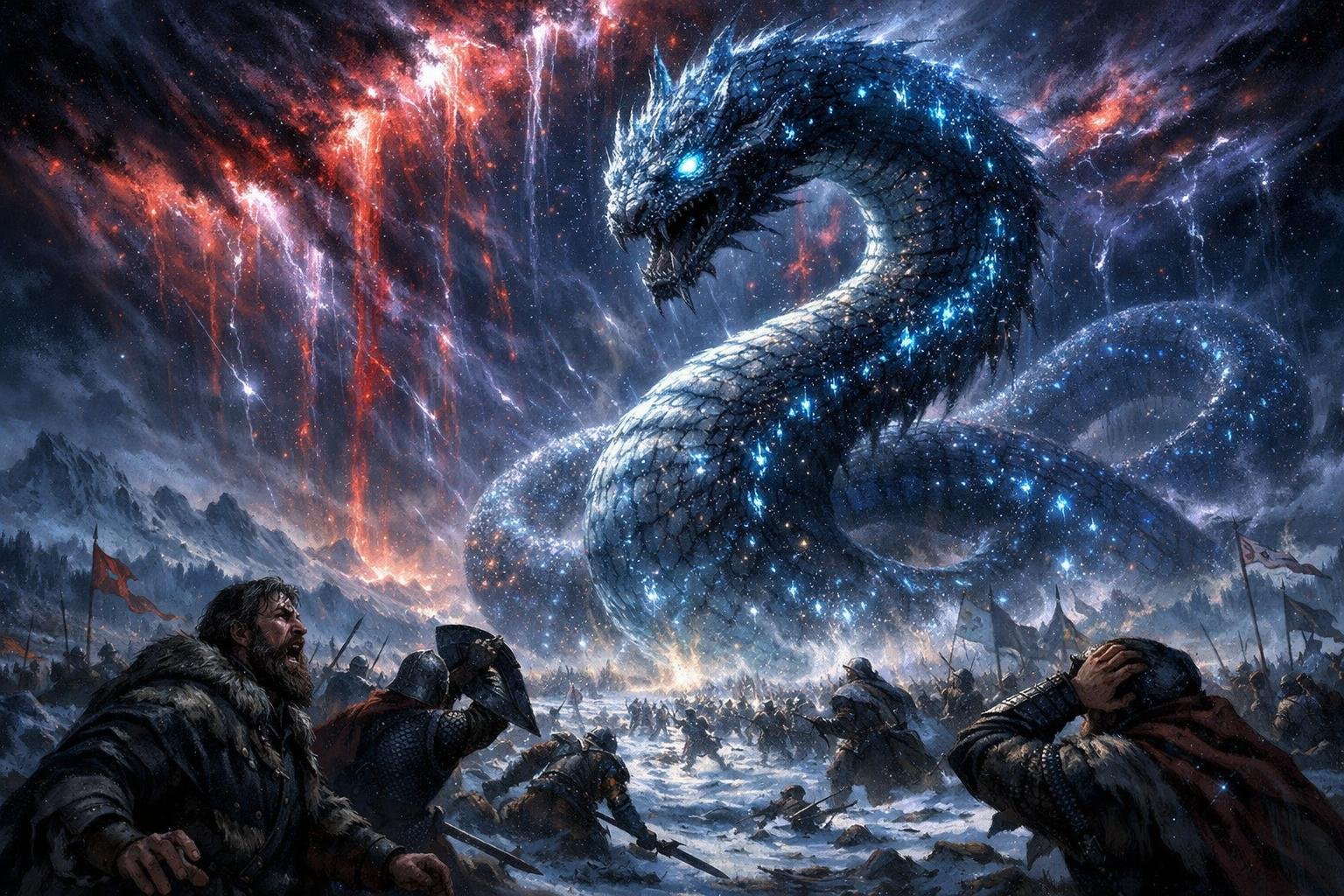
- The Manifestation: Snaka returns as a force of nature. He is “resurrected… only to be betrayed”.His return immediately destabilizes the battlefield. He is not a humanoid figure but a return to the monstrous serpent form, a “constellation of stars” made of scales and malice.
6.2 The Betrayal: A Patricide Reprised
The most controversial and thematically dense moment in the saga is the second death of Snaka.
- The Execution: Lik-Rifa and Rotta do not fight him fairly. They use treachery. The text suggests a poisoning strategy: “I poisoned myself… Filled my body with poison and hurled myself into his mouth”. This “suicide bomber” tactic (likely performed by a thrall or a manipulated character like Hrung) capitalizes on Snaka’s fatal flaw: his gluttony. He eats blindly, and thus eats his own death.
- The Harvesting: Once incapacitated/slain, his heart is extracted. Lik-Rifa intends to consume it to gain his power. This cannibalism is the ultimate act of the “Rebel” child usurping the “Sage” father.
6.3 Critical Analysis: The “Anti-Climax” Debate
The fan reception to Snaka’s role in Fury was polarized. Many felt the “Introduction” and “Death” happened too quickly (within ~50 pages), leading to accusations of a “fake out”.
- The Critique: “We waited so long for his introduction, and his death was so quick and easy”.Readers expected a “God War” where Snaka would be a primary combatant.
- The Defense: From a literary standpoint, Snaka had to die quickly. He represents the “Old World” of mindless consumption. Lik-Rifa represents the “New World” of calculated tyranny. By having Lik-Rifa kill Snaka, Gwynne asserts that the new villain is more dangerous because she possesses agency and intellect, whereas Snaka was merely a force of hunger. The “Anti-Climax” is a thematic statement: Brute power is obsolete; cunning (Rotta) and ambition (Lik-Rifa) are the new gods.
7. The Mystery of the Heart: The Open Wound of the Ending
The saga concludes, but the thread of Snaka is not cut. It is merely knotted.
7.1 The Theft
Lik-Rifa fails to consume the heart. In the chaos of the final battle, the heart is stolen. The culprit is Vesli, a Tennur (Vaesen) allied with the protagonists.
- The Visual: The epilogue describes Vesli “sitting on a locked chest” and giving a “wide-mouthed grin”.6 The implication is absolute: Snaka’s heart is in the box.
7.2 Future Implications
This leaves the Bloodsworn Saga with a massive “Chekhov’s Heart.”
- Vesli’s Agenda: Vesli is a Vaesen, a creature created by Lik-Rifa but allied with Orka. Does she intend to eat it? Destroy it? Or bargain with it?
- Rotta’s Survival: Rotta (The Rat) survived the battle. He knows the heart exists. He is the God of Cunning. A sequel series would likely feature a “Rat Race” for the Serpent’s Heart.
- The Persistence of Seiðr: As long as the heart exists, the source of Seiðr magic remains potent. The “Tainted” are not free of their legacy.
8. Themes and Literary Symbology
8.1 The Trauma of Lineage
Snaka is the ultimate “Bad Father.” His relationship with his children—consumption and war—mirrors the human struggles in the book. Elvar fights to escape her father’s shadow; Orka fights to save her son. Snaka represents the generational trauma that must be killed for the children to thrive. His death is the breaking of the cycle of abuse on a cosmic scale.
8.2 Environmental Horror
Gwynne uses Snaka to explore the concept of “living on the bones of the past.” The world of Vigrið is literally built on a corpse. This creates an atmosphere of inevitable decay. The resources (god-bone) are finite, and their use pollutes the world (Seiðr storms). It is an ecological allegory: Extraction of ancient power leads to present-day ruin.
8.3 The Sage-Rebel Dialectic
Snaka embodies the Sage/Rebel conflict.
- Sage: He is the “Eldest,” the repository of all history and magic. He knows the secrets of creation.
- Rebel: He refuses to accept the natural order of succession. He rebels against the idea that the Creator must step aside for the Creation. His hunger is a rebellion against death itself.
9. FAQ: Uncoiling the Mysteries of Snaka
Q1: Who is Snaka in the Bloodsworn Saga? A: Snaka is the Serpent God and the “Father of All” in John Gwynne’s Bloodsworn Saga. He is the creator of the other animal gods (like Ulfrir the Wolf and Orna the Eagle). He was killed 300 years before the main story during the “Guðfalla” (God-Fall) when he attempted to eat his own children. His remains form the landscape of Vigrið, specifically the Boneback Mountains and the city of Snakavik.
Q2: How was Snaka resurrected and killed in The Fury of the Gods? A: In the final book, The Fury of the Gods, Snaka is resurrected by his daughter Lik-Rifa and the rat god Rotta using a dark Seiðr ritual involving his heart. However, his return is short-lived. He is almost immediately betrayed by his resurrectors. A thrall (Hrung) poisons himself and throws himself into Snaka’s mouth. Consumed by gluttony, Snaka eats the poisoned offering and is weakened enough for Lik-Rifa to slay him and extract his heart.
Q3: What are the abilities of Snaka’s Tainted descendants? A: Unlike the descendants of the Wolf or Bear gods who gain physical strength or frenzy, Snaka’s descendants (known as Seiðr-witches) inherit magical aptitude. Their abilities include casting rune-magic, manipulating fire and ice, and a unique power called “Serpent Charming,” which allows them to control snakes. They are the primary magic-users of the saga.
Q4: What happened to Snaka’s heart at the end of the trilogy? A: Snaka’s heart was not consumed by Lik-Rifa as intended. In the chaos of the final battle, it was stolen by Vesli, a Tennur (Vaesen) allied with Orka. The epilogue strongly implies the heart is inside the locked chest that Vesli is guarding. This leaves the ultimate power of the creator in the hands of a scavenger, setting up potential future conflicts.
10. Conclusion: The Serpent Sleeps, The Heart Beats
In the final analysis, Snaka is John Gwynne’s masterpiece of atmospheric world-building. He is less a character than he is a condition of existence. To live in Vigrið is to live inside Snaka. His lore provides the skeleton for the plot, his blood provides the fuel for the magic, and his family provides the conflict for the heroes.
While his appearance in The Fury of the Gods was brief, it was the necessary catalyst for the final transformation of the world. By resurrecting and then re-killing the Father, Gwynne stripped away the myth of the “Good Old Days.” There is no benevolent creator coming to save the Bloodsworn. There is only the cold reality of the Rat, the Dragon, and the Wolf fighting over the scraps.
The saga ends with the world “remade” , but the chest Vesli sits upon reminds us that the power of the Serpent is not gone. It is merely contained, waiting for the next fool to turn the key. Snaka is dead. Long live Snaka.

1 comment
You are my inhalation, I own few web logs and occasionally run out from post :). “To die for a religion is easier than to live it absolutely.” by Jorge Luis Borges.