
I. Introduction: The Death of the Farmboy Hero and the Birth of Industrial Fantasy
The landscape of modern fantasy literature is littered with the corpses of chosen ones. For decades, the genre was dominated by the monolithic shadow of J.R.R. Tolkien, where morality was absolute, wizards were benevolent shepherds of destiny, and the return of the king was a cause for celebration rather than suspicion. In that established order, the farmboy leaves his village, gains a magic sword, defeats the Dark Lord, and ushers in a golden age. This report posits that Joe Abercrombie’s The First Law trilogy represents a definitive schism in this tradition—a brutal, methodical, and cynical dismantling of the “Hero’s Journey” that serves not merely as a subversion of tropes, but as a mirror to the geopolitical and socioeconomic realities of the modern world.
From the perspective of a Sage-Rebel literary analyst, The First Law is less a fantasy series and more a political thriller disguised in the trappings of swords and sorcery. It is a narrative insurgency. Through a rigorous examination of the text, historical parallels, and character archetypes, we dissect how Abercrombie replaces the romanticism of the genre with a grim utilitarianism. In this world, the “Sage” is a CEO, the “Hero” is a psychopath, the “Prince” is a puppet, and the “Villain” is the only one telling the truth about the nature of power.
The trilogy does not simply invert tropes; it exposes the mechanics behind them. When the farmboy pulls the sword from the stone in Abercrombie’s world, it is likely because a bank financed the sword, a torturer bribed the stone, and the farmboy is being set up as a figurehead for a taxation scheme. By leveraging insights into the historical inspirations behind the Union and the Gurkish Empire—specifically the parallels to the Holy Roman Empire, the British Empire, and the Ottoman Empire—this report elucidates how Abercrombie grounds his fantastical elements in the grit of real-world history. Furthermore, we explore the distinct narrative techniques, such as the internal monologues of Sand dan Glokta and the berserker fugues of Logen Ninefingers, to understand how the prose itself reinforces the themes of deception and the fragility of identity.
II. The First of the Magi: Bayaz and the Corporatization of Magic
The Gandalf Deception: Subverting the Mentor Archetype
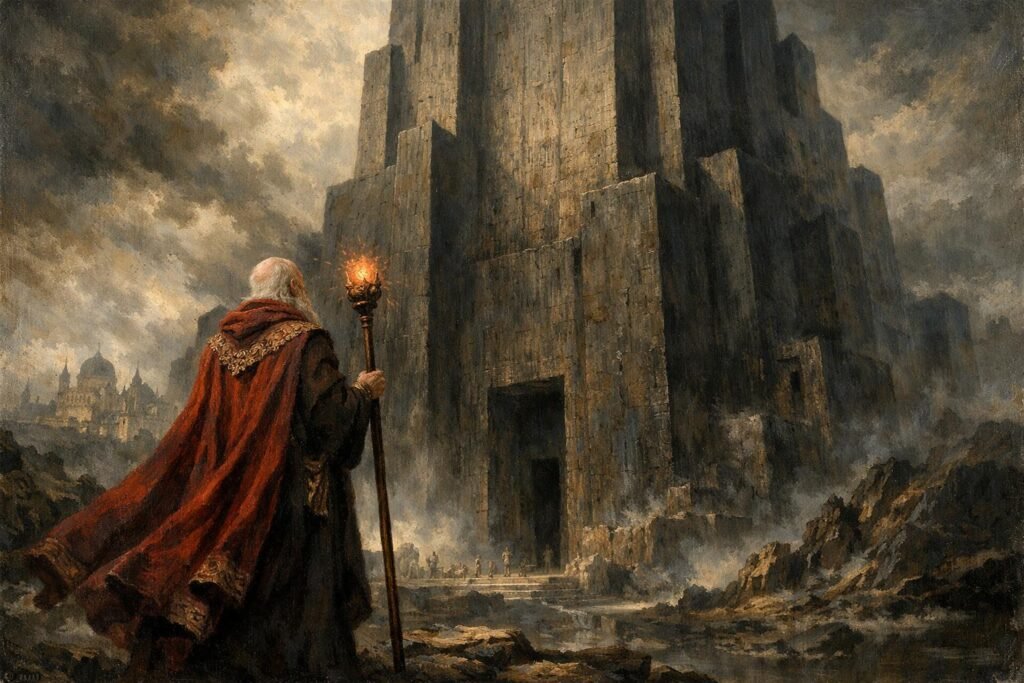
To understand the radical nature of Abercrombie’s work, one must first confront the character of Bayaz, the First of the Magi. In the lexicon of high fantasy, the wizard is traditionally the mentor figure—the Gandalf or Obi-Wan Kenobi who guides the protagonist toward a moral victory. Bayaz is introduced with all the hallmarks of this archetype: a grumpy but seemingly wise old man, living in a remote northern library, shepherding a group of diverse adventurers on a quest to save the world. He appears to be the custodian of history, the one man who remembers the past and seeks to protect the future from the returning evil of the Other Side.
However, the trajectory of the trilogy reveals this to be a carefully constructed facade, a deception perpetrated not just on the characters but on the reader’s genre expectations. The analysis suggests that Bayaz is the primary antagonist of the series, not in the sense of opposing the protagonists, but in opposing the very concept of free will. He is not a shepherd; he is a rancher. The “First Law”—that power makes all things right—is a chilling distillation of realpolitik that strips away any pretension of morality. Where Gandalf refuses the One Ring because he fears its corrupting influence, Bayaz actively seeks the Seed—his world’s equivalent of a weapon of mass destruction—specifically to use it.
The Industrialist Wizard and Debt-Trap Diplomacy
Bayaz operates less like a mystic and more like a ruthless industrialist or a CEO of a transnational corporation. His power base is not merely arcane but economic. The revelation that the banking house of Valint and Balk is an extension of his will fundamentally shifts the genre’s focus from “magic vs. might” to “debt vs. sovereignty.” This is a profound shift from the agrarian feudalism typical of fantasy to a pre-industrial capitalist critique.
Valint and Balk serves as a mechanism for what modern geopolitical analysts might term “debt-trap diplomacy.” By indebting the Union, the nobility, and even the crown itself to his banking house, Bayaz ensures compliance without the need for constant magical intervention. The ledger becomes more powerful than the spellbook. Glokta’s realization that the bank knows “the names of every man and woman employed” and that their influence permeates every strata of Styrian and Union society illustrates a Panopticon of finance.
This mirrors historical and contemporary practices where economic leverage is used to control nations. The “First of the Magi” is effectively the “Chairman of the Board,” and the Union is his subsidiary. When King Jezal attempts to show a spine, Bayaz does not use a fireball; he uses the crushing weight of economic ruin and physical intimidation to remind the “employee” of his place. The magic is secondary to the monopoly.
The Seed as Nuclear Deterrent
The “Seed,” the magical artifact sought throughout the trilogy, further cements Bayaz’s role as a nuclear power. He does not seek to heal the world; he seeks a deterrent—or a weapon of total dominance—to maintain his hegemony against his rival, Khalul. The detonation of the Seed in Adua is not a cleansing fire of righteousness but a radioactive fallout that sickens the populace. The descriptions of the aftermath—radiation sickness, hair loss, the “wasting” of the city—are a stark metaphor for the collateral damage of industrial warfare and the deployment of weapons of mass destruction. This recontextualizes the “final battle” not as a glorious stand against evil, but as a callous deployment of a tactical nuke in a populated urban center to protect an asset.
The House of the Maker: A Monument to Hubris
The physical manifestation of this industrialist philosophy is the House of the Maker. Described as a “mountain of naked stone” with “sharp, black angles” and “impossible geometry,” it stands in the center of Adua as a looming reminder of technological and magical superiority. Unlike the organic, nature-bound magic of traditional fantasy (e.g., elves in forests, druids in groves), the Maker’s magic is mechanical, cold, and harsh.
The interior of the House, with its rotating rings resembling a solar system and its time-dilating properties, suggests a mastery of physics and reality that transcends mere spellcasting. It is a factory of gods. The “Maker’s Breath” that sickens those who approach serves as a barrier not of holiness, but of radiation or toxic runoff. The description of the “massive space” and the “dark metal box” found within evokes the imagery of a reactor core or a containment vessel. This aligns with the interpretation of the Maker as a figure of unchecked industrial progress, a Prometheus who did not care if the fire burned the world. Bayaz’s usurpation of this House symbolizes his seizure of the means of production—both magical and historical.
III. The Bloody-Nine: Deconstructing the Noble Savage
The Duality of Man and Monster
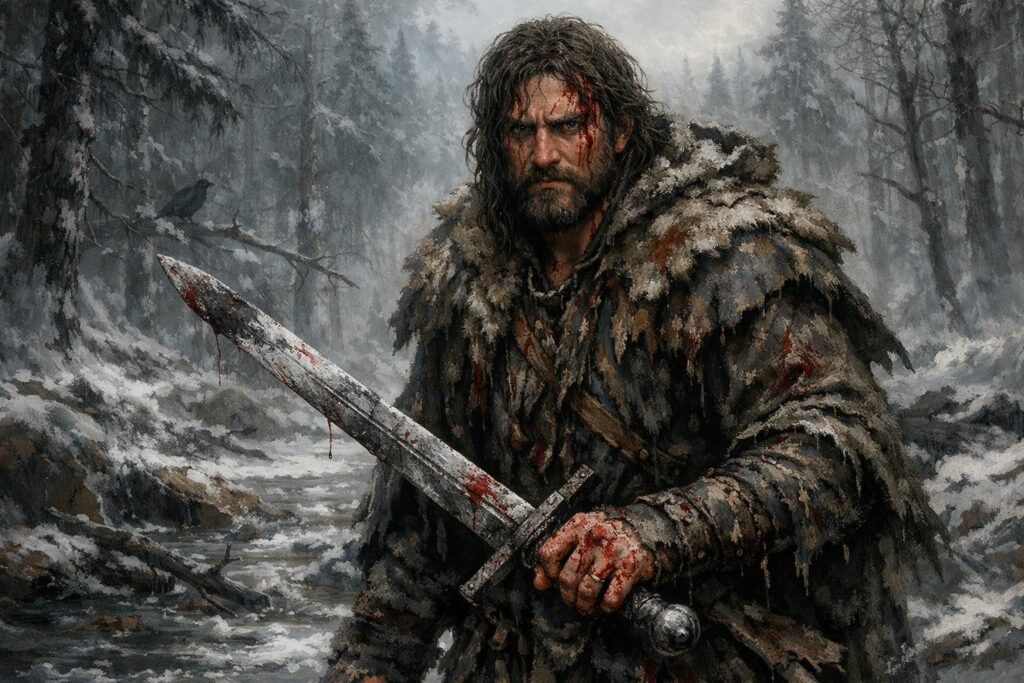
Logen Ninefingers is presented initially as a weary survivor, a man who wants to be better—a “noble savage” seeking redemption. This trope, popularized by characters like Conan the Barbarian (in his more philosophical moments) or the noble warriors of the Dothraki, relies on the idea that civilization is corrupt and the primitive man is pure. Logen carries the wisdom of the earth; he speaks to spirits, he understands the “mud.”
Abercrombie shatters this illusion by decoupling intent from action. Logen thinks he wants to be good. He philosophizes that “You have to be realistic about these things,” a mantra that serves as a universal excuse for his atrocities. However, the presence of “The Bloody-Nine”—his berserker alter ego—raises profound questions about culpability.
Is the Bloody-Nine a demonic possession, or is it a dissociative psychological break allowing Logen to indulge his darkest desires without guilt? The text supports a psychological reading, though the supernatural element is left ambiguous. The Bloody-Nine emerges when Logen is threatened, but also when he is simply frustrated or cornered. It is the ultimate removal of inhibition. The Bloody-Nine does not just kill enemies; he kills friends, children, and allies with equal glee, laughing maniacally. This destroys the “honorable berserker” trope found in gaming and literature, where the hero’s rage is always directed conveniently at the villain.
The Survivor’s Guilt as a Survival Mechanism
Logen’s narrative is a cycle of violence fueled by the lie of necessity. He convinces himself he fights to survive, yet he consistently places himself in the center of conflicts. His return to the North to settle scores with Bethod is not a reluctant duty; it is a compulsion. He is an addict, and violence is his drug.
The tragedy of Logen is not that he fails to be better, but that he succeeds at being a monster while convincing the reader (and himself) he is a victim. When he returns to the North, Bethod—the supposed villain—reveals that it was Logen who pushed for more war, Logen who demanded more blood during their conquests. This revelation re-contextualizes the entire first two books. The “evil king” Bethod was actually the one trying to restrain the psychopath Logen. The “Hero” was the villain all along, but his amnesia and self-deception hid it from the audience.
The Philosophy of Mud and Anxiety
“Back to the mud” is the funeral rite of the Northmen, a phrase that encapsulates their nihilistic worldview. There is no glorious Valhalla, only the earth. This grounding in the physical reality of death contrasts sharply with the high-minded ideals of the Union. For Logen, life is mud, blood, and fear.
“You have to have fear to have courage,” Logen muses. This insight dissects the traditional bravery of fantasy heroes. Aragorn charges the Black Gate with solemn resolve; Logen charges because he is terrified of what happens if he stops. His courage is a byproduct of his terror. The phrase “Better to do it than live with the fear of it” is not just a call to action; it is a diagnosis of anxiety. Logen kills preemptively because the waiting for violence is more intolerable than the violence itself. He is a man driven by a pathological inability to sit still in peace.
IV. The Logic of Torture: Sand dan Glokta and the Anti-Hero
The Detective in the Dungeon
Sand dan Glokta is arguably the most compelling character in modern fantasy because he embodies the genre’s shift from external conflict to internal endurance. A former war hero turned “cripple” by Gurkish torturers, he is now an Inquisitor. He is the personification of the state’s monopoly on violence.
Glokta serves the narrative function of a noir detective. He is cynical, observant, and tasked with uncovering conspiracies. However, his methods are those of the villain. He extracts truth through pain. The brilliance of Abercrombie’s writing lies in making the reader root for the torturer. We share his frustration with bureaucracy, his hatred of beautiful people, and his grim satisfaction when he outwits his superiors. He is a monster we understand, a man who has been hollowed out by the system and now serves as its teeth.
The Architecture of Internal Monologue: The Split Self
The use of italicized internal monologue for Glokta is a critical stylistic choice that separates him from the other POV characters. It creates a bifurcation of the character: the public Glokta, who is obsequious and pathetic, and the private Glokta, who is sharp, witty, and deeply bitter.
- Spoken: “I am your humble servant, Arch Lector.”
- Thought: “You bloated pig. I hope you choke on your wine.”
This technique allows Abercrombie to explore the psychological toll of chronic pain. Glokta’s thoughts are constantly invaded by the reality of his body—the ache in his leg, the spasm in his back, the difficulty of stairs. It grounds the fantasy in a visceral reality. While other fantasy characters ignore wounds to fight on, Glokta cannot ignore a flight of stairs. His mantra, “Body found floating by the docks,” is a refrain of survival. It acknowledges the precariousness of his position; one misstep in the political dance, and he is refuse. This phrase serves as a grim memento mori, repeated whenever he senses the shifting tides of power that could crush him.
Dagoska and Famagusta: The Historical Siege
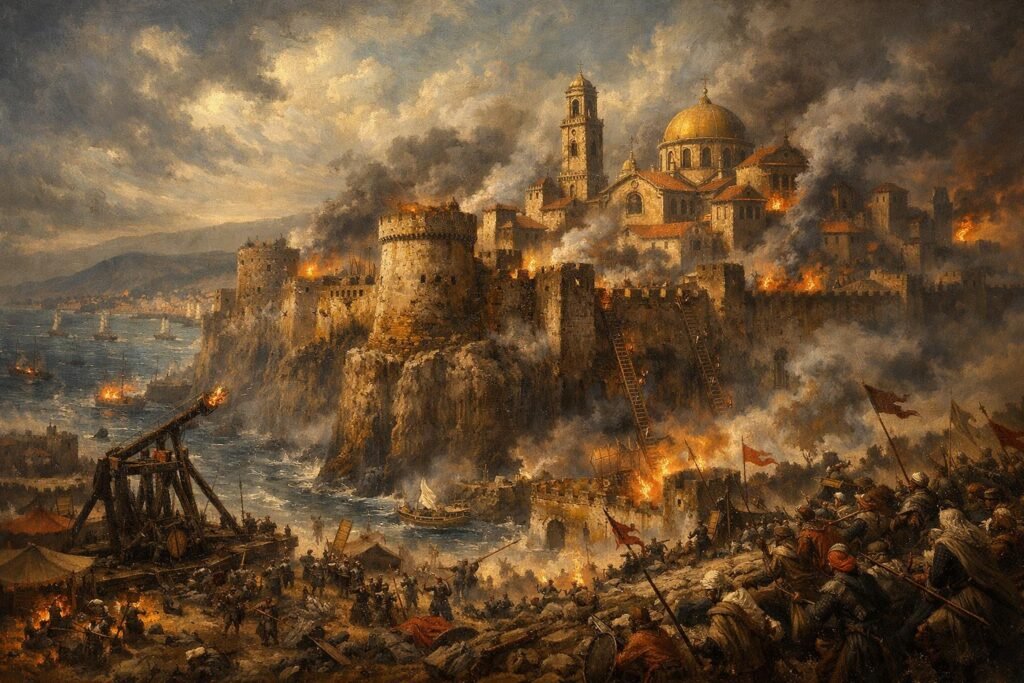
Glokta’s defense of Dagoska in Before They Are Hanged is a direct parallel to the historical Siege of Famagusta (1571), where the Venetian commander Marcantonio Bragadin defended Cyprus against the Ottoman Empire. The parallels are granular and demonstrate Abercrombie’s commitment to historical realism over fantasy heroism.
Table 1: Comparative Analysis of The Siege of Dagoska vs. The Siege of Famagusta
| Feature | The Siege of Dagoska (Fiction) | The Siege of Famagusta (History) |
| Defender | Sand dan Glokta (Union Inquisitor) | Marcantonio Bragadin (Venetian Captain) |
| Attacker | The Gurkish Empire (Prophet Khalul) | The Ottoman Empire (Mustafa Pasha) |
| Strategic Location | A peninsula city, key to the Southern Sea | Coastal city in Cyprus, key to Eastern Med. |
| Defensive Tactics | Repairing walls, hidden ditches, rationing | Strengthening bastions, improvised explosives |
| Outcome | City lost/surrendered; Glokta escapes | City surrendered; Bragadin flayed alive |
| Betrayal | The Union Council refuses to send aid | Venice/Holy League failed to send timely aid |
| The Protagonist | Already a “cripple” from previous torture | Becomes a martyr through torture (flaying) |
In history, Bragadin was flayed alive after surrendering, his skin stuffed with straw and paraded. In the book, Glokta (who was already tortured/flayed in the past) manages to escape the city before it falls, but the psychological shadow of his previous capture by the Gurkish looms over the entire campaign. Glokta realizes that the Union Council does not intend to save Dagoska—that he is merely buying time for a political maneuver elsewhere. This reinforces the theme of the expendability of soldiers. He is a piece on a board, fighting a war that his masters have already written off as a loss. The “heroic defense” is revealed to be a bureaucratic stalling tactic.
V. The Empty Scabbard: Jezal dan Luthar and the Hollow Hero
The Fencing Circle vs. The Battlefield
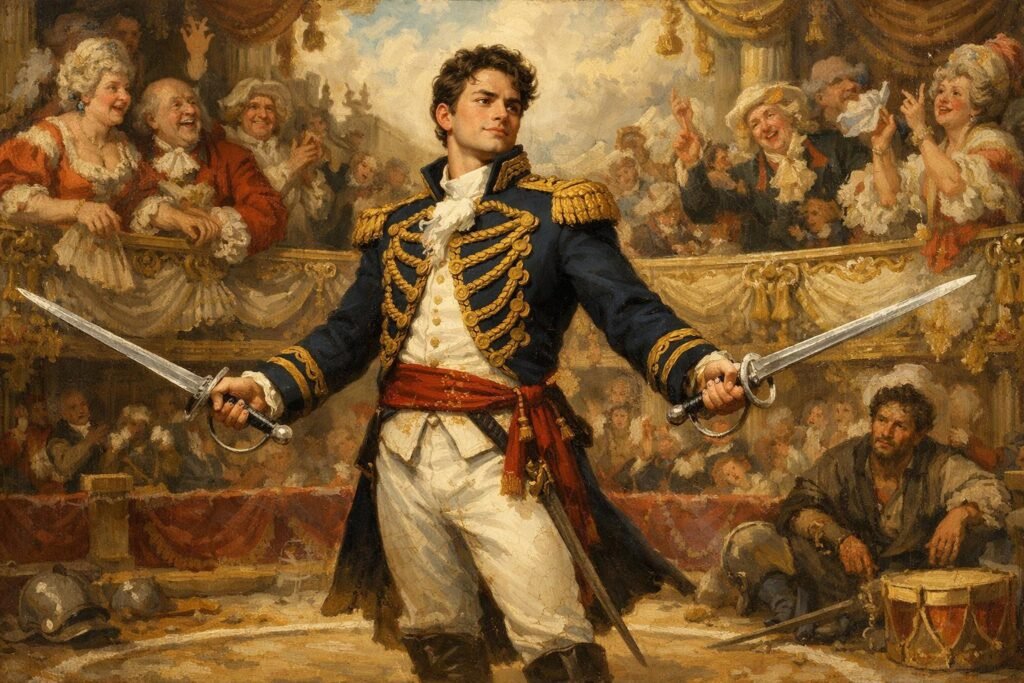
Captain Jezal dan Luthar begins as the archetype of the arrogant princeling: vain, obsessed with status, and talented but lazy. His arc appears to be set up as a “maturation” story—the selfish boy becomes a selfless leader. Abercrombie uses the sport of fencing to deconstruct Jezal’s understanding of violence.
The “Circle” fencing sequences in the early books serve as a microcosm of Jezal’s worldview. Fencing in the Union is a sport of rules, lines, and judges. It is clean, geometric, and aristocratic. It draws inspiration from historical fencing manuals like those of Capo Ferro or Agrippa, emphasizing form over function. Jezal excels here because the stakes are social, not mortal. He believes war to be an extension of this sport—a place for glory.
The shattering of this illusion when he faces real combat is brutal. On the battlefield, there are no steel circles, no judges, and no pauses. The “Varuz training montage,” where he is pushed to physical exhaustion, mimics the preparation for a sports movie, leading the reader to expect a triumphant victory. While Jezal does win the contest, the victory is hollow. It is later revealed that Bayaz used magic to aid him, ensuring his victory not because Jezal earned it, but because Bayaz needed a popular figurehead. The subversion lies in the fact that his hard work was irrelevant; the outcome was rigged by the “Chairman” (Bayaz) to ensure his asset (Jezal) gained the necessary public approval rating.
The Puppet King: A Study in Cowardice
The ultimate deconstruction of Jezal’s character is his ascension to the throne. In a traditional fantasy, the discovery that the protagonist is the secret bastard of the king is a moment of triumph (e.g., Jon Snow, Aragorn). For Jezal, it is a trap.
He becomes High King not because of his merit, but because he is malleable. Bayaz explicitly selects him because he is a vain, empty vessel that can be filled with Bayaz’s policy. Jezal’s attempt to assert authority—to be the benevolent king he thinks he should be—is ruthlessly crushed by Bayaz in a scene that strips away all pretense. Bayaz uses his magic not to inspire, but to torture and cow the King into submission, using the “Voice” to humiliate him.
Jezal ends the trilogy as a prisoner in his own palace. He has the crown, the queen, and the kingdom, but he possesses zero agency. He is described as a “coward” not because he flees battle, but because he chooses the safety of submission over the certain death of resistance. He marries a woman (Terez) who despises him, and his true love (Ardee West) marries Glokta. Jezal’s arc ends in a state of comfortable, gilded misery—a “realistic” outcome for a mediocre man thrust into power by forces beyond his comprehension.
VI. Geopolitics of the Circle: World-Building as Mirror
Abercrombie’s world, the “Circle of the World,” is a distorted map of Europe and the Mediterranean, designed to facilitate a clash of civilizations that mimics our own history. The geography determines the politics, and the politics determine the plot.
The Union as the Holy Roman Empire / Great Britain
The Union is a complex amalgamation of the Holy Roman Empire (bureaucracy, election of kings by a council) and Georgian Britain (class structure, industrialization, banking, naval power). The squabbling Open Council and Closed Council satirize the inefficiency of parliamentary systems and the disconnect between the ruling elite and the populace. The incompetence of the Union military, led by officers who bought their commissions (like Jezal), reflects the pre-Napoleonic European armies where lineage mattered more than competence. The “Angland” province mirrors lowland Scotland, a contested borderland with the wilder North.
The Gurkish Empire as the Ottoman Empire
The Gurkish Empire, with its prophet Khalul (a rival Magus to Bayaz), represents the Ottoman Empire or a caliphate. The “Eaters” (cannibalistic mages) are a dark fantasy exaggeration of the fear of the “other.” However, Abercrombie subverts the “evil eastern empire” trope by revealing that Khalul’s hatred of Bayaz is potentially justified. Bayaz killed their master, Juvens. The Gurkish are not attacking simply because they are evil; they are fighting a proxy war between two immortal wizards. The aesthetic of the Gurkish—curved swords, light armor, desert warfare—draws directly from Ottoman and Mamluk history.
The North as Scotland/Scandinavia
The Northmen are culturally distinct, valuing strength and directness over the Union’s etiquette. They resemble the Highland Scots or Vikings. The dialogue of the Northmen—laden with grim humor and fatalism—provides a linguistic contrast to the flowery, deceptive language of the Union courtiers. Their clan structure and the “duel in the circle” legal system are direct lifts from Norse sagas.
The Old Empire as Rome/Byzantium
The Old Empire, a fractured landscape of warring city-states and ruined grandeur, stands in for the fallen Roman Empire or Byzantium. It serves as a warning of what the Union will become. The journey through the Old Empire is a journey through the graveyard of civilization, reinforcing the cyclical nature of history. The “Old Empire” is not a place of magic, but of failed politics, where the “Emperor” is a figurehead fighting over scraps.
Table 2: Geopolitical Analogies in The First Law
| Faction | Real-World Analog | Key Cultural/Political Traits |
| The Union | Holy Roman Empire / UK | Bureaucratic, Classist, Mercantilist, Naval Power |
| Gurkish Empire | Ottoman Empire | Religious Theocracy, Expansionist, “Eastern” Threat |
| The North | Scots / Vikings | Tribal, Warrior Culture, Rugged Terrain, Oral Tradition |
| Old Empire | Rome / Byzantium | Fractured, Ruined, Historical Grandeur, Civil War |
| Styria | Renaissance Italy | City-states, Condottieri (Mercenaries), Banking Centers |
VII. The Craft of Cynicism: Narrative Techniques and Style
The Anti-Quest
The second book, Before They Are Hanged, features a classic fantasy trope: The Quest. Bayaz leads the party across the continent to find the “Seed.” In Tolkien, the quest succeeds; the ring is destroyed. In The First Law, the quest is a failure. They reach the island, find the stone, and discover… the Seed isn’t there.
This “shaggy dog story” structure is a masterstroke of nihilism. The characters endure immense suffering, grow closer, and learn about themselves, only to find that the external goal was a lie or a mistake. It forces the realization that the journey was the point, but not in the sentimental way. The journey proved that even with magic, failure is possible. It strips the characters of the “destiny” safety net. It mimics the frustration of real-world military campaigns where objectives are unclear or based on faulty intelligence.
Humor as a Weapon
Abercrombie is frequently cited as “Grimdark,” but a more accurate descriptor might be “Grim-Wit.” The books are hilarious. The humor arises from the gap between expectation and reality.
- Jezal expects a noble duel; he gets beaten in the face with the pommel.
- Logen expects wisdom from the spirits; they tell him nothing useful or vague riddles.
- Glokta expects assassination; he gets a promotion he doesn’t want.
This dark irony serves a thematic purpose: it highlights the absurdity of the human condition. When Glokta laughs, it is a laugh of recognition that the world is a joke played by cruel gods (or wizards). The humor prevents the bleakness from becoming melodrama. It acknowledges that even in the darkest times, people still tell jokes, usually about how screwed they are.
The Prose of Violence
Abercrombie’s combat writing is distinct for its focus on confusion and pain. Unlike the choreographed ballets of R.A. Salvatore, Abercrombie’s fights are messy.
- Jezal’s Fencing: Precise, described with technical terms. It is a dance of ego.
- Logen’s Melee: Chaos. “The Blade Itself incites to deeds of violence.” Logen does not duel; he brawls. He uses his environment—mud, spit, headbutts. The prose becomes staccato, brutal, and rhythmic.
- The Glokta Factor: Glokta fights with a cane and a knife, dirty and desperate. He fights knowing that if he falls, he cannot get up.
The description of wounds is medical. Teeth are broken and swallowed. Noses crunch. Concussions linger. There are no “flesh wounds” that heal in the next chapter. If a character is stabbed, they limp for the rest of the book (or series). This adherence to biological reality reinforces the theme that violence has consequences.
VIII. Conclusion: The Definition of Grimdark
The First Law did not invent dark fantasy, but it codified “Grimdark” as a distinct subgenre. Before Abercrombie, dark fantasy often meant “horror elements” or “sad endings.” Abercrombie introduced Moral Nihilism combined with Late-Stage Capitalist Critique.
The trilogy asserts that systems (banking, government, war) are more powerful than individuals. No matter how strong Logen is, he cannot fight a bank. No matter how skilled Jezal is, he cannot outfence a rigged election. No matter how smart Glokta is, he cannot cure the rot of the system; he can only excise the most obvious tumors to keep the host alive for another day.
The “Realistic” Fantasy
The term “realistic” is used by characters to justify compromise. “You have to be realistic.” This is the series’ thesis statement. Realism means accepting that the bad guys often win because they are better organized and better funded. It means acknowledging that heroism is often a PR stunt.
In conclusion, The First Law is a forensic report on the death of high fantasy idealism. It dissects the corpse of the genre, pulls out the organs of “Destiny,” “Honor,” and “Magic,” and replaces them with “Finance,” “Survival,” and “Radiation.” It is a masterpiece not because it is dark, but because it is honest about the darkness. It respects the reader enough to say: There are no happy endings, only life, and life is the misery we endure between disappointments.
Table 3: Key Quotes and Philosophies
| Quote | Speaker | Context / Meaning |
| “Power makes all things right. That is my first law, and my last.” | Bayaz | The definition of his moral nihilism and political philosophy. |
| “You have to be realistic about these things.” | Logen | The justification for survival at any cost; acceptance of grim reality. |
| “Body found floating by the docks…” | Glokta | A reminder of his mortality and the consequence of failure in the Inquisition. |
| “Better to do it than live with the fear of it.” | Logen | A proactive approach to anxiety that often leads to preemptive violence. |
| “Rules are for children. This is war, and in war the only crime is to lose.” | Bayaz | The rejection of honor in favor of absolute victory. |
- Historical Analysis & Geopolitics:
- Literary Analysis & Themes:
- Interviews & Author Insights:
