Key Takeaways
- The “Sparkle” is Dead; The Butcher is Back: The 2025/2026 fantasy cycle, cemented by the release of Jay Kristoff’s Empire of the Dawn, has definitively ended the era of the romanticized, misunderstood vampire. The market has swung violently back to the vampire as a parasitic, theological horror.
- The “Silversaint” has Real-World DNA: Kristoff’s fictional holy order mirrors the historical Order of the Dragon (1408), founded by Sigismund of Luxembourg to fight the Ottomans. The motto O Quam Misericors est Deus (Oh, how merciful is God) was used by men who impaled their enemies—a hypocrisy central to modern grimdark.
- Bureaucracy Created the Vampire: The modern vampire mythos wasn’t born in a castle, but on a paperwork desk. The 1725 report by Austrian Imperial Provisor Frombald on the corpse of Peter Plogojowitz turned a Serbian superstition into a Western European media sensation, effectively creating the “scientific” monster.
- Market Bifurcation: The “Middle Earth” middle ground is evaporating. In 2026, the genre is splitting into two extremes: Extreme Grimdark (visceral, high-stakes) and Cozy Fantasy (low-stakes, comfort reading). You must pick a side.
- Gamifying Trauma: The most effective storytelling mechanic for this trend is Corruption. Borrowing from RPGs like Symbaroum and Dark Heresy, writers are treating “humanity” as a depleting resource, where using magic or fighting monsters physically degrades the hero’s soul.
The Kristoff Effect: Why We Started Hating Heroes Again
If you have been tracking the bestseller lists in late 2025 and early 2026, you will have noticed a distinct lack of polite fiction. The release of Jay Kristoff’s Empire of the Dawn on November 4, 2025, marked the conclusion of a trilogy that fundamentally reshaped reader expectations for dark fantasy.1 The series, which began with Empire of the Vampire, didn’t just sell books; it validated a specific aesthetic: the Catholic-Gothic fusion where the cross is not a shield, but a shiv.
Kristoff’s protagonist, Gabriel de León, is the antithesis of the “Chosen One” trope that dominated the 2010s. He is not saving the world because he is good; he is saving it because he hates the alternative slightly more. The narrative structure—a prisoner narrating his life to a historian while awaiting execution—is a direct nod to the unreliable nature of history itself.2 We are not watching a hero win; we are watching a broken man explain how he lost everything.
The reviews for the 2025 finale paint a picture of a genre that has stopped apologizing for its edges. One reviewer described the climax as a “Messiah-meets-Joan-of-Arc crusade” where the “Redeemer” rises not to bring peace, but to lead “armed hordes” into a slaughter.2 This is not the clean, sanitized war of high fantasy. This is the muddy, bloody reality of trench warfare with fangs.
The View from the Vistula: A Polish Perspective
To truly understand the reception of this shift, one must look to markets that have never had patience for American prudishness. The Polish fantasy community, famously critical and grounded in the legacy of The Witcher, has embraced Kristoff’s work with a cynical nod of approval.
On the prominent Polish book portal Lubimyczytać.pl, the consensus strips away the marketing hype to reveal why it actually works. One user captured the essence of the series with brutal honesty:
(Derivative to the core… but the effect turned out to be interesting and—above all—very engaging.) 3
Another review cuts straight to the atmospheric core:
(Dark, brutal, and sparing no heroes.) 3
This is the actionable insight for 2026: Originality is dead; Execution is King. The “Silversaint” concept is a mashup of The Witcher, Castlevania, and Van Helsing. The plot is a remix of every “reluctant father figure protecting a magical child” story from The Mandalorian to The Last of Us. But it dominates the market because it commits to the consequences of violence in a way that feels fresh after a decade of YA softness.
The “Empire” as a Reflection of 2026 Trends
The success of Empire of the Dawn confirms three specific trends for the coming year:
- The Return of Religion as Horror: The “Silversaints” are not benevolent priests. They are tattooed zealots. The use of religious iconography—chalices, blood, sacraments—is flipped to emphasize the grotesque nature of faith when pushed to extremism.4
- The “Chronicle” Narrative: Readers are responding to the “interview” format because it creates intimacy. It mimics the true-crime podcasts and deep-dive documentaries that dominate other media. We don’t just want the story; we want the confession.5
- Monstrous Vampires: These are not the romantic partners of 2010. Kristoff’s vampires are organized into clans with distinct, horrifying biological traits, stripping away the human veneer to reveal the apex predator beneath.6
The Historical Autopsy: Where Fiction Steals its Bones
You want to write a blog post that resonates? Stop treating fantasy as something that happens in a vacuum. The reason Kristoff’s “Silversaints” feel grounded is that they are barely exaggerated versions of real historical organizations. The truth of 15th and 18th-century Europe is far stranger than any fiction you are likely to invent.
The Order of the Dragon (1408): The Real Silversaints
In Empire of the Vampire, the Brotherhood of the Silversaints is a military order dedicated to holding back the dark. This is a direct fictionalization of the Societas Draconis (Order of the Dragon), a monarchical chivalric order founded in 1408 by Sigismund of Luxembourg, who was then King of Hungary.8
This was not a social club. It was a military alliance forged in the fires of the Ottoman wars, designed to bind the most powerful warlords of Eastern Europe to the defense of the Cross. The founding members list reads like a “Who’s Who” of Balkan power players 9:
- Stefan Lazarević, the Despot of Serbia, known as “The Tall.”
- Hermann II, Count of Celje.
- Vlad II Dracul, who was inducted later, and whose cognomen “Dracul” (The Dragon) would be passed to his son, Vlad III (Dracula).
The Theological Irony
The Order’s charter reveals the exact kind of cognitive dissonance that powers grimdark fantasy. Their motto was:
“O Quam Misericors est Deus, Pius et Justus”
(“Oh, how merciful is God, faithful and just”).10
Consider the irony. This motto was worn by men who spent their lives conducting brutal border wars, impaling enemies, and burning villages to deny resources to the Ottomans. The “Mercy of God” was delivered at the tip of a lance. Kristoff captures this perfectly with his Silversaints, who tattoo their bodies with silver ink and smoke vampire blood (Sanctus) to gain the strength to kill. The holy symbol becomes a weapon; the prayer becomes a death sentence.
The Bureaucrat who Created the Vampire (1725)
Most writers assume vampires come from ancient folklore. While the fear of the undead is ancient, the specific archetype of the “Vampire” as a distinct creature is an 18th-century invention of the Austrian civil service.
Following the Treaty of Passarowitz (1718), the Habsburg Monarchy annexed parts of northern Serbia. This brought the “Enlightened,” bureaucratic Austrian administration into direct contact with the rural, superstition-heavy Serbian peasantry.11
The collision of these two worlds gave us Peter Plogojowitz (Petar Blagojević).
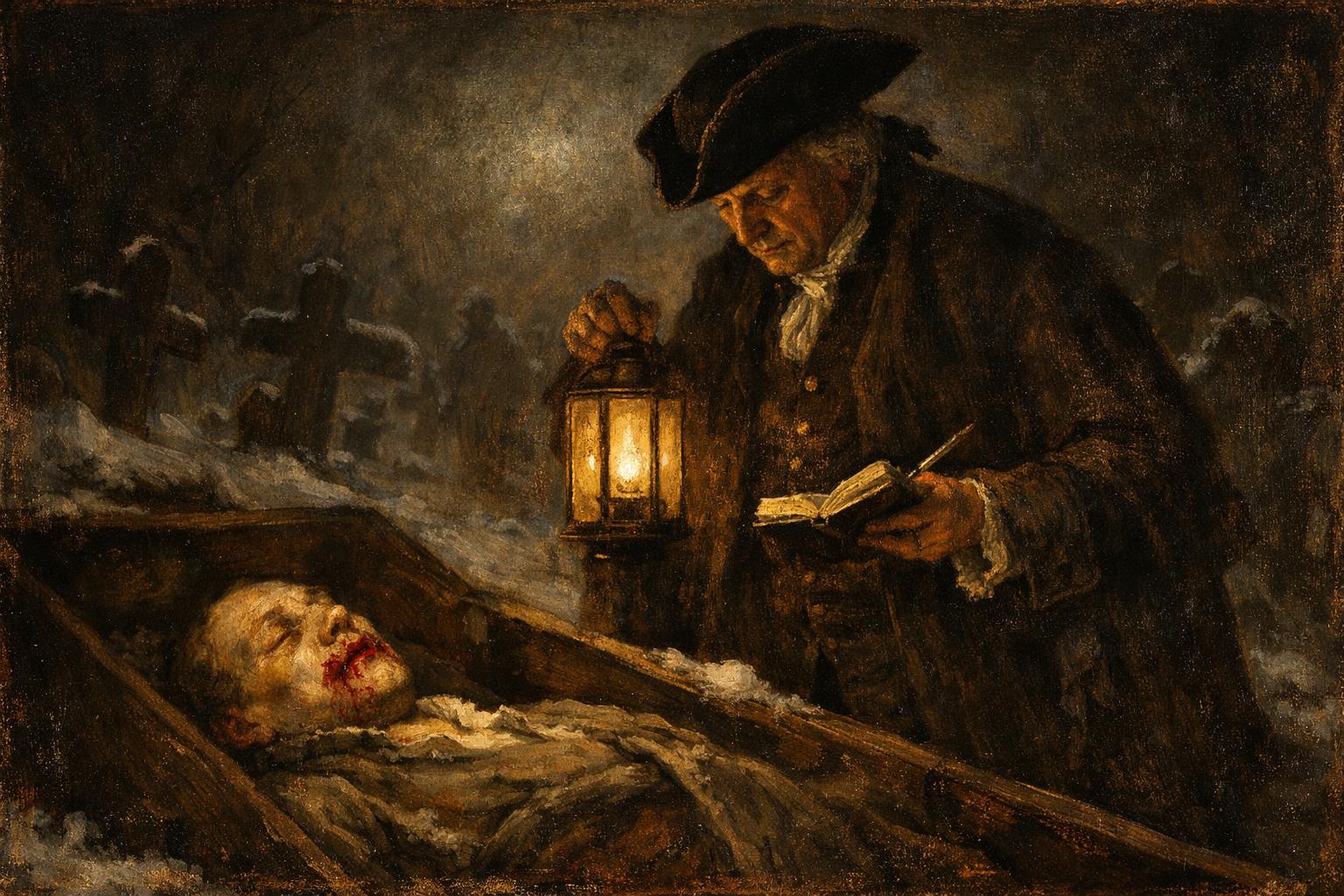
In 1725, in the village of Kisiljevo, Plogojowitz died. Within a week, nine other villagers died after short illnesses, claiming on their deathbeds that Plogojowitz had come to them in the night and throttled them.12
Enter Imperial Provisor Frombald. Frombald was not a Van Helsing. He was a mid-level administrator who just wanted to file his reports and go home. When the villagers demanded to exhume the body, Frombald initially refused, citing the need for permission from the Belgrade administration. The villagers, terrified, threatened to abandon the village entirely—a disaster for a tax collector. Frombald relented and attended the exhumation.13
The Report that went Viral
Frombald’s report, published in the Wienerisches Diarium in July 1725, is a masterclass in bureaucratic horror. He describes the impossible with clinical detachment:
“The body, except for the nose which was somewhat fallen away, was completely fresh.” 11
“Not only did the hair and beard… grow, but also new nails.” 12
“In his mouth I saw not without astonishment some fresh blood, which… he had sucked from the people killed by him.” 14
Frombald then watched as the villagers staked the corpse. He dutifully recorded that “much fresh blood flowed from his ears and mouth” and that other “wild signs” (likely an erection, a common decomposition phenomenon interpreted as vitality) occurred.15
The Insight for Writers:
The vampire wasn’t scary because it was a monster. It became a sensation because the government confirmed it. Frombald’s report was translated into French, English, and German, sparking the “Vampire Controversy” of the 18th century. If you are writing fantasy in 2026, do not just have peasants whisper about monsters. Have the government study them. Have the tax collector verify the zombie outbreak. Horror is most effective when it is stamped, filed, and indexed.
The Sword that Prays
The Silversaints in Kristoff’s work wield weapons that are practically religious artifacts. This, too, is historical.
In 17th-century Germany, the executioner (Scharfrichter) occupied a strange social space. He was a professional killer, but he was also the agent of divine justice. To reconcile this, executioners inscribed their swords with prayers, framing the decapitation as a final act of mercy or redemption for the sinner.
Existing executioner swords from the period bear inscriptions that are chilling in their piety:
“Wan ich Das Schwerdt thu auff heben so / Wunch ich Dem armen sunder das Ewege Leben”
(“When I raise this sword, so I wish that this poor sinner will receive eternal life.”) 16
“Die Welt sturtz zu unheil ich richte das urthel”
(“The world steers toward mischief and I execute judgment.”) 18
This is the aesthetic of 2026 dark fantasy: Sanctified Violence. The hero doesn’t kill out of anger; he kills out of duty, and he prays while doing it. It adds a layer of complexity to the violence that a simple “hack and slash” lacks.
Trend Watch 2026: The Bifurcation of the Market
If Kristoff is the current king of the hill, where is the rest of the market going? The data from 2025 and early 2026 suggests a massive split. The “middle ground”—generic epic fantasy with moderate stakes—is dying. Readers are migrating to the poles.
1. The “Cozy” Rebellion
On one side, we have the “Cozy Fantasy” movement. Triggered by the success of Travis Baldree’s Legends & Lattes, this subgenre has solidified into a major market force.19 These are books where the stakes are personal, not apocalyptic. The conflict is about opening a coffee shop, not stopping a dark god.
- Why it’s trending: In a world of real-life geopolitical instability, a significant portion of the audience uses fantasy as a warm blanket. They want low stress.
- The Trap: Many writers mistake “cozy” for “boring.” The successful cozy books still have tension, but it is relational tension, not mortal tension.
2. The Rise of LitRPG and Progression Fantasy
This is the sleeping giant that has finally woken up. Once relegated to web serials on RoyalRoad, LitRPG (Literature Role Playing Game) and Progression Fantasy have hit the mainstream bestseller lists.19
- Key Titles: Dungeon Crawler Carl by Matt Dinniman, Cradle by Will Wight.
- The Appeal: These books gamify the narrative. The protagonist gets stronger in quantifiable ways. It appeals to the generation raised on video games (Dark Souls, Skyrim) who crave a clear sense of progress and reward.
- The aesthetic: It is often absurd, violent, and surprisingly deep. Dungeon Crawler Carl, for instance, features a man fighting through a galactic dungeon with a talking cat, yet it offers a scathing critique of corporate media and exploitation.19
| Feature | Grimdark (Kristoff/Abercrombie) | Cozy Fantasy (Baldree) | LitRPG (Dinniman/Wight) |
| Primary Emotion | Dread / Awe | Comfort / Warmth | Adrenaline / Achievement |
| Pacing | Slow burn, heavy atmosphere | Slice-of-life, gentle | Fast, episodic, escalation |
| Magic System | Costly, dangerous, corruption | Helpful, domestic, low-risk | Quantifiable, systematic, “level-up” |
| Protagonist | Broken, cynical veteran | Retired, optimistic builder | Underdog, tactical thinker |
3. Romantasy: The Dark Turn
Romance remains the dominant commercial force, but the tone is shifting. The “Faerie Porn” of the early 2020s is evolving into Dark Romance. The love interests are more villainous, the settings are bleaker, and the dynamic is often predatory before it becomes romantic. This aligns with the broader “Gothic” revival Kristoff is leading.
The Storyteller’s Perspective: Gamifying the Trauma
Since you write for rpgstorytellers.com, your readers don’t just want to read about these trends—they want to play them. How do you bring the vibe of Empire of the Vampire or the 17th-century executioner to a D&D or Pathfinder table?
The answer lies in Corruption Mechanics.
In standard high fantasy (D&D 5e), characters are binary: they are either fine, or they are dead (0 HP). There is no lingering cost to fighting monsters.
In Dark Fantasy, the fight changes you.
Stealing from Symbaroum
The Swedish RPG Symbaroum offers the perfect mechanical chassis for a Kristoff-style campaign.
- The Concept: Magic is not a neutral tool; it is a violation of the natural order. Nature fights back.
- The Mechanic: Every character has a Corruption Threshold (usually derived from their Resolute/Willpower stat).
- Casting a spell or using a magical artifact generates Temporary Corruption (1d4).
- If your Total Corruption exceeds your Threshold, you must roll to see if you gain a Physical Stigma (e.g., skin turning pale, eyes glowing in the dark, thirst for raw meat).20
- If your Permanent Corruption exceeds the threshold? You become an Abomination. The GM takes your character sheet. You are now the monster the party must kill.22
Why this works for the “Silversaint” vibe:
It turns magic into a “Push Your Luck” resource. The player can cast that powerful smite to save the party, but it might be the final straw that destroys their humanity. It forces the player to roleplay the degradation of their soul.
Stealing from Dark Heresy (Warhammer 40k)
If you want to simulate the psychological toll of the Plogojowitz report—where witnessing the unnatural breaks the mind—look to the Insanity Points system from Dark Heresy.
- The Shock Table: When a character fails a Fear test, they don’t just run away. They roll on a Shock Table. Results range from “The character vomits uncontrollably” to “The character faints” to “Permanent Insanity”.23
- The Spiral: As Insanity Points accumulate, the character gains “Mental Disorders” (paranoia, hallucinations). This mimics the journey of Gabriel de León, whose trauma compounds until his reality is fundamentally fractured.
Actionable Advice for GMs:
Don’t just damage the players’ HP. Damage their character sheet.
- Homebrew Rule: “The Taint.”
- Every time a player creates a magical effect of 3rd level or higher, or lands a critical hit on an aberration, they gain 1 Taint point.
- At 5 points, they gain a minor flaw (sunlight sensitivity).
- At 10 points, they gain a major flaw (cannot be healed by holy magic).
- At 15 points, they retire.
Conclusion: The Monster is Us
To answer your initial query—“Maybe this, or maybe something else?”—you are currently reading the peak of the genre. Empire of the Dawn is not just a book; it is a synthesis of the current mood. It combines the historical weight of the Order of the Dragon with the modern hunger for systemic magic and moral ambiguity.
If you enjoy Kristoff, you are essentially enjoying a high-octane remix of 18th-century Austrian bureaucratic reports and 15th-century crusader politics. The trend for 2026 is clear: we are done with heroes who are born great. We want heroes who are carved out of the mud, who smoke vampire blood to stop the shaking of their hands, and who pray for the souls of the monsters they butcher because they know, deep down, they are only one bad day away from joining them.
What to Read Next (If Kristoff is too much or not enough)
- If you want the History without the Magic: The Historian by Elizabeth Kostova. It treats the search for Dracula as a scholarly detective story.
- If you want the Grime without the Glamour: The Lesser Dead by Christopher Buehlman. Vampires in 1978 New York subways. Nasty, unwashed, and parasitic.
- If you want the Mechanics: Dungeon Crawler Carl. It sounds like a joke. It isn’t. It’s the most stressful “fun” you will have this year.
When was Empire of the Dawn by Jay Kristoff released?
Empire of the Dawn, the third and final book in the Empire of the Vampire trilogy, was released on November 4, 2025. It concludes the story of Gabriel de León and the rise of the Redeemer.
Is the “Order of the Silversaints” based on real history?
Yes. The brotherhood is heavily inspired by the Order of the Dragon (Societas Draconis), a monarchical chivalric order founded in 1408 by Sigismund of Luxembourg. Members included Vlad II Dracul, the father of Vlad the Impaler. The order’s mix of religious devotion and brutal warfare parallels the Silversaints.

1 comment
Good write-up, I’m normal visitor of one’s web site, maintain up the nice operate, and It’s going to be a regular visitor for a lengthy time.