Key Takeaways
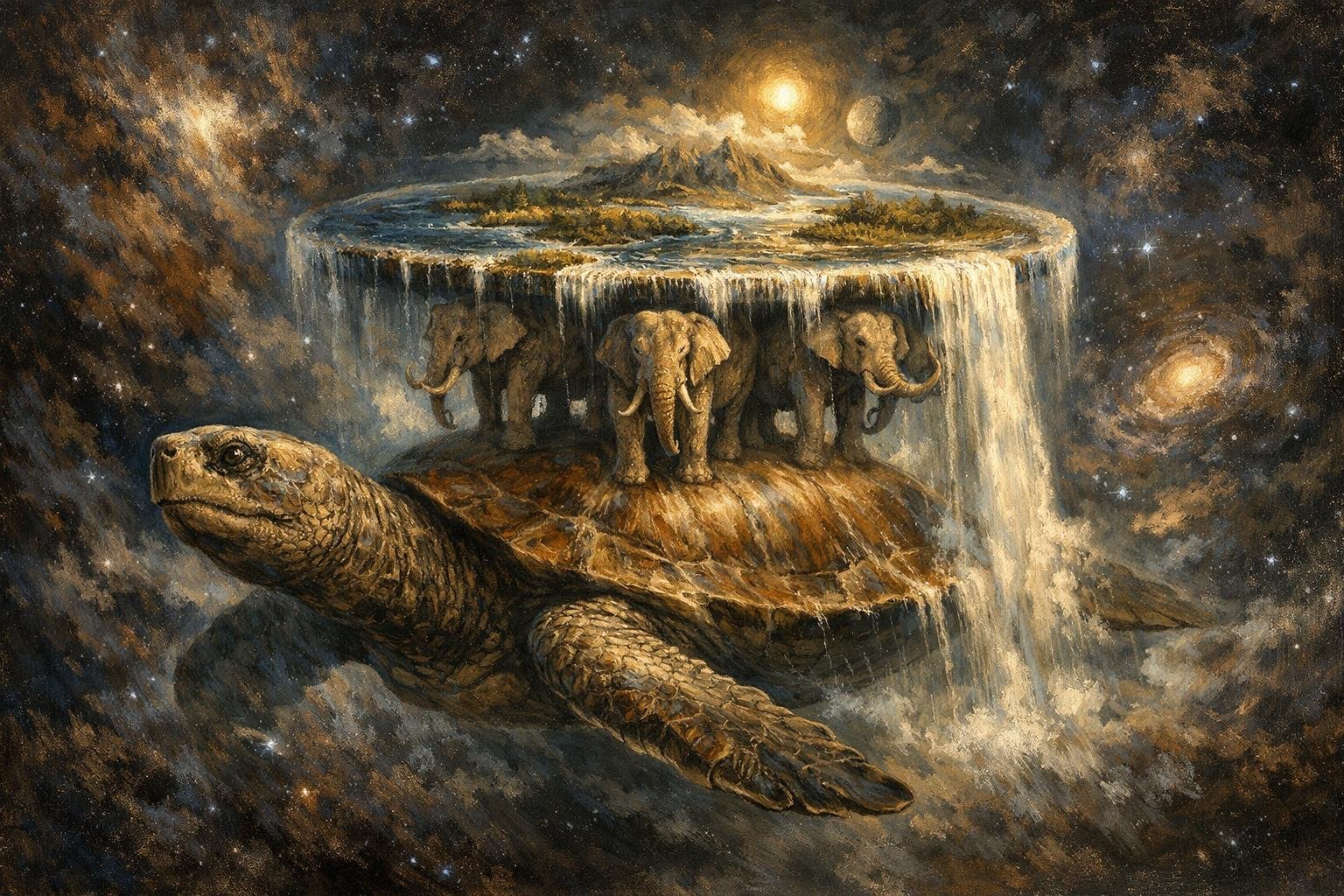
- Mythology as Infrastructure: The Great A’Tuin isn’t just a random surrealist image; it is a deliberate, engineered reconstruction of Hindu (Chukwa/Akupara) and Native American (Lenape/Iroquois) cosmological myths, designed to re-center the universe around human belief rather than cold physics.
- The “Boots Theory” is Real Economics: Captain Vimes’ observation on the cost of poverty has transcended fiction to become a recognized concept in socioeconomic discourse, illustrating precisely how the mechanics of being poor are expensive.
- Policing by Consent: The City Watch arc is a fictional stress-test of Sir Robert Peel’s 19th-century policing principles, specifically the transition from a military guard to a civilian peace force, layered with the gritty procedural tone of Ed McBain’s 87th Precinct.
- Narrativium over Physics: Discworld runs on “Narrativium,” an element that ensures narrative causality trumps the laws of thermodynamics. Things happen because they must for the story to work, providing a meta-commentary on the nature of fiction itself.
- Shakespearean Deconstruction: Wyrd Sisters doesn’t just reference Macbeth; it dismantles the misogyny of the “Weird Sisters” trope, replacing chaotic hags with pragmatic community caretakers who use “Headology” (psychology) instead of fireballs.
1. The Chelonian Foundation: Cosmological Engineering and the Rejection of Physics
If you want to understand the Discworld, you have to stop looking at it as a “funny fantasy world” and start looking at it as a deliberate architectural rebuttal to the Copernican universe. Most high fantasy tries to ground itself in a pseudo-reality—maps with realistic coastlines, magic systems that obey conservation laws, economies that almost make sense. Pratchett looked at that and said, “Boring.” Instead, he went back to the source code of human imagination. He didn’t build a world on physics; he built it on myth.
The Great A’Tuin: Excavating the Mytheme
The Discworld rests on the backs of four elephants (Berilia, Tubul, Great T’Phon, and Jerakeen), who in turn stand on the shell of Great A’Tuin, the World Turtle. This isn’t Pratchett being “zany” for the sake of it. He is excavating one of the oldest mythemes in human history.
The concept of the “World Turtle” (or Aspidochelone) appears in the mythologies of the Lenape and Iroquois peoples of North America, where the earth is formed on the back of a giant turtle. However, the specific configuration of elephants-on-turtle is a direct nod to Hindu cosmology. The Sanskrit texts describe the world supported by elephants (the Diggaj), who stand on the tortoise Akupara (or sometimes Kurma, an avatar of Vishnu).
Pratchett admitted to encountering this myth in an astronomy book when he was nine years old—a book that likely framed the concept with the smug superiority of the atomic age, mocking the “old farts in togas”. By making this “primitive” model the literal reality of his world, Pratchett forces a shift in perspective. On Discworld, the ancient myths are the hard science. The absurd is the baseline.
There is also the philosophical joke of Infinite Regress. You know the story: A philosopher explains the world is on a turtle. A lady asks what the turtle stands on. “Another turtle.” And below that? “It’s turtles all the way down”. Pratchett solves the regress problem pragmatically: Great A’Tuin is swimming. Through space. It doesn’t need to stand on anything. It’s a biological starship. This immediately establishes the tone of the series: philosophical questions are answered with biological realities.
| Feature | Discworld Realization | Mythological/Scientific Origin |
| Base Support | Great A’Tuin (Star Turtle) | Hindu Akupara / Kurma; Lenape World Turtle |
| Intermediary Support | Four Elephants (Berilia, Tubul, T’Phon, Jerakeen) | Hindu Diggaj (World Elephants) |
| Movement | Swimming through space to a mating ground | The “Big Bang” vs. Biological Imperative; Solving “Infinite Regress” |
| Shape | Flat Disc | Ancient Near Eastern cosmology; Pre-Copernican astronomy |
| Edges | The Rimfall (Waterfall into space) | Norse/Celtic “Edge of the World” motifs |
The Physics of the Rimfall
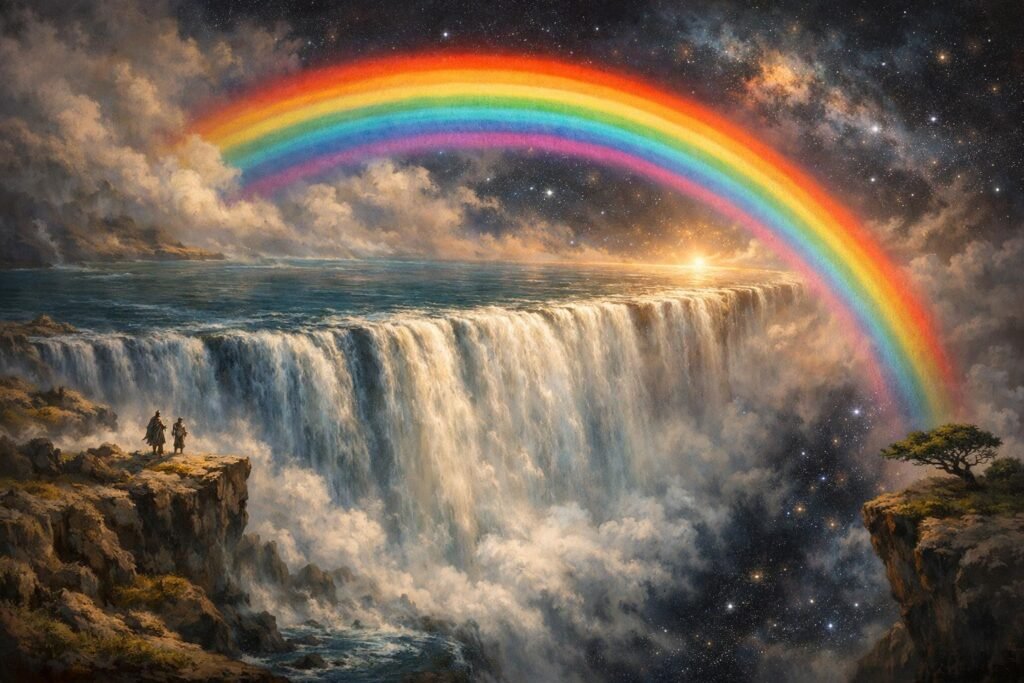
On a round world, gravity pulls everything to the center. On a flat world, the water has to go somewhere. Hence, the Rimfall—the largest waterfall in the universe, where the Circle Sea drains endlessly into the void.
From a hard sci-fi perspective, this is a nightmare. Where does the water come from? How does the atmosphere remain stable? Pratchett waves this away with “Arrangements are made”. The water cycles back via thaumic fields (magic) and cloud systems. But the visual of the Rimfall serves a specific literary purpose: it is the ultimate “memento mori.” In our world, the horizon is an optical illusion. In Discworld, the horizon is a cliff edge.
The mist from this massive waterfall creates the Rimbow—an eight-color rainbow. The eighth color is Octarine, the color of magic, visible only to wizards and cats. This is a subtle dig at our visible spectrum. Why should a magical world be limited to Roy G. Biv? By adding a color that “doesn’t exist,” Pratchett highlights the limitations of human perception. The Rimbow is described as a “phantom bridge” of light, heavily charged with magic, creating a visual spectacle that defies the physics of refraction as we know them.
Narrativium: The Element of Story
In our universe, the fundamental forces are gravity, electromagnetism, and the nuclear forces. In Discworld, the fundamental force is Narrativium.
Pratchett posits that the universe runs on stories. If a million-to-one chance crops up, it strikes nine times out of ten—if it makes for a good story. This is known as the Law of Narrative Causality.
- Dragons: They don’t fly because of aerodynamics (they are too fat, essentially flying flamethrowers). They fly because they are dragons, and that is what dragons do in stories.
- The Hero: Heroes always win when outnumbered. If you are a guard on the villain’s payroll, you are doomed, not because of tactical disadvantage, but because you are a “mook” in someone else’s narrative.
This is a meta-fictional device that allows Pratchett to deconstruct tropes from the inside. The characters who are “genre-savvy” (like Vimes or Granny Weatherwax) survive because they understand the story they are in and refuse to play along. They recognize the presence of Narrativium and act to subvert it.
2. Urban Palimpsest: Excavating Ankh-Morpork
Ankh-Morpork is arguably the most fully realized city in fantasy literature. It is not Minas Tirith, gleaming and sterile. It is a cesspit of commerce, crime, and culture—a “metropolitan compost heap.” It feels real because it is built on the grime of real history.
The Geography of Grime: Tallinn, Prague, and the Big Wahoonie
Lazy critics often tag Ankh-Morpork as “Victorian London.” They’re only 30% right. While the fog and the urchins scream Dickens, the architectural chaos is far more continental.
Pratchett himself cited Tallinn (Estonia) and Prague (Czech Republic) as visual inspirations. These are cities with medieval cores that have been built over, besieged, and rebuilt for a thousand years. The winding, illogical streets of “The Shades” (Ankh-Morpork’s slums) mirror the medieval layouts of Central European old towns more than the planned grid of American cities or the Regency squares of London.
However, the spirit of the city borrows heavily from 19th-century Seattle and modern New York City (referred to as “The Big Wahoonie” in The Truth). It is a melting pot. You have Dwarfs (acting as a metaphor for insular immigrant communities), Trolls (often filling the role of the feared “other” or heavy laborer), and Undead, all trying to make a buck. The energy is capitalist and kinetic.
| Ankh-Morpork Feature | Real-World Historical Inspiration | Literary/Atmospheric Function |
| The Shades | Medieval Tallinn / Prague Old Town | Represents the ancient, unknowable, dangerous heart of the city. |
| The River Ankh | The Thames (Great Stink of 1858); Cuyahoga River (caught fire) | Satirizes urban pollution; solid enough to draw a chalk outline on. |
| The City Spirit | 19th Century Seattle / NYC | The “melting pot” energy; ruthless capitalism and multicultural friction. |
| Political System | Renaissance Italian City-States (Tyranny by consent) | “One Man, One Vote” (The Patrician is the Man, he has the Vote). |
The Tower of Art: Vertical Evolution
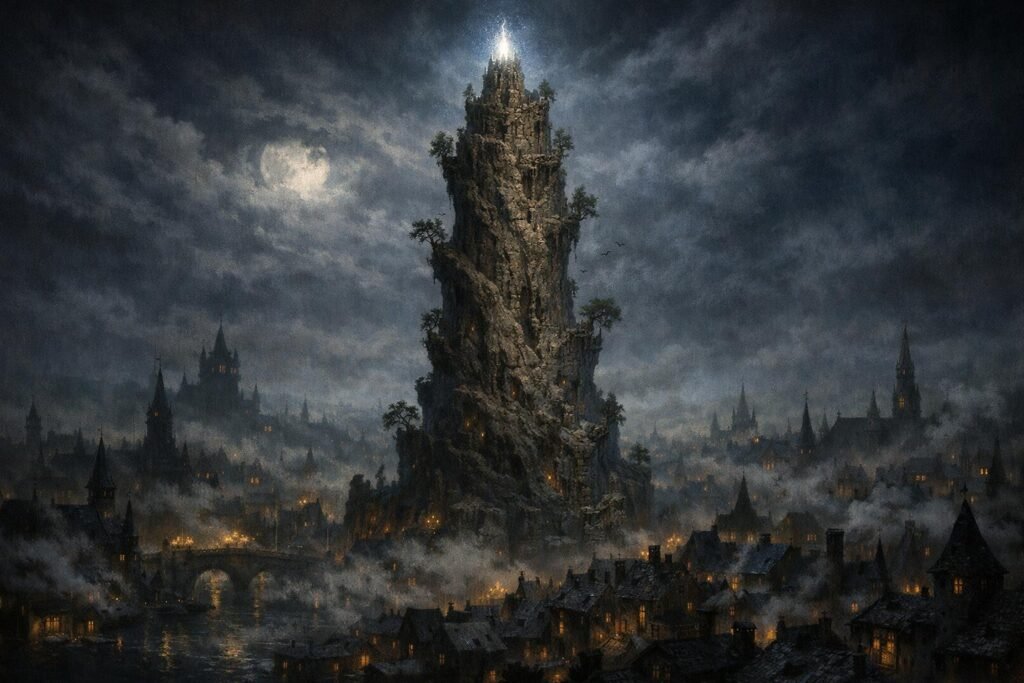
Standing 800 feet tall at the center of Unseen University, the Tower of Art is a physical manifestation of the accumulation of history. It has 8,888 steps and is described as looking like a “gnarled yew tree” due to centuries of indifferent repairs.
It’s not the pristine ivory tower of Tolkien’s Orthanc; it’s a crumbling, dangerous relic that houses its own micro-ecosystems. The tower is so old and so magical that evolution has gone slightly wrong inside it. There are species of beetles and small mammals unique to the upper floors of the tower. This is Pratchett applying evolutionary biology to architecture—if a building stands long enough, nature will colonize it, even if that nature is fueled by background radiation from the library.
The City Watch: Policing by Consent (and heavy boots)
The evolution of the Ankh-Morpork City Watch is the most sophisticated analysis of law enforcement in modern fiction.
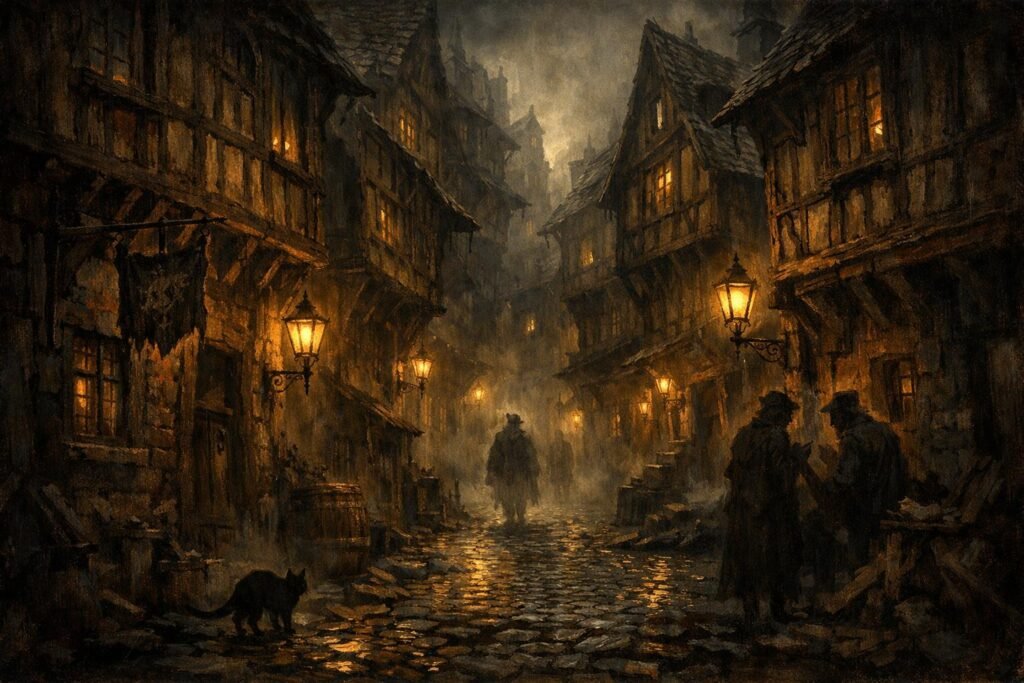
At the start (Guards! Guards!), the Watch is a joke—three drunks and a kid, hiding from trouble. This parallels the pre-modern “Night Watch” systems of medieval Europe: incompetent, underpaid, and avoided by everyone. As the series progresses, Samuel Vimes transforms the Watch into a modern police force. This arc is a direct exploration of Sir Robert Peel’s principles of policing (the “Peelers” or “Bobbies” of 19th-century London).
- Policing by Consent: Vimes constantly reinforces that the Watch only has power because the city agrees to let them have it. “The city wasa, wasa, wasa wossname. Thing. Woman,” Vimes slurs in Guards! Guards!, but the sentiment matures into a philosophy that the Watch are civilians in uniform.
- John Keel: In Night Watch, Vimes travels back in time and assumes the identity of his own mentor, “John Keel.” The name is a homophone for “Peel,” cementing the historical connection.
- Procedural Roots: The tone of the Watch books shifts from fantasy parody to police procedural. Pratchett acknowledged the influence of Ed McBain’s “87th Precinct” novels. The banter, the squad room dynamics, and the weary cynicism are lifted straight from the noir tradition and dropped into a world with dragons. The “87th Precinct” becomes the “City Watch House,” complete with the archetype of the “deaf man” villain and the ensemble cast of detectives.
The Boots Theory of Socioeconomic Unfairness
This is perhaps the most famous piece of social theory to come out of the series. In Men at Arms, Vimes muses on why the rich get richer and the poor get poorer. It is a brilliant distillation of the “poverty premium.”
“The reason that the rich were so rich, Vimes reasoned, was because they managed to spend less money. Take boots, for example. He earned thirty-eight dollars a month plus allowances. A really good pair of leather boots cost fifty dollars. But an affordable pair of boots, which were sort of OK for a season or two and then leaked like hell when the cardboard gave out, cost about ten dollars…. A man who could afford fifty dollars had a pair of boots that’d still be keeping his feet dry in ten years’ time, while the poor man who could only afford cheap boots would have spent a hundred dollars on boots in the same time and would still have wet feet.”
This passage has been cited in real-world socioeconomic papers and journalism to explain why being poor is expensive. It attacks the “lazy poor” narrative by showing that poverty is a trap of liquidity, not character.
The Economics of Making Money: Gold vs. The Golem
In Making Money, Pratchett takes his rage to the banking sector. The villain is the “Old Money” Lavish family—decadent, incompetent, and obsessed with tradition.
- The Gold Standard: Pratchett satirizes the obsession with gold. Moist von Lipwig (the protagonist) argues that gold is just a heavy metal we agreed is valuable. He moves the city toward a fiat currency based on the strength of the city’s economy.
- The Golem Trust: The Golems are the ultimate proletariat—tireless workers who are literally owned. Their liberation and the subsequent backing of the currency with their “future labor” is a complex commentary on slavery, automation, and the value of labor vs. capital. Pratchett asks: What backs money? Is it metal in a vault, or is it the capacity of the city’s people (and golems) to do work? He sides with the latter.
3. Deconstructing the Narrative: Parody as Weapon
Pratchett doesn’t just reference other works; he disassembles them to see how they tick, then reassembles them with better parts. His treatment of Shakespeare and High Fantasy tropes is surgical.
Wyrd Sisters vs. Macbeth: A Comparative Analysis
Wyrd Sisters is not just a retelling of Macbeth; it is an interrogation of it. It takes the “Weird Sisters” (the three witches) from Shakespeare and asks: What if they weren’t agents of chaos, but the responsible adults in the room?
| Scene / Trope | Shakespeare’s Macbeth | Pratchett’s Wyrd Sisters | The Satirical Point |
| The Meeting | “When shall we three meet again? / In thunder, lightning, or in rain?” | “When shall we three meet again?” / “Well, I can do next Tuesday.” | Demystifies the supernatural; Witches are busy community members, not just atmospheric props. |
| The Dagger | “Is this a dagger which I see before me?” (Hallucination of guilt) | “Is this a dagger I see before me?” / “Um. No, my lord. It’s my handkerchief.” | Undercuts the tragic soliloquy with physical comedy; highlights the villain’s madness vs. reality. |
| The Hand Washing | Lady Macbeth tries to wash the “spot” of blood from her hands. | The Duke (Felmet) constantly washes his hands, wearing away the skin. | Physicalizes the psychological guilt; makes the villain pathetic rather than tragic. |
| The Play | The Mousetrap (in Hamlet) reveals the King’s guilt. | The Witches commission a play to tell the truth about the King’s murder. | Propaganda vs. Truth. “Words have power” to rewrite history. |
Headology vs. High Magic: The Gendered Magic System
The wizards of Unseen University practice High Magic—complex rituals, octograms, and fireballs. It is academic, structural, and largely useless. It is also exclusively male (initially).
The witches, conversely, practice Headology. This is psychology weaponized.
- The Placebo Effect: Granny Weatherwax knows that if you give someone a bottle of colored water and tell them it will cure their warts with enough conviction, the warts will fall off. It relies on the patient’s belief, not the witch’s power.
- Social Power: Witches don’t rule by law; they rule by being the person who knows when you were born, who delivered your baby, and who laid out your grandmother. It is “soft power” hardened into steel.
- Gender Analysis: This dichotomy is a sharp critique of the Gendered division of labor. Wizardry is “professorial”—it comes with titles, dinners, and big buildings. Witchcraft is “domestic”—it happens in cottages, deals with bodily fluids, and gets no respect despite doing all the actual work.
The Footnote: A Narrative Device
Pratchett’s use of footnotes is legendary. In most literature, footnotes are the dry dust of academia. Pratchett hijacked this device and turned it into a second channel of narration.
- The Meta-Commentary: Pratchett uses footnotes to step out of the story and speak directly to the reader.
- The Punchline Storage: Often, the set-up is in the text, and the punchline is in the footnote. For example, describing a character looking to heaven, with a footnote: “For Trolls, heaven is down”. This enriches the world-building (trolls are mineral-based, so they want to return to the earth) without breaking the flow of the action scene.
- Pedantry as Humor: He uses footnotes to mock the very concept of “explaining” a fantasy world, often giving information that is technically true but entirely unhelpful.
4. The Rage Behind the Smile: Humanism, Death, and Justice
Neil Gaiman famously said: “Terry Pratchett isn’t jolly. He’s angry.”. This is the skeleton key to the entire series. The humor is not there to distract you; it is there to expose the absurdity of cruelty.
“There Is No Justice. There Is Just Us.”
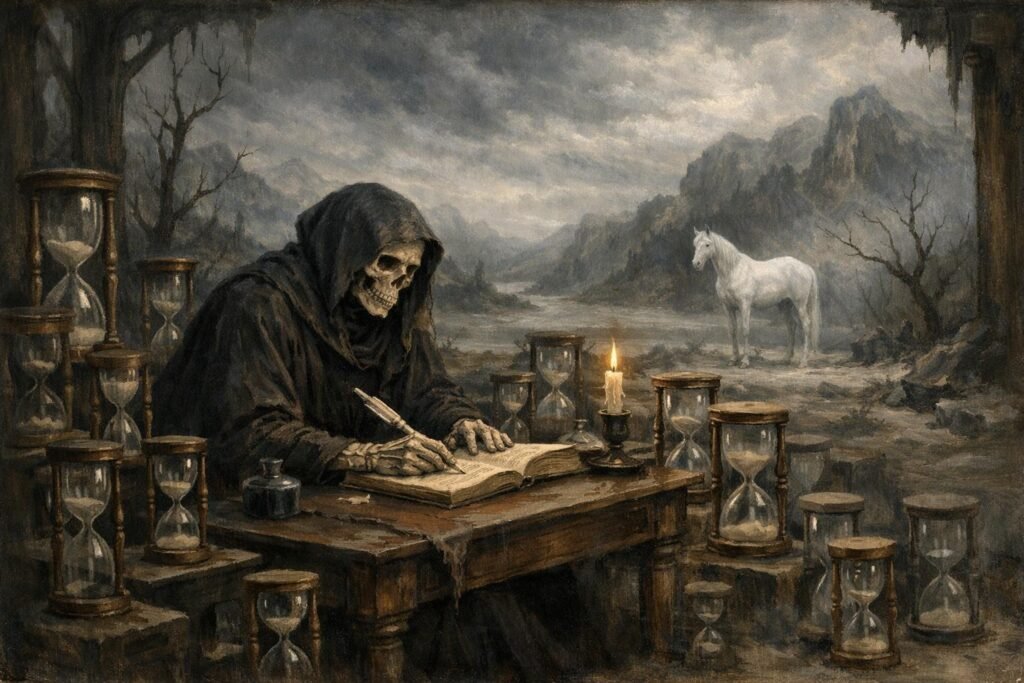
The character of Death is Pratchett’s greatest humanist mouthpiece. He is an anthropomorphic personification who is fascinated by humanity because we are the only creatures who invent concepts like “mercy” and “justice.”
In Reaper Man, Death confronts the Azrael (the Death of Universes) and delivers the thesis statement of the entire canon:
“THERE IS NO JUSTICE. THERE IS JUST US.”
Death argues that the universe is cold and indifferent. Justice, mercy, and fairness do not exist in the atoms of the universe. They exist only because humans believe in them and enact them. If we stop caring, justice ceases to exist. This is Existential Humanism: we must create the moral order we want to see, because the gods certainly won’t do it for us.
The “White Hot Fury”
Gaiman recounts seeing Pratchett in a “white hot fury”. This anger was directed at stupidity, at the mistreatment of the weak, and at the systems that perpetuate inequality.
- Goblins in Snuff: The treatment of Goblins as vermin parallels real-world genocides and the dehumanization of indigenous peoples. Vimes’ rage at this injustice drives the plot.
- Small Gods: A searing critique of organized religion. The Great God Om finds that his church has become so powerful it no longer needs him. It has become a machine for power and torture (the Inquisition), completely divorced from faith. Pratchett attacks the institution while preserving the dignity of the true believer (Brutha).
5. The Storyteller’s Perspective: Practical Advice for World-Builders
If you are a writer or world-builder, stop trying to copy Pratchett’s jokes. You will fail. Instead, steal his mechanics.
1. The “Bootstrap” Method
Do not invent a new fantasy vegetable if a potato will do. Ground your world in the mundane. The humor comes from the friction between the Magical (Wizards) and the Mundane (Potatoes). If you have a high-fantasy economy, ask: “Who cleans the toilets?” Pratchett answered: The Undead (or Harry King, the night soil man).
2. Anger is Energy
Identify what makes you furious about the real world. Is it bureaucracy? Unfair wages? Racism? Take that anger, dress it up in a pointy hat, and exaggerate it until it looks ridiculous. Satire requires a target. Pratchett didn’t just write about “evil overlords”; he wrote about bureaucrats who were evil.
3. Research the “Wrong” History
Don’t just read about kings and battles. Read about the history of sewage, the price of boots, the development of the postal service. Pratchett’s world feels real because he understood infrastructure. Going Postal is a masterclass in the history of communication systems (The Clacks vs. The Post).
4. Literalize the Metaphor
If a myth says the world is on a turtle, make it a real turtle. If people say “Knowledge is power,” make a library that radiates radiation. Take abstract concepts and make them physical problems your characters have to deal with.
FAQ
1. Is Discworld a flat earth theory endorsement?
No. It is a satire of ancient cosmologies. Pratchett uses the flat earth on the back of a turtle (based on Hindu and Native American myths) to contrast “mythological reality” with “scientific reality.” Roundworld (our earth) appears in the Science of Discworld books as a bizarre anomaly where physics, not narrative, rules.
2. What is the Vimes “Boots Theory”?
It is a socioeconomic theory from Men at Arms stating that poverty is expensive. A poor person cannot afford durable, high-quality goods (like $50 boots), so they buy cheap, low-quality goods ($10 boots) repeatedly. Over time, the poor person spends more than the rich person but still has wet feet. It illustrates the “poverty trap.”
3. Did Terry Pratchett hate Shakespeare?
Absolutely not. He loved Shakespeare enough to dismantle him. Wyrd Sisters is a loving parody of Macbeth, and Maskerade riffs on Phantom of the Opera. Pratchett criticized the “elitism” often attached to Shakespeare, reclaiming the Bard as a populist storyteller who wrote for the cheap seats (the “groundlings”).
4. Why is the librarian an Orangutan?
In The Light Fantastic, the Librarian was transformed by a magical accident. He refuses to be turned back because being a 300lb primate makes it much easier to reach high shelves and deal with unruly students. It is a classic Pratchett character trait: prioritizing pragmatism over humanity.
Links and Sources
- Wikipedia: World Turtle
- Reddit: Origin of Great A’Tuin
- [StackExchange: Sources of Discworld Imagery
- LibraryThing: Iroquois Creation Story & Discworld
- Terry Pratchett Forums: Hindu Mythology & Akupara
- Diva Portal: Performance of Witchcraft in Wyrd Sisters
- Witch Awareness Month: Macbeth Parody Analysis
- LSpace: City Watch & Ed McBain Influence
- Dalspace: Night Watch Literary Analysis
- Crime Fiction Lover: 87th Precinct
- Wikipedia: 87th Precinct
- Georgetown Law: The Boots Theory
- Wikipedia: Boots Theory
- Terry Pratchett Official: Boots Theory
- TandF Online: Boots Theory in Mental Health Context
- Reddit: Use of Footnotes
- Terry Pratchett Forums: Footnotes as Punchlines
- LSpace: Headology Definition
- Reddit: Gender Analysis in Magic
- Goodreads: Equal Rites Quotes
- Wikipedia: Narrativium
- LSpace: Narrative Causality
- [Thoughts Along The Way: Narrativium Analysis
- Reddit: Making Money & The Gold Standard
- Discworld Fandom: Making Money Plot
- LSpace: Annotated Pratchett File (Wyrd Sisters)
- Goodreads: Reaper Man Quotes
- KJ Charles Writer: Pratchett & Humanism
- Reddit: Vimes & Robert Peel
- Wikipedia: Sir Robert Peel
- Discworld Wiki: Night Watch & Peelers
- Leseriana: Macbeth and Wyrd Sisters
- LSpace: Rimfall Description
- Discworld Fandom: Rimfall
- LSpace: Tower of Art Description
- Wikipedia: Ankh-Morpork Historical Inspirations
- Reddit: Ankh-Morpork & The Big Wahoonie
- Reddit: Ankh-Morpork & NYC
- LSpace: Tower of Art Dimensions
- Wikipedia: Ankh-Morpork & Tallinn
- DergiPark: Wyrd Sisters Translation & Allusions
- The Guardian: Neil Gaiman on Pratchett’s Anger
- MetaFilter: Gaiman Quote
- LSpace: Rimbow
