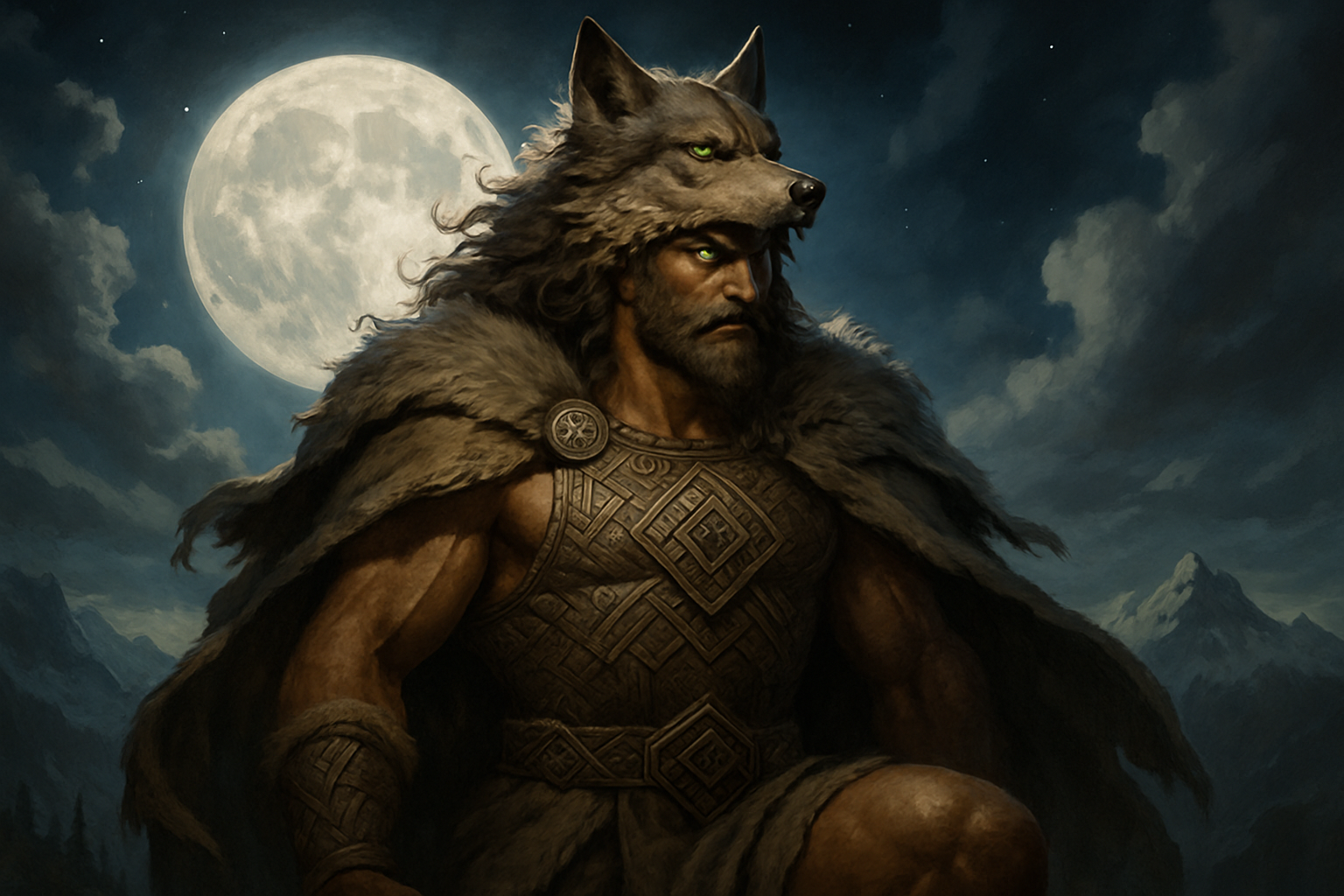
The Etymology of Divine Wolves: From Ulfrir to Fenrir
The divine wolf has stalked through human consciousness since the dawn of civilization, leaving paw prints across mythological landscapes from the Arctic tundra to Germanic forests. Ulfrir the Wolf God, as immortalized in the haunting digital artwork by Helm1892 on DeviantArt, represents more than mere artistic expression—it embodies a mythological archetype that spans millennia and continues to prowl through the pages of modern fantasy literature.
The name “Ulfrir” finds its roots in the Old Norse linguistic tradition, where úlfr simply means “wolf”. This ancient word traces its lineage through Proto-Germanic wulfaz and ultimately to Proto-Indo-European wĺ̥kʷos. The suffix “-ir” transforms the mundane wolf into something divine, echoing the naming conventions found in Norse mythology where gods and mythical beings often bear descriptive appellations.
While Ulfrir may not appear in the primary Norse mythological texts as a distinct deity, the concept draws from the rich tradition of wolf gods that permeate Indo-European mythology. The most famous of these divine wolves remains Fenrir (also called Fenrisúlfr), the monstrous offspring of Loki who was prophesied to devour Odin during Ragnarök. Fenrir’s name derives from Old Norse, meaning “he who dwells in the marshes” or “fen-dweller”, while alternative names like Hróðvitnir translate to “fame-wolf”.
The Indo-European Wolf Cult: Ancient Origins of Divine Canines
Archaeological and linguistic evidence reveals that wolf worship formed a fundamental aspect of Proto-Indo-European culture, particularly associated with warrior initiation rites. The concept of the kóryos—young warrior bands who “transformed into wolves” during their initiation—provides the cultural foundation for later mythological wolf gods.
This warrior-wolf connection manifested across Indo-European cultures. In Greek mythology, Zeus Lykaios and Apollo Lyceus bore epithets connecting them to wolves, while Mount Lykaion in Arcadia hosted festivals where human sacrifices allegedly transformed participants into wolves for several years. Roman culture elevated the wolf through the foundational myth of Romulus and Remus, making the wolf sacred to Mars, the god of war.
The Celtic tradition embraced wolves as symbols of both protection and destruction, with the Morrigan often depicted alongside ravens and wolves. Germanic tribes particularly venerated wolves, with warriors called Ulfhednar (“wolf-coats”) entering battle believing they channeled lupine ferocity.
The Mythological Landscape: Wolves as Divine Messengers and Destroyers
Across cultures, wolves served dual roles as both divine messengers and agents of destruction. In Norse mythology, Odin kept two wolves, Geri and Freki (meaning “greedy” and “ravenous”), who accompanied him and received meat from his table. These wolves represented the positive aspects of lupine divinity—loyalty, protection, and wisdom.
Conversely, the apocalyptic wolves of Norse mythology embodied chaos and destruction. Beyond Fenrir, his sons Sköll and Hati were prophesied to devour the sun and moon during Ragnarök. This duality—wolves as both protectors and destroyers—reflects the complex relationship between civilization and wild nature that permeates mythological thinking.
The shamanic traditions of circumpolar cultures, including the Inuit peoples portrayed in Jordanna Max Brodsky’s The Wolf in the Whale, viewed wolves as spirit guides capable of bridging the mortal and divine realms. These traditions emphasized the wolf’s role as a psychopomp—a guide between worlds—rather than merely a destroyer.
Modern Literary Renaissance: Wolf Gods in Contemporary Fantasy
The digital age has witnessed a remarkable revival of wolf mythology in literature, with authors weaving ancient archetypes into contemporary narratives. Patricia Briggs stands as perhaps the most influential contemporary author in this realm, with her Mercy Thompson series and Alpha & Omega spin-offs featuring werewolves governed by ancient rules and hierarchies.
Briggs’s world-building draws heavily from actual wolf behavior and pack dynamics while incorporating mythological elements. Her werewolves follow the leadership of the Marrok, Bran Cornick, who governs all North American packs and whose decision to reveal werewolves to humanity drives much of the series’ overarching plot. The character of Anna Latham, an Omega werewolf, embodies the rare peaceful force within pack dynamics, reflecting the complex social structures that real wolves exhibit.
Jordanna Max Brodsky’s The Wolf in the Whale represents perhaps the most sophisticated blending of historical accuracy with mythological elements in contemporary fantasy. Set in 1000 CE Arctic Canada, the novel follows Omat, an Inuit shaman whose spirit guides include wolves, as they encounter Norse explorers bringing their own wolf-associated gods. The narrative explores the collision between Inuit animistic traditions and Norse polytheism, with Christianity looming as a third mythological force.
The novel’s portrayal of divine wolves reflects authentic shamanistic traditions where wolves serve as spirit guides and totems rather than mere supernatural creatures. Brodsky’s meticulous research into both Inuit and Norse mythological systems creates a narrative where competing wolf mythologies—the Inuit Wolf as spirit guide and the Norse wolves as harbingers of apocalypse—clash and intermingle.
Urban Fantasy and the Werewolf Renaissance
The urban fantasy genre has embraced werewolves and wolf gods with particular enthusiasm, creating entire fictional ecosystems around lupine supernatural beings. Authors like Kim Harrison, Laurell K. Hamilton, and Jim Butcher have established werewolves as integral components of modern urban fantasy landscapes.
The Alpha & Omega dynamics popularized in paranormal romance have created their own mythological framework, where wolf gods and powerful alphas govern supernatural societies. This modern mythology borrows heavily from both actual wolf behavior and ancient mythological traditions, creating new archetypes that resonate with contemporary readers.
Recent publications demonstrate the continued vitality of wolf-centered fantasy. Ali Hazelwood’s Bride (2024) features an Alpha werewolf whose authority derives from ancient bloodlines, while series like The Bloodsworn Saga by John Gwynne explores post-Ragnarök worlds where the old gods have died but their offspring—including divine wolves—remain as sources of power.
The Digital Age and Mythological Art
The digital artwork of Ulfrir the Wolf God by Helm1892 exemplifies how modern artists continue to breathe life into ancient mythological concepts. Digital art platforms like DeviantArt have become repositories for mythological interpretation, allowing artists to create visual representations of gods and creatures that may never have been depicted in ancient sources.
These modern interpretations often blend various mythological traditions, creating syncretic deities like Ulfrir that draw from Norse, Germanic, and broader Indo-European wolf mythologies. The artist’s description—”He is my favourite of all. The ferocious wolf.”—captures the continued appeal of the wolf as a divine archetype[attachment].
Such digital interpretations serve as bridges between ancient mythology and contemporary fantasy, inspiring writers and readers to explore mythological themes in new contexts. The visual representation of Ulfrir as a fierce, divine wolf connects directly to the literary traditions explored by modern fantasy authors.
Psychological and Cultural Significance
The enduring appeal of wolf gods like Ulfrir speaks to deep psychological and cultural needs that transcend historical periods. Carl Jung would likely interpret the wolf god as an archetypal figure representing the Shadow—those aspects of human nature that civilization seeks to repress but which remain essential to psychological wholeness.
The wolf embodies the tension between civilization and wilderness, between social order and individual freedom, between protection and destruction. In mythological terms, wolf gods like Fenrir represent the inevitable return of repressed natural forces, while protective wolves like Geri and Freki embody the possibility of channeling wild power in service of higher purposes.
Modern fantasy literature continues to explore these themes, with werewolf narratives often focusing on characters struggling to balance their civilized and wild natures. The popularity of “fated mate” tropes in paranormal romance reflects ancient beliefs about wolves mating for life, while pack hierarchies mirror human social structures and their discontents.
Contemporary Werewolf Literature: A Thriving Ecosystem
The werewolf romance subgenre has exploded in recent years, with dozens of new titles published annually. Series like The Millennium Wolves, Alpha Jax, and God of Wolves demonstrate the continued market appetite for stories featuring wolf gods and divine werewolves.
These contemporary works often blend mythological elements with modern concerns. Environmental themes appear frequently, with werewolves serving as guardians of natural spaces threatened by human development. Issues of consent and bodily autonomy are explored through transformation narratives, while pack dynamics allow authors to examine questions of authority, belonging, and individual versus collective identity.
The supernatural romance genre has particularly embraced wolf mythology, with “Alpha” characters often possessing god-like powers and ancient bloodlines connecting them to primordial wolf deities. These stories create new mythologies while drawing on ancient traditions, suggesting that the human fascination with divine wolves remains as strong as ever.
Academic and Folkloric Scholarship
Scholarly interest in wolf mythology continues to evolve, with researchers examining the cultural and psychological functions of lupine deities across different societies. The Indo-European wolf cult has received particular attention from comparative mythologists seeking to understand the common origins of European werewolf traditions.
Recent archaeological discoveries have supported theories about ancient warrior cults associated with wolves, lending credibility to mythological accounts of shape-shifting warriors. The Srubnaya culture archaeological evidence from the Samara Valley includes ritual wolf/dog sacrifices that align with Vedic descriptions of similar ceremonies.
These scholarly investigations provide important context for understanding how ancient mythological traditions continue to influence contemporary fantasy literature. Authors like Jordanna Max Brodsky explicitly engage with academic research to create more authentic mythological worlds, while others draw inspiration from folkloric traditions without necessarily adhering to historical accuracy.
The Future of Wolf Mythology in Literature
As climate change and environmental destruction become increasingly pressing concerns, wolf mythology seems poised to evolve in new directions. Contemporary fantasy increasingly portrays wolves and werewolves as guardians of threatened ecosystems, reflecting real-world conservation efforts to restore wolf populations.
The rise of climate fiction and eco-fantasy subgenres suggests that future wolf god narratives may focus more explicitly on environmental themes, with divine wolves serving as representatives of threatened wild spaces. The success of works like The Wolf in the Whale, which explicitly address the collision between traditional cultures and modernizing forces, indicates reader appetite for mythologically grounded environmental narratives.
Digital storytelling platforms and webnovels have democratized fantasy publishing, allowing for more diverse interpretations of wolf mythology drawn from non-European traditions. This diversification promises to enrich the mythological landscape, introducing readers to African, Asian, and Indigenous American wolf traditions that complement the Indo-European material that has dominated Western fantasy literature.
The Eternal Hunt: Why Ulfrir Endures
The enduring fascination with figures like Ulfrir the Wolf God reflects humanity’s complex relationship with the natural world and our own animal nature. In an increasingly urbanized and technologically mediated world, wolf gods represent both what we have lost and what we fear losing—the wild, the instinctual, the authentically powerful.
Wolf mythology serves as a reminder that civilization’s victory over nature remains incomplete and perhaps should remain so. The divine wolf embodies the possibility of reconciliation between human consciousness and natural instinct, between individual will and collective belonging, between the tame and the wild.
Whether manifesting as the world-ending Fenrir, the loyal companions Geri and Freki, or the contemporary Alpha werewolves of urban fantasy, wolf gods continue to capture human imagination because they represent aspects of existence that purely human narratives cannot fully express. They are totems of transformation, guardians of boundaries between worlds, and eternal reminders that some powers cannot be tamed—only respected, feared, and perhaps, if we are fortunate, befriended.
In the digital art of Ulfrir and the pages of contemporary fantasy novels, ancient mythological truths find new expression, ensuring that the howl of the divine wolf will continue to echo across the landscapes of human imagination for generations yet to come.
