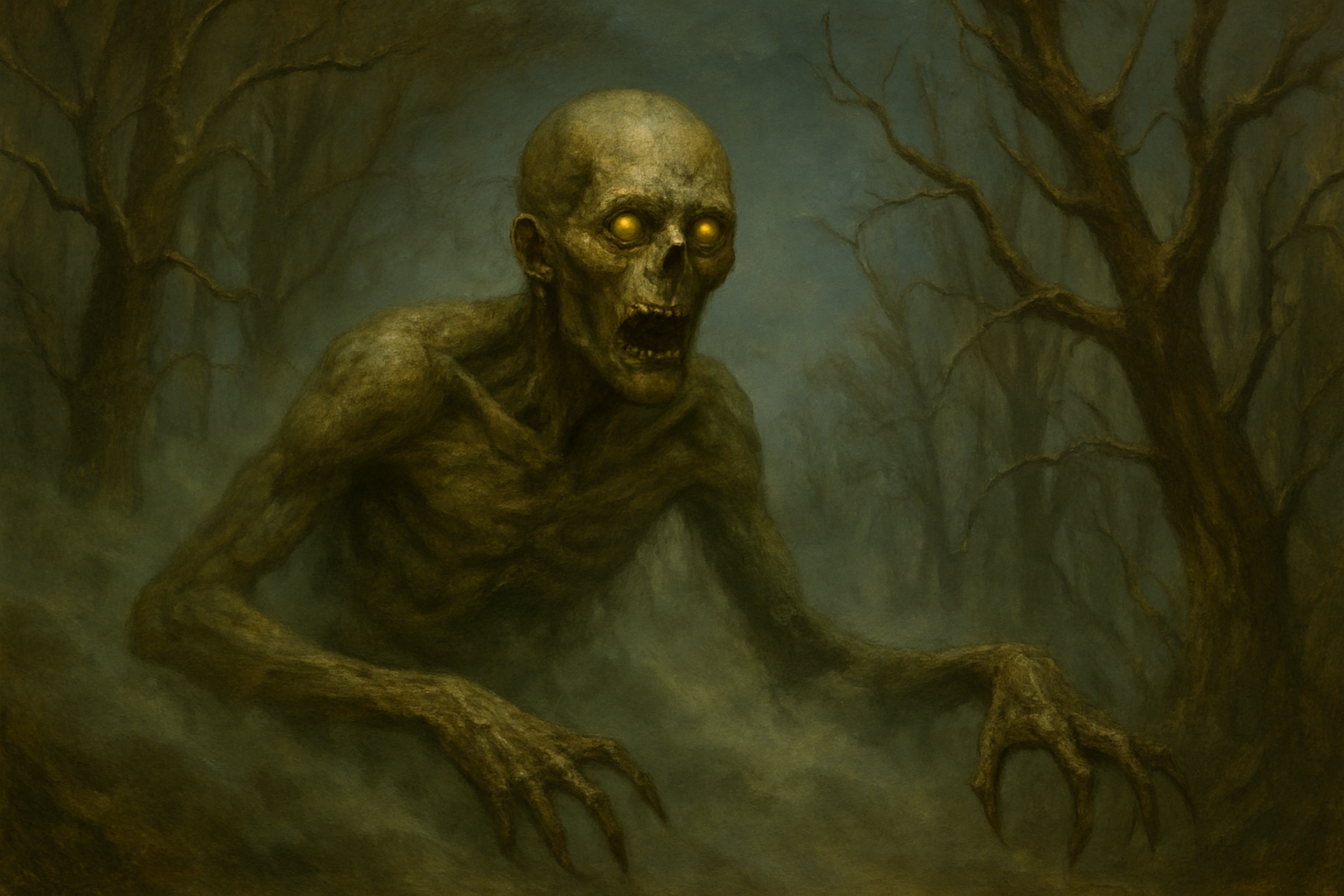
Ancient Roots: Mesopotamian “Gallu” and the Birth of a Monster
Quick Overview: What’s Inside
- The Origin: How Mesopotamian gallu demons laid the foundation for the ghoul myth.
- Arabian Folklore: The evolution of the ghūl as a shapeshifting desert predator.
- Western Adaptation: How 18th-century translations redefined the creature for Gothic literature.
- Lovecraft’s Legacy: The shift from supernatural spirits to a subterranean, biological race.
- Modern Fantasy: A guide to contemporary novels and RPG influences.
- Reading List: A curated selection of must-read books featuring ghouls.
Ghouls, those macabre creatures of folklore and fantasy, have a rich and varied history, evolving from ancient Mesopotamian demons and Arabic shape-shifting desert spirits to the graveyard-haunting, corpse-eating monsters of Western literature, and further into the intelligent, subterranean races of modern fantasy. This article traces their haunting evolution and highlights notable fantasy books where ghouls play a significant role, offering a feast of fiction for fans and RPG storytellers alike.
1.1 Ancient Roots: Mesopotamian “Gallu” and the Birth of a Monster
The conceptual origins of the ghoul can be traced back to ancient Mesopotamian mythology, predating their more commonly known Arabic counterparts. In Sumerian, Babylonian, and Assyrian traditions, there existed demonic entities known as gallu (or gallă). These malevolent beings were denizens of the underworld, often depicted as agents of chaos and destruction, capable of traversing between the realm of the living and the realm of the dead. Their primary role was to drag mortals, particularly those who had offended the gods or violated sacred laws, down into the underworld, a place of eternal darkness and suffering.
The gallu were considered powerful and fearsome, often associated with storms and tempests, acting as messengers or enforcers for higher deities like Anu, the sky god. Descriptions of these entities highlight their terrifying nature; they were often portrayed as neither male nor female, possessing a silence “heavy with seastorms,” and their forms could include animalistic features, such as the heads of beasts, further emphasizing their otherworldly and monstrous characteristics. The etymological link between the Mesopotamian gallu and the Arabic ghūl is a subject of scholarly discussion, with some researchers suggesting a direct line of cultural transmission or shared mythological heritage, given the geographical proximity and historical interactions between Mesopotamian and early Arabian cultures. This ancient lineage establishes the ghoul as a creature deeply embedded in humanity’s earliest fears of death, the unknown, and the monstrous forces that lurk beyond the veil of the mundane world.
The gallu demons were not merely abstract concepts but played specific roles within the cosmological and religious frameworks of Mesopotamian societies. They were invoked in incantations and rituals, often as forces to be appeased or warded off. For instance, their appeasement was sometimes sought through sacrificial offerings, such as the slaughter of a lamb, indicating their perceived power and influence over human fate. The descriptions of these entities often emphasized their terrifying and often hybrid appearances, combining human and animal traits in unsettling ways. This characteristic, the blending of familiar forms into something grotesque and unnatural, is a recurring theme in the depiction of monstrous beings across various cultures and persists in modern portrayals of ghouls. The idea that these creatures could bridge the gap between the world of the living and the realm of the dead, acting as psychopomps or abductors, also laid an early foundation for the ghoul’s later association with graveyards and the consumption of the dead. While the direct narrative continuity between the Mesopotamian gallu and the later Arabic ghūl is complex and subject to academic debate, the thematic parallels in their roles as underworld demons, their association with death, and their terrifying, often shapeshifting natures, suggest a deep-rooted mythological archetype that evolved and adapted as it moved across cultures and millennia. This ancient heritage underscores the ghoul’s enduring presence as a symbol of our deepest anxieties surrounding mortality and the supernatural.
1.2 Arabian Nights and Beyond: The Ghūl in Arabic Folklore
The figure of the ghūl (غول) as it is more widely recognized today finds its most prominent early literary expressions in pre-Islamic Arabian mythology and, subsequently, in the rich tapestry of Arabic folklore, most notably within the seminal collection One Thousand and One Nights (also known as Arabian Nights). In these traditions, the ghūl is depicted as a malevolent, shapeshifting demon or spirit, often (though not exclusively) female, that inhabits desolate places such as deserts, ruins, and, significantly, burial grounds. These creatures were considered a particularly dangerous type of jinn (spirits), sometimes said to be the offspring of Iblīs (Satan).
Their primary modus operandi involved luring unsuspecting travelers astray, often by taking on deceptive forms, such as a beautiful woman, a lost animal, or even a familiar person, to lead them into the wilderness or an isolated area where they could be killed and devoured. Beyond preying on the living, ghūls were also known to feast on the flesh of the dead, desecrating graves and consuming corpses, an aspect that would become central to their later Western interpretations. The ability to change shape was a defining characteristic, allowing them to approach their victims undetected, though some legends suggest they could always be identified by an unalterable sign, such as the hooves of an ass. This association with death, decay, and the violation of sacred burial sites cemented their reputation as profoundly malevolent and terrifying entities in the Arab imagination, serving as cautionary figures against venturing into unknown or dangerous territories.
The One Thousand and One Nights played a crucial role in popularizing and disseminating the concept of the ghūl beyond the Arab world. Stories within this collection, such as “The Story of Sidi Nouman,” feature ghūls prominently, showcasing their deceptive nature and gruesome habits. In these narratives, ghūls are not mindless monsters but often cunning and intelligent adversaries. For example, in some tales, a ghūl might marry a human, only to reveal its true, horrifying nature later, or they might form alliances with other supernatural beings, like enchantresses. The methods to overcome a ghūl were specific and required wit or divine intervention; one common belief was that a ghūl could only be killed with a single blow, as a second strike would restore it to life. This detail highlights a vulnerability, albeit a tricky one, and adds a layer of strategy to encounters with these creatures. The plural of ghūl in Arabic is ghīlān, and the female form is ghūlah. Over time, the term ghūl also came to be used metaphorically in Arabic to describe a greedy or gluttonous person, extending its cultural significance beyond the purely supernatural. The rich and varied depictions of ghūls in Arabic folklore provided a fertile ground for later literary adaptations, offering a complex and terrifying creature that embodied the dangers of the unknown and the perversion of natural order.
1.3 A Western Transformation: Ghouls in European Literature and the Influence of Antoine Galland
The introduction and subsequent transformation of the ghūl into the Western literary consciousness, and its evolution into the more commonly known “ghoul,” is a fascinating study in cultural adaptation and the power of translation. The pivotal moment in this journey was the French translation of One Thousand and One Nights by Antoine Galland, published between 1704 and 1717. Galland’s translation, while immensely popular and influential in introducing European audiences to a wealth of Eastern tales, was not always a literal rendering of the source material. In his version, particularly in the translation of “The Story of Sidi-Nouman,” Galland appears to have reinterpreted or, some scholars argue, reinvented certain aspects of the ghūl. His depiction emphasized the creature’s role as a scavenger that fed on corpses, an interpretation that, while present in some Arabic folklore, was perhaps not as uniformly central as it became in the Western imagination. This specific characteristic—the consumption of the dead in graveyards—resonated deeply with European Gothic sensibilities and became a defining trait of the Western ghoul. This reinterpretation effectively shifted the ghūl from a more general desert-dwelling, shapeshifting demon that preyed on the living to a creature more specifically associated with graveyards and the desecration of the dead.
Following Galland’s influential translation, the ghoul began to appear in various European literary works, often blending with existing local folklore about revenants, vampires, and other creatures of the night. William Beckford’s 1786 Orientalist Gothic novel Vathek is often cited as one of the first significant English-language works to feature a ghoul, drawing directly from the imagery popularized by Galland. In Vathek, the ghoul is presented as a grave-robbing entity, aligning with the emerging Western archetype. Throughout the 19th century, ghouls continued to populate Gothic and Romantic literature. Lord Byron referenced them in his 1813 poem “The Giaour,” and Hans Christian Andersen included them in his 1838 fairy tale “The Wild Swans,” where the heroine encounters ghouls feasting on a corpse in a cemetery. Edgar Allan Poe further cemented the ghoul’s place in Western horror with mentions in his poems “The Bells” (1848) and “Ulalume” (1847), describing them as “neither man nor woman…neither brute nor human,” emphasizing their ambiguous and terrifying nature. This European adaptation saw the ghoul increasingly associated with themes of death, decay, cannibalism, and the violation of sacred burial grounds, reflecting societal anxieties of the era. The creature became a staple of horror fiction, often depicted as a loathsome, corpse-eating denizen of graveyards, a far cry from the more versatile and sometimes even seductive ghūl of Arabic lore, yet retaining its core malevolence and connection to the macabre.
1.4 Lovecraft’s Legacy: Redefining Ghouls for the Modern Era
H.P. Lovecraft, a seminal figure in weird fiction, played a crucial role in redefining and popularizing a distinct version of the ghoul for modern horror and fantasy literature. Moving away from the more traditional, often mindless, corpse-eaters of earlier Western depictions, Lovecraft imbued ghouls with a new layer of complexity and cosmic horror. In his Cthulhu Mythos stories, particularly ”Pickman’s Model” (1926) and The Dream-Quest of Unknown Kadath (written 1926, published 1943), ghouls are presented as a distinct, subterranean race of monstrous humanoids. These creatures are not merely undead or spirits but a separate species, albeit one with unsettling connections to humanity. Lovecraftian ghouls are typically described as having a vaguely canine or hyena-like appearance, with a “forward slumping” posture and an “unpleasant rubberiness” to their texture. They are intelligent, capable of speech, tool use, and even forming complex societies in the vast network of tunnels and catacombs beneath human cities and ancient ruins. Their primary sustenance is human flesh, preferably carrion, which they scavenge from graves or the victims of disasters, sometimes emerging into the human world through subway tunnels or forgotten crypts.
A particularly intriguing aspect of Lovecraft’s ghouls is their potential for interbreeding with humans and the concept of transformation. In some stories, it is suggested that humans can, under certain horrific or degenerate circumstances, transform into ghouls. Conversely, ghouls are also depicted as sometimes abducting human infants and replacing them with one of their own kind—a ghoulish changeling that appears human in youth but gradually assumes its true, monstrous form as it matures. This theme of blurred lines between human and monster, and the horrifying possibility of degeneration into a ghoulish state, added a profound psychological dimension to Lovecraft’s portrayal. Furthermore, Lovecraft’s ghouls are not always outright malevolent towards humans; while dangerous, they can sometimes be reasoned with or even form uneasy alliances, as seen in The Dream-Quest of Unknown Kadath, where the protagonist, Randolph Carter, encounters his former acquaintance, the artist Richard Upton Pickman, who has fully transformed into a ghoul and now dwells in the Dreamlands. This nuanced portrayal, shared and expanded upon by Lovecraft’s contemporaries and literary successors like Clark Ashton Smith and Robert E. Howard, significantly influenced the collective idea of the ghoul in American popular culture and beyond, moving it beyond a simple graveyard menace into a more multifaceted and unsettling creature of the dark. The Lovecraftian ghoul, with its hints of a secret, degenerate civilization lurking beneath our own, continues to inspire writers and creators, solidifying its place as a modern archetype of horror.
1.5 Ghouls in the Contemporary Fantasy Landscape
In contemporary fantasy literature, ghouls continue to be a versatile and enduring presence, drawing from the rich tapestry of their historical and literary antecedents while also being subject to new interpretations and creative reimaginings. Modern authors often blend elements from the Arabic ghūl, the European Gothic ghoul, and the Lovecraftian subterranean dweller to create creatures that fit diverse narrative needs and thematic concerns. While some depictions adhere to the traditional image of the ghoul as a mindless, flesh-eating undead or a grave-robbing monster, others explore more complex and nuanced portrayals. For instance, ghouls might be presented as tragic figures, cursed beings, or even as a misunderstood species with its own culture and societal structures, echoing Lovecraft’s more elaborate conceptions. The theme of transformation from human to ghoul, often explored in darker fantasy, allows for an examination of themes like degeneration, addiction, and the loss of humanity. In urban fantasy settings, ghouls might inhabit the shadowy fringes of society, operating in criminal underworlds or existing as solitary scavengers, sometimes even interacting with human protagonists in ambiguous ways, ranging from outright hostility to uneasy alliances.
The influence of role-playing games (RPGs) and other popular media has also shaped the contemporary fantasy ghoul. RPG bestiaries often provide detailed statistics and ecologies for ghouls, codifying their abilities (such as paralyzing touches or disease-carrying bites) and their place in fictional worlds, which in turn influences how they are portrayed in tie-in novels and by authors who are also gamers. This has led to a degree of standardization in some depictions, but also to creative variations as writers put their own spin on established tropes. For example, ghouls might be organized into clans or families, led by powerful “Ghoul Princes” or other hierarchical figures, as suggested in some RPG-inspired fiction. Furthermore, contemporary fantasy often explores the moral ambiguity of ghouls. Are they inherently evil, or are their actions a product of their nature or circumstances? Can they be reasoned with, or are they irrevocably monstrous? These questions allow for deeper character development and more complex narratives than simple monster-slaying tales. The enduring appeal of ghouls lies in their potent symbolism: they embody our fears of death, decay, and the corruption of the body, as well as the primal terror of being consumed. As fantasy literature continues to evolve, ghouls will undoubtedly continue to shamble, slink, or even stride through its pages, adapting to new contexts and continuing to haunt the imaginations of readers.
2. Feasting on Fiction: Notable Fantasy Books Featuring Ghouls
2.1 “The Gryphon King” by Sara Omer: A New Epic of Ghouls and Monsters
Sara Omer’s upcoming debut novel, The Gryphon King, is poised to be a significant addition to the epic fantasy genre, particularly for its inclusion of “terrifying ghouls and deadly monsters” within a Southwest Asian-inspired setting. The novel, described as the first in a sweeping trilogy, aims to combine cut-throat dynastic politics with expansive worldbuilding and a slow-burning romance. Old evils are rising. Only together will Nohra and Bataar stand a chance against the djinn, ghouls, and monsters that threaten to overrun their world.
2.2 “The Gutter Prayer” by Gareth Hanrahan: Ghouls in the Gritty Underworld
Gareth Hanrahan’s The Gutter Prayer presents a unique and compelling portrayal of a ghoul as one of its central characters. The novel follows a group of three young thieves—an orphan named Cari, a “Stone Man” named Spar, and a ghoul named Rat. Rat’s people are described as haunting the city’s underworld, suggesting a subterranean existence and a society distinct from humans.
2.3 “Throne of Bones” by Brian McNaughton: Dark Fantasies of Ghoulish Depths
Brian McNaughton’s The Throne of Bones (1997) is a celebrated collection where ghouls are intelligent, possess a dark and sardonic sense of humor, and have a complex society. They possess the disturbing ability to absorb the memories and even the appearance of those they consume, a power that leads to tragic, twisted interactions with humans.
2.4 “Vathek” by William Beckford: An Early Gothic Encounter with a Ghoul
William Beckford’s Vathek (1786) stands as a landmark in Gothic literature and is particularly notable for being one of the earliest English-language works to feature a ghoul. The ghoul is encountered in a subterranean palace, described as performing its “office” of digging up the dead.
2.5 “The Dream-Quest of Unknown Kadath” by H.P. Lovecraft: Ghouls in the Dreamlands
Unlike his more horror-centric tales, this story presents ghouls as sentient beings with their own society and a degree of camaraderie, albeit a grotesque one. The protagonist encounters a pack of ghouls who prove to be surprisingly helpful, if unsettling, allies.
2.6 “The Man-Eaters of Zamboula” by Robert E. Howard: Sword, Sorcery, and Ghoulish Terrors
This tale features Conan the Cimmerian in a city where the streets are not safe at night due to the presence of cannibalistic “Druj” (ghoul-like creatures). Howard’s portrayal emphasizes their savagery and the terror they inspire.
2.7 “Stardust Thief” by Chelsea Abdullah: Ghouls in Middle Eastern-Inspired Fantasy
The narrative centers on Loulie al-Nazari, known as the Midnight Merchant. Among the many threats Loulie and her companions face are ghoul attacks, which aligns with their traditional portrayal in Arabian folklore as dangerous, predatory creatures that inhabit desolate places.
2.8 Other Literary Encounters: Short Stories and Anthologies
One notable anthology specifically dedicated to these creatures is Ghoul!, edited by Bill Pronzini. Other authors include Robert Bloch with “The Grinning Ghoul,” Clark Ashton Smith, and Fritz Leiber’s renowned Fafhrd and the Gray Mouser series.
3. Conclusion: The Enduring Allure of the Ghoul in Fantasy
The ghoul, in its many incarnations, has proven to be an enduringly captivating figure in fantasy literature, its evolution mirroring shifts in cultural anxieties and literary tastes. From its ancient Mesopotamian roots as a demonic gallu dragging souls to the underworld, through its Arabic folkloric identity as a shapeshifting ghūl haunting deserts and graveyards, to its Western Gothic transformation into a corpse-eating denizen of cemeteries, and finally to Lovecraft’s reimagining as an intelligent, subterranean race, the ghoul has consistently embodied humanity’s deepest fears surrounding death, decay, and the corruption of the flesh.
FAQ: Frequently Asked Questions about Ghouls
Q: Where does the word “ghoul” actually come from? A: It originates from the Arabic word ghūl, which is linked to pre-Islamic mythology. Some scholars also trace its etymological roots further back to the Mesopotamian demon known as gallu.
Q: Are ghouls just another type of zombie? A: In traditional folklore and literature like Lovecraft’s works, ghouls are often distinct from zombies. While zombies are usually mindless animated corpses, ghouls are frequently depicted as an intelligent, separate species or sentient beings with their own culture and language.
Q: Can ghouls change their shape? A: According to original Arabic folklore, yes. Ghūls were known as shapeshifters that could take the form of animals or beautiful women to lure travelers to their doom. This trait is less common in modern Western depictions, which focus more on their scavenger nature.
Q: Who popularized the idea of ghouls living in underground societies? A: H.P. Lovecraft was instrumental in this shift. In stories like “Pickman’s Model” and “The Dream-Quest of Unknown Kadath,” he reimagined them as a biological subterranean race rather than just solitary spirits.
Q: What is a “ghoulish changeling”? A: This is a concept mentioned in Lovecraftian lore where ghouls abduct human infants and replace them with their own kind. The changeling appears human during youth but gradually transforms into a monstrous ghoul as it matures.
