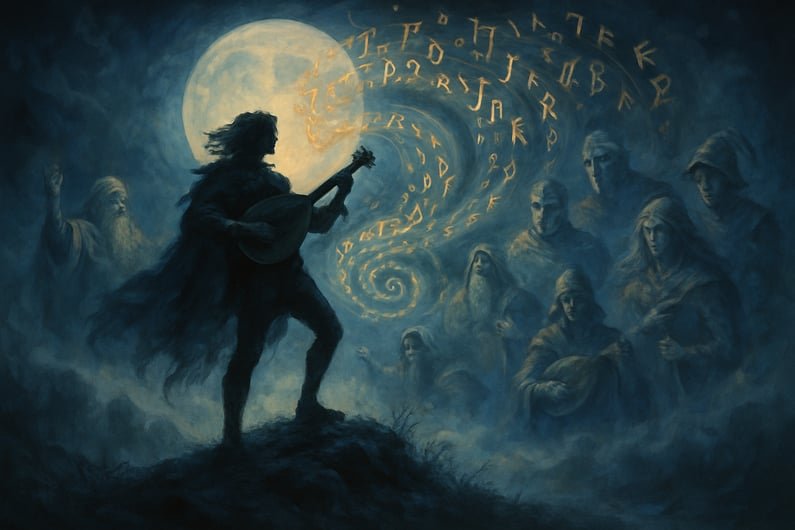
Bards in Fantasy: Legends, History, and the Books That Sing Their Song
Unlock the mystique of bards in fantasy—explore their origins, legendary tales, magical traditions, and the most enchanting books to begin your own bardic journey.
Guardians of Song, Keepers of Secrets, Weavers of Power Most ProfoundIn the misty realms where fantasy bleeds into legend, none wield power quite like the humble bard. Armed with naught but voice and instrument, they command audiences, topple kingdoms, and bridge the sacred and profane with a mere melody. Yet beneath their jaunty exteriors lurk depths that would make the deepest dungeons seem shallow.
The Echoes of Ages Past: Historical Threads of the Bardic Tapestry
Long before fantasy scribes penned their first tales of magical minstrels, bards walked among us as flesh and blood—though one might argue their powers were no less mystical for being real. The Celtic bardic tradition stands as the primordial fountain from which all modern fantasy bards drink, a wellspring that has bubbled forth for millennia.
The Origins of Ancient Power
The bardic tradition dates back to the Iron Age, when Celtic societies flourished across Europe and bards were revered figures, akin to druids and other spiritual leaders. These were not mere entertainers prancing about with lutes; they were the memory banks of entire civilizations, the living libraries who preserved oral history, mythology, and laws through verse and song. In a time before written records, the bard’s memory and eloquence were the primary means of preserving cultural identity—a responsibility that would make even modern historians quake.
The training required was nothing short of monumental. Bards underwent rigorous education that could last anywhere from seven to twenty years, mastering not only music and poetry but also philosophy, law, and the complex art of genealogy. They learned the Ogham alphabet, that mysterious symbolic script linked to trees and natural elements, and absorbed vast repositories of traditional stories and cultural wisdom.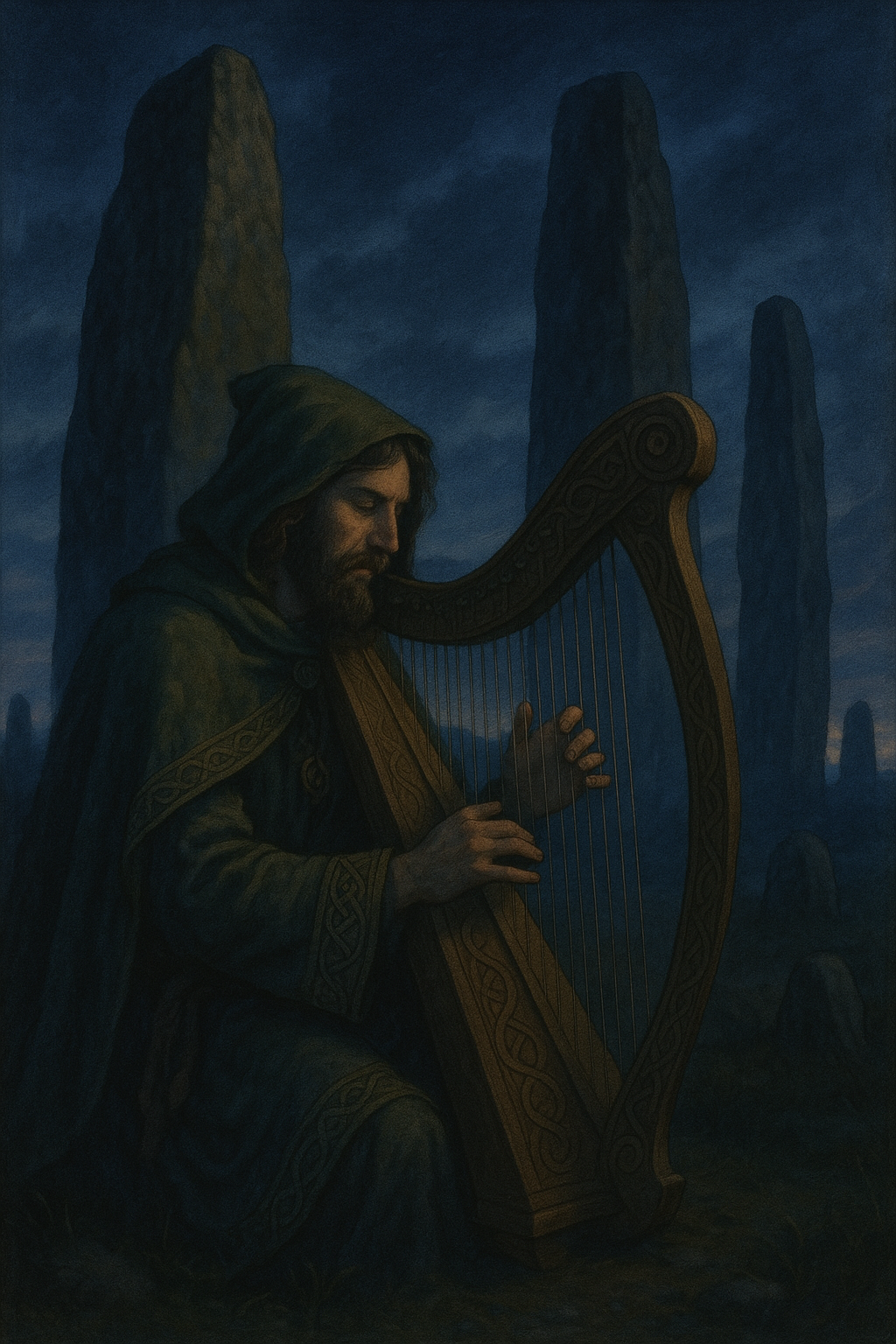
Celtic bard performing ancient songs beneath mystical standing stones
The Weight of Words: Bardic Power and Influence
In Celtic societies, words held immense power—a concept that would later influence fantasy literature profoundly. The belief in the potency of language is evident in the concept of “Geis” (pronounced “gesh”), a form of magical vow or prohibition that a bard’s words could impose. Celtic culture accorded great esteem to bards, and noble Celtic families often feared to provoke a poet to slander, understanding that a well-crafted verse could destroy reputations and even lives.
Ancient sources describe bards as possessing supernatural abilities beyond mere wordplay. They were seers who could foretell the future through “Filidecht,” a form of divination involving poetic composition. Through poetic inspiration, a bard could gain insights into future events, uncover hidden truths, or communicate with the Otherworld. Some bards, like the legendary Amairgin of the Milesians, were said to calm raging storms through song, while others could allegedly cut short a man’s life through the sheer power of their words.
Legendary Figures of the Bardic Realm
Among the mists of history and legend stride figures whose names echo through the ages. Taliesin, perhaps the most famous of all Celtic bards, lived in the 6th century and served as chief bard in the courts of at least three kings of Britain. His name means “shining brow” in Welsh, and he is often referred to as “Taliesin Ben Beirdd” (Chief of Bards). The legendary account of his life tells of his transformation from Gwion Bach, a servant boy who accidentally tasted three drops from the witch Ceridwen’s cauldron of wisdom, granting him divine knowledge and bardic power.
From Greek mythology comes Orpheus, the archetypal bard whose musical prowess was so extraordinary that it could charm stones, tame wild beasts, and even move the gods themselves. The son of Apollo (or the Thracian king Oeagrus) and the muse Calliope, Orpheus represents the idealized vision of the bard as a bridge between mortal and divine realms. His most famous tale—the descent into the underworld to rescue his beloved Eurydice—has influenced countless fantasy narratives about the power of music to transcend even death.
The Sacred and the Profane: Evolution Through the Ages
As Christianity spread through Celtic lands, the bardic tradition underwent profound transformation. The old pagan ways were gradually absorbed and adapted, with many bardic tales being rewritten to conform to Christian sensibilities, though the core magical elements often remained. This fusion created a unique literary tradition that preserved ancient wisdom while adapting to new spiritual frameworks.
The bardic tradition survived longest in Scotland and Wales, where it became deeply embedded in the cultural identity. In Wales, bards formed an organized society with hereditary rights and privileges, regulated by laws said to have been formulated by rulers like Hywell Dha. They were exempt from taxes and military service, their special duties being to celebrate victories and sing hymns of praise—a reflection of their continued importance in society.
By the medieval period, the distinction between different types of poets became more refined. In Ireland, there were fili (poets who composed and functioned as historians, genealogists, and seers) and bards (who sang and played the compositions). The fili were considered to possess spiritual powers and initiation in practices such as divination, reflecting their connection to druidic traditions.
The Transformation into Fantasy: From History to Magic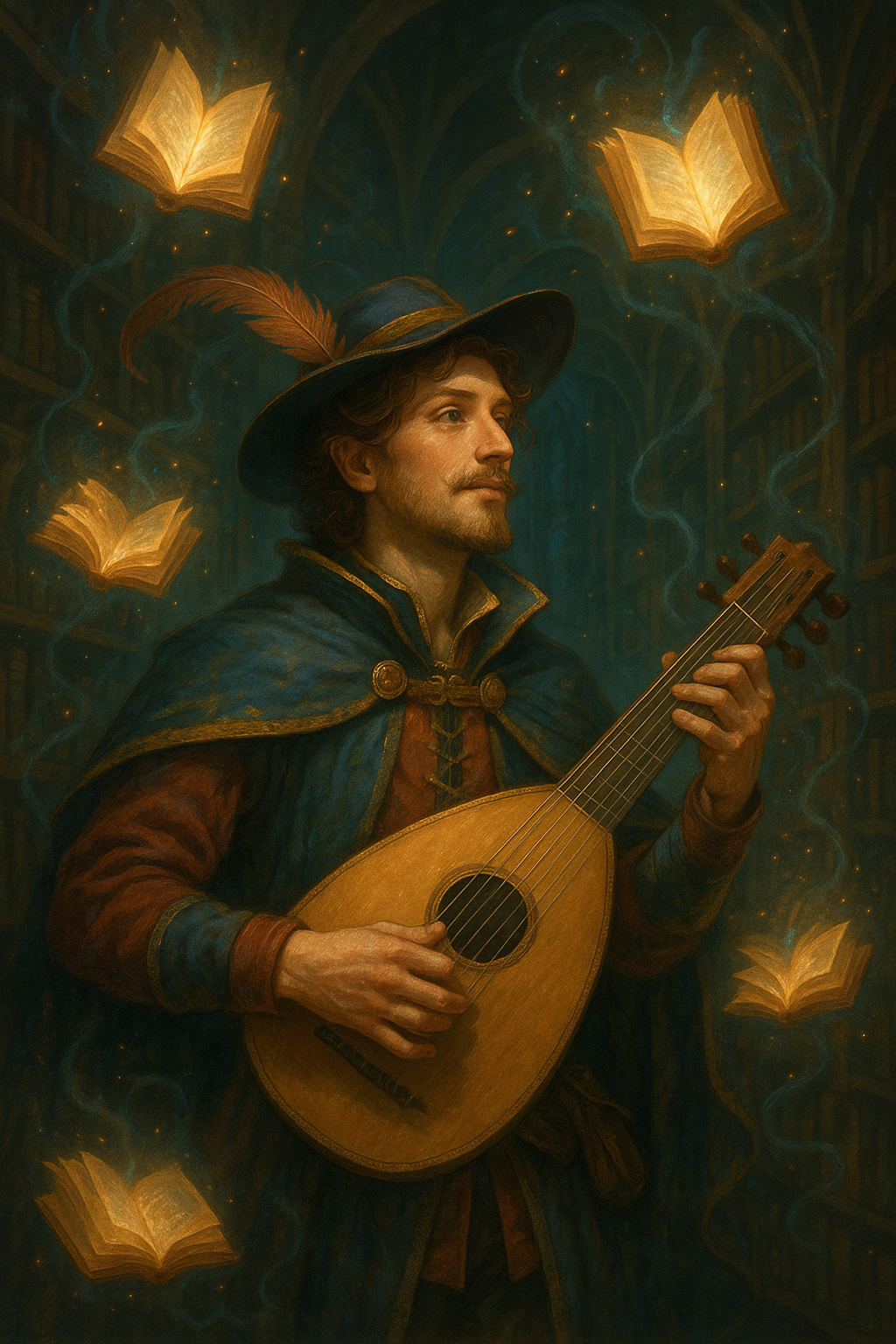
A fantasy bard surrounded by enchanted tomes and magical knowledge
Modern fantasy literature has taken these historical foundations and woven them into something both familiar and wonderously strange. The evolution from historical bard to fantasy archetype represents one of the genre’s most successful adaptations of real-world mythology.
The D&D Revolution
Perhaps no single influence has shaped the modern conception of fantasy bards more than Dungeons & Dragons. The bard class, introduced as a playable character option, crystallized the fantasy bard archetype for generations of readers and writers. The D&D bard combined historical elements with new magical abilities, creating the template that many fantasy novels would follow: a versatile character capable of both combat and magic, using artistic talents to induce supernatural effects.
The class drew inspiration from diverse sources: the Celtic bard and fili, Norse skalds, and southern European minstrels, creating a “hodgepodge” that nonetheless felt coherent within fantasy settings. Listed inspirations included legendary figures like Taliesin, Homer, Will Scarlet, and Alan-a-Dale—a mix that perfectly encapsulates the bard’s role as both entertainer and hero.
The Literary Pantheon: Essential Bard Chronicles for the Discerning Reader
For those seeking to immerse themselves in the rich tradition of bardic fantasy literature, the following tomes represent the finest examples of the art—each a masterwork that illuminates different facets of the bardic experience.
The Magnificent Foundational Works
The Name of the Wind by Patrick Rothfuss
The undisputed crown jewel of bardic fantasy, Rothfuss’s masterpiece follows Kvothe, “the greatest bard to ever tune a lute”. This legendary tale chronicles the transformation of an innkeeper named Kote, whose sparkling eyes betray more charisma than any normal person should possess, as he reveals his true identity as the renowned warrior, seducer, and musician Kvothe. Using magic based around the “true names” of things, Kvothe demonstrates the ultimate expression of bardic power—the ability to charm the very forces of nature.
The novel excels in its detailed exploration of bardic education at the University, where music theory combines with magical practice in ways both logical and wondrous. Rothfuss’s attention to the craft of music-making, from the technical aspects of lute-playing to the emotional power of performance, sets a standard that few other works achieve.
The Harper Hall Trilogy by Anne McCaffrey
Set within McCaffrey’s beloved Pern universe, this trilogy (Dragonsong, Dragonsinger, and Dragondrums) provides perhaps the most thorough exploration of bardic education and society in fantasy literature. Following young Menolly, a girl with extraordinary musical talent who breaks gender barriers to become the first journeywoman Harper in Pern’s history, the series delves deep into the social structures, training methods, and daily life of a society built around musical communication.
McCaffrey’s background in music and theater shines through in her authentic portrayal of musical education and performance. The Harper Hall books excel at showing how music serves not just as entertainment but as the vital communication network that holds a scattered society together.
The Mercedes Lackey Imperium
No discussion of fantasy bards would be complete without acknowledging Mercedes Lackey’s prolific contributions to the subgenre. Her Bardic Voices series, beginning with The Lark and the Wren, has become a cornerstone of bardic fantasy.
The series follows characters like Rune, who flees an abusive home to become the greatest violinist her world has ever known, and Robin, a gypsy bard who must recruit supernatural allies to save her kingdom. Lackey’s work is notable for its unflinching exploration of social issues, its detailed attention to musical craft, and its integration of bardic magic into complex political scenarios.
Lackey’s Bedlam’s Bard series takes the concept into urban fantasy territory, demonstrating the versatility of the bardic archetype across different settings. Her extensive musical background—she’s written lyrics for and recorded nearly fifty songs—lends authenticity to her portrayal of musicians and their craft.
The Elegant Artisans
The Bards of Bone Plain by Patricia A. McKillip
McKillip brings her signature lyrical prose and mythic sensibilities to the bardic tradition with this haunting tale of academic research that becomes a journey through time itself. The novel follows Phelan Cle, a bardic scholar researching the legendary Bone Plain for his graduate thesis, and Princess Beatrice, an archaeologist uncovering ancient artifacts. As their investigations into the past and present converge, the story reveals the deeper mysteries connecting music, magic, and memory.
McKillip’s work stands out for its sophisticated treatment of the relationship between scholarship and magic, showing how the pursuit of knowledge can become its own form of enchantment. Her prose style—dreamy, layered, and rich with metaphor—perfectly captures the mystical nature of bardic power.
A Song for Arbonne by Guy Gavriel Kay
Kay’s masterful reimagining of medieval troubadour culture creates one of fantasy literature’s most nuanced portrayals of a society built around musical artistry. Set in a world inspired by 12th-century Provence, the novel explores the political and cultural implications of a civilization that values artistic excellence above martial prowess.
The story follows Blaise, a warrior from the militaristic north who finds himself caught between his heritage and his growing appreciation for Arbonne’s music-centered culture. Kay’s background as a collaborator with Tolkien’s estate brings extraordinary depth to his world-building, creating a setting that feels both fantastical and historically grounded.
The Modern Marvels
A River Enchanted by Rebecca Ross
Ross’s debut adult fantasy introduces Jack Tamerlaine, a bard summoned home to the Scottish-inspired Isle of Cadence to use his musical magic to communicate with elemental spirits and solve the mystery of missing girls. The novel excels in its integration of Celtic folklore with original magical systems, creating a world where bardic music serves as the bridge between human and spirit realms.
The book’s strength lies in its atmospheric world-building and the way it uses traditional Scottish elements—from the misty landscapes to the clan rivalries—to create a setting that feels both familiar and wonderously strange.
Sing the Four Quarters by Tanya Huff
Huff’s Quarters series presents a unique take on bardic magic, where bards can “sing” elemental spirits to accomplish various magical effects. The protagonist, Annice, is a rare talent able to command all four elements, making her one of the most powerful bards in her kingdom. The series is notable for its progressive social attitudes and its refusal to sideline pregnant women—Annice must navigate political intrigue and magical threats while expecting a child.
Huff’s Canadian background brings a refreshing perspective to fantasy literature, and her books are praised for their casual equality and acceptance of diverse relationships.
The Contemporary Champions
Bloody Rose by Nicholas Eames
The second book in Eames’s Band trilogy follows Tam Hashford, a young bard who joins the legendary mercenary band Fable, led by the infamous Bloody Rose. The story cleverly parallels the music industry with fantasy adventure, as mercenary bands perform in arenas for entertainment rather than undertaking traditional quests.
Eames brings humor and heart to the bardic tradition, exploring themes of fame, family, and finding one’s authentic voice in a world obsessed with celebrity. The novel won both the BookNest Fantasy Award and the r/Fantasy Stabby Award for Best Novel.
The Warrior Bards Trilogy by Juliet Marillier
Marillier’s recent series (The Harp of Kings, A Dance with Fate, and A Song of Flight) follows three young warriors training on Swan Island, combining musical magic with combat skills in early medieval Ireland. The series is notable for its strong female characters and its exploration of how music can serve both as weapon and healing force.
Marillier’s connection to druidry and Celtic spirituality brings authentic depth to her portrayal of the relationship between music, nature, and magic. The series has been praised for its “signature mix of history, folklore and romance, all written in beautiful lyrical language”.
The Symphonic Conclusion: Why Bards Matter
The enduring appeal of bards in fantasy literature stems from their embodiment of fundamental human truths about the power of art, story, and song to shape reality. They represent the belief that creativity is itself a form of magic—that the right words, sung at the right moment, can indeed move mountains, stop wars, or heal broken hearts.
From the ancient Celtic druids who served as living libraries to the modern fantasy heroes who wield music as both sword and shield, bards remind us that knowledge, creativity, and emotional intelligence are forces as powerful as any magical artifact. In a genre often dominated by warriors and wizards, bards offer a different kind of heroism—one based on understanding, empathy, and the patient work of preserving and transmitting culture.
For those ready to embark upon this melodious journey, the works listed here provide entry points into a tradition both ancient and eternally relevant. Each book offers its own interpretation of what it means to wield the power of song, from the scholarly mysteries of Patricia McKillip to the rock-and-roll adventures of Nicholas Eames.
The bards await your attention, dear reader. Will you answer their call?
Links & Sources
The Celtic Bardic Tradition – Celtic Life International
https://celticlifeintl.com/the-celtic-bardic-tradition/
Celtic Bards: Wielders of the Word – Moonfish Writing
https://www.moonfishwriting.com/post/celtic-bards-wielders-of-the-word
Historical Bards and the Legendary Powers They Wielded – YouTube
https://www.youtube.com/watch?v=LSrNf72Xmwk
Taliesin – Wikipedia
https://en.wikipedia.org/wiki/Taliesin
Orpheus – Wikipedia
https://en.wikipedia.org/wiki/Orpheus
Folklore Thursday: Taliesin: The Legendary Figure – Jo-Anne Blanco
https://www.jo-anneblanco.com/2021/08/05/folklore-thursday-taliesin-the-legendary-figure/
The Name of the Wind – Wikipedia
https://en.wikipedia.org/wiki/The_Name_of_the_Wind
Patrick Rothfuss Official Website
http://patrickrothfuss.com/content/note.html
The Harper Hall Trilogy – Wikipedia
https://en.wikipedia.org/wiki/The_Harper_Hall_Trilogy
Bardic Voices Books In Order
https://www.bookseriesinorder.com/bardic-voices/
A Song for Arbonne – Wikipedia
https://en.wikipedia.org/wiki/A_Song_for_Arbonne
The Bards of Bone Plain – Wikipedia
https://en.wikipedia.org/wiki/The_Bards_of_Bone_Plain
A Song of Flight: A Warrior Bards Novel 3 – Pan Macmillan Australia
https://www.panmacmillan.com.au/9781760988838/
Interview with Rebecca Ross (A RIVER ENCHANTED) – Fantasy-Hive
https://fantasy-hive.co.uk/2022/12/interview-with-rebecca-ross-a-river-enchanted/
Sing the Four Quarters: A Quarters Novel – Bookshop
https://bookshop.org/p/books/sing-the-four-quarters-a-quarters-novel-tanya-huff/10894180
Interview with Nicholas Eames (BLOODY ROSE) – Fantasy-Hive
https://fantasy-hive.co.uk/2019/01/interview-with-nicholas-eames-bloody-rose/