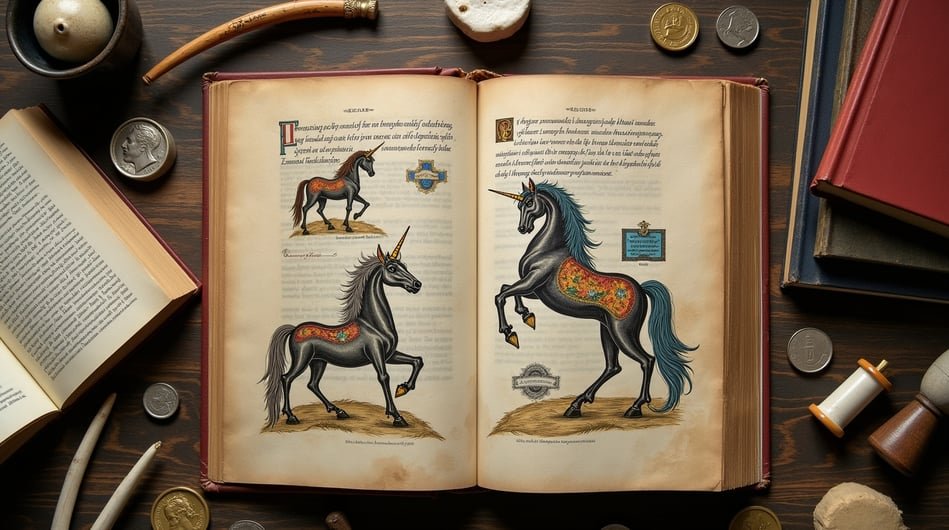
THE PRIMORDIAL GENESIS: ANCIENT ORIGINS AND SCHOLARLY FOUNDATIONS
The unicorn stands as one of history’s most enigmatic creatures, neither fully of this world nor entirely beyond it. What began as scattered observations in ancient texts evolved into a rich tapestry of spiritual symbolism, alchemical wisdom, and cultural fascination that continues to captivate readers centuries later.
The unicorn’s story begins not in fairy tales, but in the dusty archives of ancient scholarship. The earliest written accounts emerge from Greek natural history, where writers described peculiar one-horned creatures dwelling in distant Indian lands. These weren’t whimsical fantasies but serious attempts at documenting exotic wildlife, likely inspired by encounters with the Indian rhinoceros or similarly distinctive animals. Archaeological evidence traces unicorn-like imagery to the Indus Valley Civilization (around 3300-1300 BCE), where seals depicted horse-like creatures with single horns. The fascination spread through ancient Mesopotamian texts, where creatures with singular horns appeared in art and literature as symbols of divine power.
The transformation from natural history to mythology occurred gradually. Greek scholars included these beings in serious texts, blending observation with imagination as stories traveled along trade routes. The creature’s horn—later known as alicorn—was believed to neutralize poison and cure disease, establishing the unicorn’s enduring association with healing and purity.
THE MEDIEVAL METAMORPHOSIS: FROM BESTIARY TO BIBLICAL ALLEGORY
By the Middle Ages, unicorns had become deeply embedded in Christian symbolism. Medieval bestiaries portrayed them as elusive creatures that could only be tamed by virgins—an allegory for the Virgin Mary and Christ’s incarnation. The famous “Lady and the Unicorn” tapestries, housed in the Musée de Cluny, represent this medieval synthesis beautifully, with each tapestry exploring the five senses while the unicorn symbolizes purity and divine mystery.
The creature’s physical description evolved during this period. Early accounts varied widely, but medieval Europe increasingly depicted unicorns as horse-like beings with spiraled horns, graceful builds, and pristine white coats. This standardization reflected the creature’s spiritual significance—horses were already associated with nobility and power, making the unicorn a perfect vessel for divine symbolism.
Interestingly, the Bible itself contributed to unicorn lore through translation mishaps. The Hebrew word re’em was rendered as “unicorn” in the King James Version, though scholars now believe this referred to aurochs or wild oxen. This biblical connection, however erroneous, cemented the unicorn’s place in Christian iconography for centuries.
THE ALCHEMICAL HORN: MEDIEVAL MEDICINE AND MYSTICAL COMMERCE
The unicorn’s horn, or alicorn, became one of medieval Europe’s most coveted commodities. Believed to purify water, neutralize poison, and cure various ailments, these “horns” commanded astronomical prices from royalty and wealthy merchants. The reality was far more mundane—and ingenious.
Viking traders exploited this lucrative market by selling narwhal tusks as genuine unicorn horns. These Arctic marine mammals possess long, spiraled tusks that perfectly matched medieval descriptions of unicorn horns. The tusks were sourced from Greenland and Arctic territories, then transported south through elaborate trade networks. Even kings and popes paid enormous sums for these “proof” of unicorn existence.
The narwhal tusk trade represents a fascinating intersection of mythology, commerce, and cultural transmission. These tusks, with their millions of nerve endings designed for sensing water temperature and salinity, became symbols of magical power in European courts. The deception wasn’t revealed until 1638, when the myth was finally debunked.
THE EVOLUTIONARY ENIGMA: SCIENTIFIC ORIGINS OF UNICORN LEGENDS
Modern paleontology has revealed intriguing connections between unicorn myths and prehistoric reality. The Elasmotherium, dubbed the “Siberian unicorn,” was a massive rhinoceros species that lived until approximately 39,000 years ago. Standing over six feet tall and weighing more than 4,000 pounds, this creature possessed a single, enormous horn centered on its skull.
The Elasmotherium roamed Eurasian grasslands during the Ice Age, when early humans were already present in the region. Could fleeting encounters with this prehistoric giant have inspired the unicorn legends that would persist for millennia? The creature’s massive horn, unique among rhinoceros species, was perfectly aligned with the spine—a detail that remarkably matches traditional unicorn descriptions.
The evolution of rhinoceros species parallels horse evolution, with both adapting to expanding grasslands over millions of years. Early rhinos lacked horns entirely, developing them later as protective adaptations. The word “karkadann” in Arabic and Persian referred to both unicorns and rhinoceroses, suggesting cultural memory of these ancient connections.
CULTURAL METAMORPHOSIS: FROM MASCULINE POWER TO MODERN SYMBOLISM
The unicorn’s symbolic meaning has undergone fascinating transformations across cultures and centuries. In medieval Europe, unicorns represented masculinity, immortality, and divine power. Celtic mythology associated them with chivalry and masculine virtue, while Christian art used them as Christ symbols.
Different cultures developed unique interpretations. Vietnamese tradition includes the unicorn (Lân) among its Four Sacred Animals, representing moral virtue and spiritual protection. In heraldry, unicorns became symbols of innocence and purity, with Scotland adopting the unicorn as its national animal.
The modern era has seen the unicorn’s symbolism evolve again. Contemporary culture has embraced unicorns as symbols of individuality, magic, and even queer identity—a radical departure from their medieval masculine associations. This transformation reflects changing cultural values and the creature’s remarkable adaptability as a symbol.
THE LITERARY RENAISSANCE: CONTEMPORARY UNICORN LITERATURE
Modern literature has embraced the unicorn with renewed sophistication, moving beyond simple children’s fantasy to explore complex themes of identity, loss, and transformation. Peter S. Beagle’s “The Last Unicorn” stands as the genre’s crown jewel, combining elegant prose with profound philosophical depth. This novel, consistently ranked among the finest fantasy works ever written, explores themes of immortality, identity, and the price of being truly unique.
The book’s enduring appeal lies in its treatment of the unicorn not as a symbol but as a fully realized character grappling with loneliness and purpose. Recent editions have expanded the original text with additional stories, including the sequel “Two Hearts,” making it essential reading for both newcomers and longtime fans.
For readers seeking contemporary takes on unicorn mythology, Brogan Thomas’s “Rebel of the Otherworld” series offers a fresh urban fantasy perspective. The protagonist, half-unicorn and half-vampire, navigates a world where supernatural creatures hide in plain sight. This series demonstrates how modern authors adapt traditional unicorn lore for contemporary audiences.
Gayl Jones’s “The Unicorn Woman” (2024) provides a more literary approach, using the unicorn as a metaphor for otherness and identity in post-World War II America. The novel follows a Black GI’s quest to find a carnival performer with a spiraled horn, exploring themes of alienation and belonging.
CHILDREN’S LITERATURE: BUILDING YOUNG IMAGINATIONS
The children’s literature market offers rich pickings for young unicorn enthusiasts. Julie Sykes’s “Unicorn Academy” series has captured young readers’ imaginations with its blend of school story and magical adventure. These books follow students at a magical academy where they bond with unicorns while learning to harness their combined powers.
For educational value, “How to Catch a Unicorn” by Adam Wallace has achieved New York Times bestseller status, combining entertainment with gentle lessons about persistence and creativity. The book’s interactive elements and humor make it ideal for read-aloud sessions.
Publishers like Dreamland Publications offer comprehensive unicorn-themed collections, including activity books, coloring books, and sticker sets. These multi-format packages provide hours of creative engagement while fostering appreciation for unicorn mythology.
SCHOLARLY PERSPECTIVES: ACADEMIC APPROACHES TO UNICORN STUDIES
Academic interest in unicorn mythology has grown significantly, with scholars examining these creatures through anthropological, cultural, and literary lenses. The journal “The Lion and the Unicorn” focuses on children’s literature analysis, regularly featuring scholarly articles on unicorn representation in various media.
Research has revealed how unicorn beliefs reflect broader cultural anxieties about purity, power, and transformation. Medieval bestiaries weren’t merely entertainment but served as moral instruction, using unicorns to communicate complex theological concepts to largely illiterate populations.
Anthropological studies have shown how unicorn myths serve similar functions across cultures, representing the intersection between the wild and the divine, the dangerous and the pure. This universality suggests deeper psychological needs that unicorn mythology addresses.
HERALDIC HERITAGE: UNICORNS IN CEREMONIAL TRADITION
Heraldry has preserved unicorn imagery in formal contexts for centuries. The creatures appear on coats of arms, royal seals, and ceremonial objects throughout Europe. Scotland’s royal coat of arms features a unicorn as one of its supporters, symbolizing the nation’s fierce independence and purity.
The heraldic unicorn follows specific conventions: typically depicted as a white horse with a spiraled horn, often shown with a chain around its neck to signify that it has been tamed. These formal depictions influenced popular understanding of unicorn appearance and behavior.
Modern heraldic artists continue this tradition, creating family crests and corporate logos that incorporate unicorn imagery. The creature’s associations with purity, strength, and noble character make it particularly appealing for institutions seeking to convey these values.
THE DIGITAL AGE: UNICORNS IN MODERN MEDIA
Contemporary media has embraced unicorns across multiple platforms. “Unicorn: Vampire Hunter” represents an innovative approach to comic book storytelling, featuring a unicorn protagonist who battles supernatural evil. This series demonstrates how traditional mythology can be adapted for modern narrative formats.
Social media platforms have become repositories for unicorn lore, with creators sharing historical facts, artistic interpretations, and literary recommendations. TikTok and Instagram accounts dedicated to unicorn content have millions of followers, suggesting sustained public interest in these creatures.
The emergence of “unicorn trivia” reflects growing interest in unicorn knowledge as entertainment. Quiz formats allow people to test their understanding of unicorn mythology while learning new facts about these fascinating creatures.
FUTURE DIRECTIONS: WHERE UNICORN STUDIES LEADS
The unicorn’s journey from ancient natural history to modern literary symbol illustrates humanity’s relationship with the mysterious and unattainable. As environmental concerns grow, unicorns increasingly represent what we risk losing—wild spaces, magical thinking, and connection to the natural world.
Contemporary authors continue finding new ways to explore unicorn mythology. Whether through urban fantasy, literary fiction, or children’s literature, these creatures provide rich material for examining human nature, cultural values, and artistic expression.
The unicorn’s enduring appeal suggests that certain symbols transcend their historical origins to become archetypal expressions of human hopes and fears. In an age of increasing technological complexity, the unicorn offers a touchstone to mystery, magic, and the possibility that wonder still exists in the world.
LINKS & SOURCES
Below are direct links and references for the sources mentioned and used in the unicorns article, organized by category for your convenience.
Primary Academic Sources
Medieval Bestiaries and Unicorn Symbolism Research
https://bestiary.ca
https://www.bl.uk/medieval-english-french-manuscripts/articles/the-lady-and-the-unicorn
Archaeological Evidence from Indus Valley Civilization
https://www.harappa.com/slide/unicorn-seal
https://www.worldhistory.org/Indus_Valley_Civilization/
Biblical Translation Studies and Hebrew Etymology
https://www.bibleodyssey.org/en/tools/ask-a-scholar/unicorns-in-the-bible
https://www.christianity.com/wiki/bible/are-there-unicorns-in-the-bible.html
Heraldic Studies and Ceremonial Traditions
https://www.royal.uk/national-animal-scotland-unicorn
https://www.heraldry-wiki.com/heraldrywiki/wiki/Unicorn
Literary Recommendations
The Last Unicorn by Peter S. Beagle
https://www.penguinrandomhouse.com/books/10840/the-last-unicorn-by-peter-s-beagle/
Rebel of the Otherworld Series by Brogan Thomas
https://www.broganthomas.com/books/
The Unicorn Woman by Gayl Jones
https://www.beacon.org/The-Unicorn-Woman-P1940.aspx
Unicorn Academy Series by Julie Sykes
https://nosycrow.com/series/unicorn-academy/
Historical Trade Documentation
Viking Trade Routes and Narwhal Tusk Commerce
https://www.nhm.ac.uk/discover/the-truth-about-unicorns.html
https://www.nationalgeographic.com/history/article/unicorn-myths-real-animals
Medieval Alicorn Market Analysis
https://www.smithsonianmag.com/history/the-unicorns-of-the-sea-92737709/
Archaeological Evidence of Elasmotherium Fossils
https://www.nhm.ac.uk/discover/news/2018/march/the-real-siberian-unicorn.html
https://www.scientificamerican.com/article/the-last-of-the-siberian-unicorns/
Contemporary Cultural Studies
Anthropological Perspectives on Unicorn Mythology
https://www.cambridge.org/core/journals/folklore/article/unicorns-in-folklore/
https://www.jstor.org/stable/1259289
Modern Heraldic Traditions and Symbolic Evolution
https://www.scotland.org/about-scotland/our-national-animal-the-unicorn
Digital Media and Unicorn Representation Studies
https://www.nytimes.com/2022/06/29/style/unicorns-pop-culture.html
https://www.theatlantic.com/technology/archive/2019/05/unicorns-are-everywhere/590740/