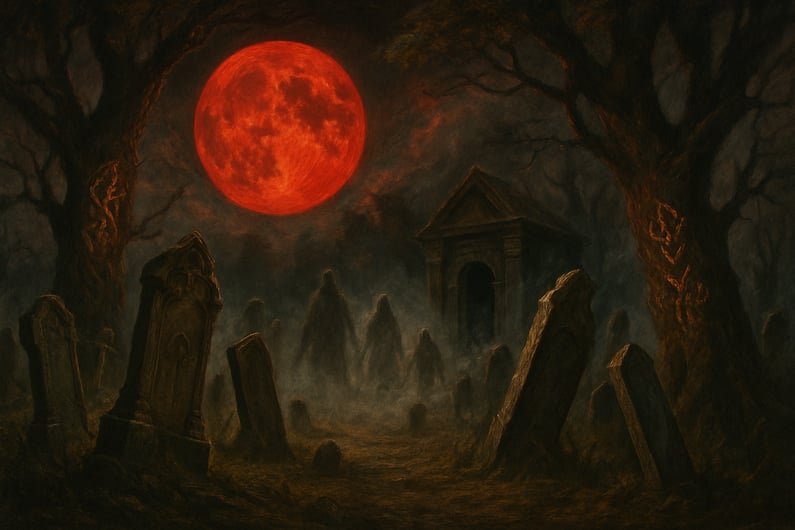
The Undead: A History Written in Shadows
Journey into the chilling legacy of the undead in fantasy literature. Explore their ancient origins, haunting legends, and the best contemporary books that bring vampires, zombies, liches, and restless spirits to unlife. Discover why these creatures continue to fascinate—and terrify—readers across the ages
Death, for most, is the end. For the undead, it’s just an inconvenient detour. These creatures—vampires, zombies, liches, revenants, and all their kin—have haunted humanity’s nightmares and stories since the first campfire tales flickered in the dark. But where did these persistent phantoms originate, and how have they evolved into the icons of fantasy literature we know today?
Ancient Roots: The First Restless Dead
The concept of the undead is as old as storytelling itself. In ancient Mesopotamia, the goddess Ishtar threatened to unleash the dead upon the living—a sort of supernatural population control. The Greeks spun tales of revenants who clawed their way from the Underworld to torment the living, while the Norse whispered of draugr: superhuman corpses who jealously guarded their barrows and treasures, occasionally stretching their legs to terrorize the countryside.
Slavic folklore birthed the first vampires, shadowy figures who rose from their graves to drink the blood of the living. Meanwhile, medieval chroniclers like Saxo Grammaticus and Bishop Thietmar of Merseburg delighted in recounting stories of pious zombies and murderous corpses, all rising inconveniently ahead of schedule—no doubt to the horror of their local clergy.
From Folklore to Fiction: The Literary Undead Emerges
The undead’s migration from oral legend to the written page began in earnest during the 18th and 19th centuries. Heinrich August Ossenfelder’s “Der Vampyr” (1748) introduced vampires to poetry, while John Polidori’s “The Vampyre” (1819) and Sheridan Le Fanu’s “Carmilla” (1872) established the aristocratic, seductive vampire archetype that would later dominate gothic fiction.
Mary Shelley’s “Frankenstein” (1818) gave us the first scientifically reanimated corpse—a prototype for the modern zombie, even if Victor’s creation had more existential angst than hunger for brains. The term “zombie” itself comes from West African and Haitian traditions, where the dead could be enslaved by dark magic—a concept that would later shamble into Western popular culture.
By the 20th century, H.P. Lovecraft’s “Herbert West–Reanimator” and the rise of pulp horror cemented the zombie as a creature of science gone wrong, while Bram Stoker’s “Dracula” (1897) ensured that vampires would forever stalk the moonlit corridors of our collective imagination.
The Undead Across Cultures: A Global Mosaic
Every culture has its own version of the undead. The Japanese tell of yuki-onna, snow women who drain the life from travelers. Indian legends warn of the vetala, spirits who possess corpses to torment the living. In the Philippines, the manananggal splits in two and soars into the night, seeking fresh prey. Even the Scots have their glaistig, a water spirit with a penchant for luring the unwary to their doom.
Despite their differences, these myths share common threads: the fear of the unquiet dead, the anxiety that death may not be the final word, and the desire to protect the living from those who refuse to stay buried. Protective runes, heavy stones on graves, and elaborate rituals abound—testaments to humanity’s ancient dread of the grave’s broken seal.
The Modern Undead: Necromancers, Liches, and the Rise of the Antihero
Contemporary fantasy has taken the undead and run wild. No longer just monsters, they are now heroes, antiheroes, and tragic figures. Necromancers command armies of the dead, liches rule ancient empires, and vampires ponder the meaning of immortality over a glass of something red (and probably type O negative).
Necromancy and Death Magic
Garth Nix’s Old Kingdom series, beginning with “Sabriel,” reimagines necromancy as a sacred duty. Here, necromancers wield bells and swords to lay the dead to rest, navigating the perilous borderlands between life and death. The Abhorsen, a hereditary office, stands as the last bulwark against the restless dead—a far cry from the cackling villains of old.
Tamsyn Muir’s Locked Tomb series, starting with “Gideon the Ninth,” blends necromancy with science fiction and dark humor. In this universe, necromancers become immortal servants of a godlike Emperor by consuming the souls of their companions. The result is a dazzling, macabre dance of power, sacrifice, and existential dread—served with a side of sarcasm.
Vampires: From Monsters to Icons
Bram Stoker’s “Dracula” remains the gold standard, but Anne Rice’s “Interview with the Vampire” transformed the bloodsucker into a brooding, romantic antihero. Today, vampires populate everything from urban fantasy to romance, their immortality a metaphor for everything from addiction to existential ennui.
Jay Kristoff’s “Empire of the Vampire” plunges readers into a world of perpetual night, where vampires rule and the last human hunters fight a losing battle. Illustrated, gothic, and unapologetically epic, it’s a love letter to the genre’s darkest traditions.
Zombies: The Unstoppable Horde
Mary Shelley’s monster may have been the first, but modern zombies owe much to H.P. Lovecraft and, later, the cinematic genius of George A. Romero. In literature, Max Brooks’ “World War Z” reframes the zombie apocalypse as a global oral history, while Mira Grant’s “Feed” explores a world where humanity has adapted to coexist with the undead—through technology, policy, and a healthy dose of paranoia.
The Comedic Undead
Terry Pratchett’s Discworld series, especially “Reaper Man,” offers a rare treat: the undead as comic relief and social commentary. Here, Death himself is a weary bureaucrat, zombies demand civil rights, and vampires attend self-help groups to kick the habit. Pratchett’s wit reveals that even the undead can have existential crises—and a sense of humor.
Essential Reading: Where to Begin Your Undead Adventure
For those ready to embrace the dark, here’s a curated list of essential undead literature:
- “Dracula” by Bram Stoker: The definitive vampire novel, blending horror, romance, and Victorian anxieties.
- “Frankenstein” by Mary Shelley: The original tale of scientific hubris and the agony of the reanimated.
- “Interview with the Vampire” by Anne Rice: The vampire as tragic philosopher and eternal outsider.
- “Sabriel” by Garth Nix: Necromancy as heroism, with a richly imagined magical system.
- “Gideon the Ninth” by Tamsyn Muir: Necromancers in space, with razor-sharp humor and gothic flair.
- “Empire of the Vampire” by Jay Kristoff: An illustrated epic of blood, darkness, and doomed heroism.
- “World War Z” by Max Brooks: A global, journalistic take on the zombie apocalypse.
- “Feed” by Mira Grant: Zombies meet political thriller in a world where the living and the dead must coexist.
- “Reaper Man” by Terry Pratchett: Death takes a holiday, and the undead get a chance at redemption—and punchlines.
Why the Undead Endure: Reflections from Beyond the Grave
Why do these creatures persist? Perhaps it’s because they embody humanity’s oldest questions: What happens after death? Can we ever truly escape our past? And what would we do if given a second chance—no matter the cost?
The undead in fantasy literature are more than monsters; they are mirrors, reflecting our fears, hopes, and the eternal human struggle to find meaning in the shadow of mortality. They remind us that the line between life and death is thin, and sometimes, the most haunting stories are those that refuse to end.
So, next time you open a book and find a vampire lurking in the margins or a necromancer raising the dead, remember: in the world of fantasy, death is only the beginning. And the best stories are the ones that keep coming back for more.
LINKS & SOURCES
Zombies: The History and Literature of Reanimated Corpses
https://galaxypress.com/zombies-the-history-and-literature-of-reanimated-corpses/
Undead Creatures | Mythical Creatures & Beasts
https://mythicalcreaturesandbeasts.com/undead-creatures/
SFE: Vampires
https://sf-encyclopedia.com/entry/vampires
Undead – Wikipedia
https://en.wikipedia.org/wiki/Undead
The Undead by Johan Egerkrans
https://grimfrost.com/products/the-undead
Zombie – Wikipedia
https://en.wikipedia.org/wiki/Zombie
The Essential Zombie Fiction Reading List
https://www.barnesandnoble.com/blog/the-essential-zombie-fiction-reading-list/
My So-Called Death: 7 Books with Thinking Zombies
https://www.barnesandnoble.com/blog/fantasy/my-so-called-death-7-books-with-thinking-zombies/
Sink Your Fangs Into Our 20 Favorite Vampire Books
https://www.esquire.com/entertainment/books/g41767553/best-vampire-books/
The 10 Best Vampire Books
https://www.carolmckibben.com/blog/the-10-best-vampire-books
60+ Best Vampire Books [Every Fan Must Read]
https://upjourney.com/best-vampire-books
The Top 20 Zombie Novels of the Last Decade
https://www.barnesandnoble.com/blog/the-top-20-zombie-novels-of-the-last-decade/
Buried Alive with an Undead Corpse: A Medieval Tale of Horror
https://www.medievalists.net/2024/07/undead-corpse-medieval-horror/
The Pious Undead of Medieval Europe
https://daily.jstor.org/the-pious-undead-of-medieval-europe/
Vigor Mortis: The Vitality of the Dead in Medieval Societies
https://www.routledge.com/Vigor-Mortis-The-Vitality-of-the-Dead-in-Medieval-Societies/Bruce-Gordon/p/book/9781032884875
Did the Greeks Have a Legend of Zombies
https://www.youtube.com/watch?v=w8X8Lvyetbw
The Walking Dead in Medieval England: Literary and Archaeological Perspectives
https://pure.manchester.ac.uk/ws/portalfiles/portal/58517836/FULL_TEXT.PDF
Sabriel – Wikipedia
https://en.wikipedia.org/wiki/Sabriel
The Locked Tomb – Fanlore
https://fanlore.org/wiki/The_Locked_Tomb
Review: Empire of the Vampire by Jay Kristoff
https://thenerddaily.com/review-empire-of-the-vampire-by-jay-kristoff/
Reaper Man | Terry Pratchett Books
https://www.discworldemporium.com/product/reaper-man-paperback/
Necromancy in Dresden Files
https://poweredbyrobots.com/tag/necromancy/
The Old Kingdom – Wikipedia
https://en.wikipedia.org/wiki/The_Old_Kingdom
The Locked Tomb – Wikipedia
https://en.wikipedia.org/wiki/The_Locked_Tomb
Empire of the Vampire – Wikipedia
https://en.wikipedia.org/wiki/Empire_of_the_Vampire