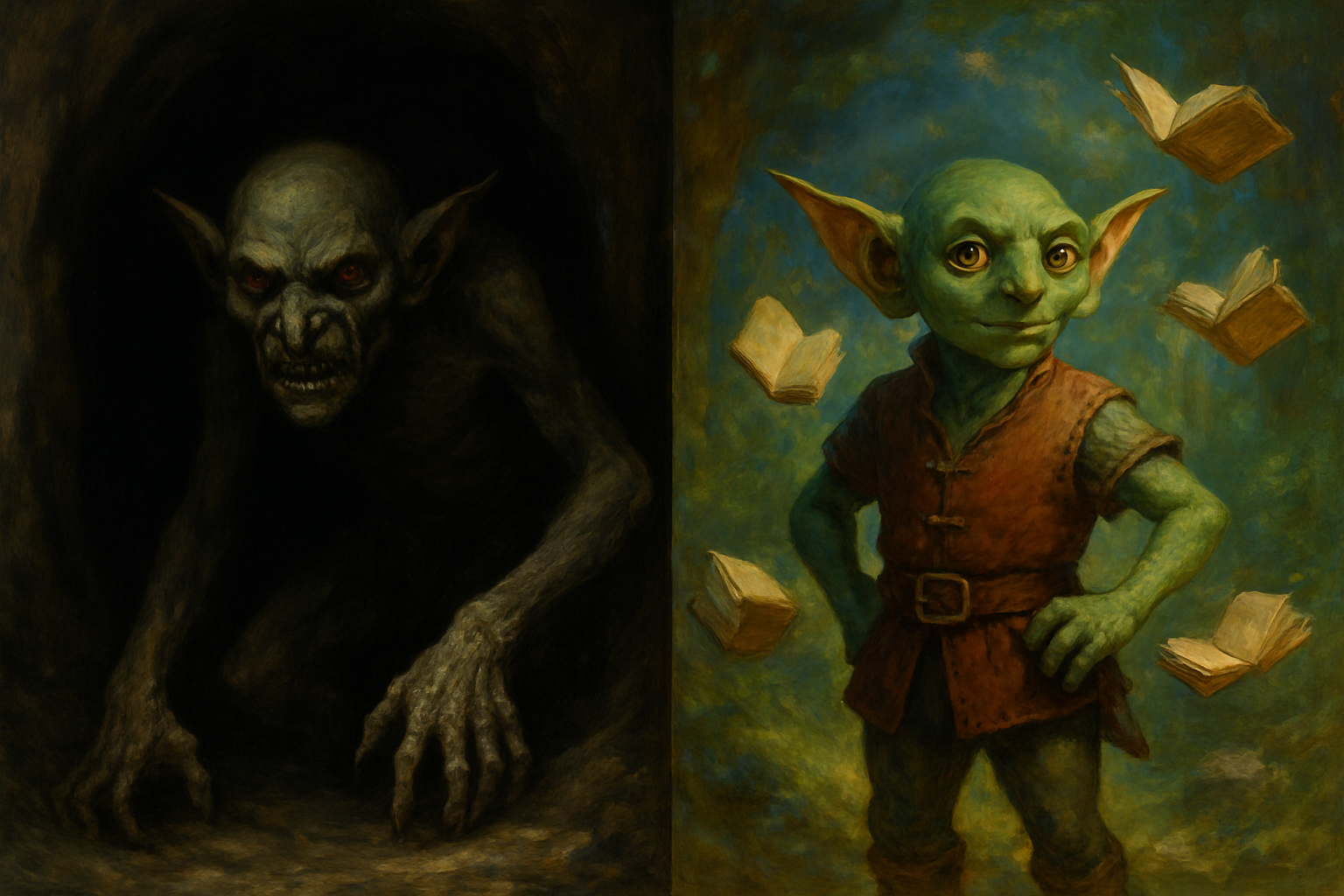
The Goblin’s Journey: From Medieval Menace to Literary Marvel
Journey through the dark evolution of goblins, from their origins as household terrors in European folklore to their transformation into complex characters in modern fantasy. Discover how these once-feared creatures became beloved protagonists, complete with essential reading recommendations for goblin enthusiasts.
The Ancient Roots: When Goblins Were Genuinely Terrifying
Long before goblins became the misunderstood protagonists of modern fantasy, they lurked in the collective nightmares of medieval Europe as household demons and malevolent spirits. These weren’t your garden-variety fantasy creatures—oh no, these were the things that made grown adults check under their beds and nail iron horseshoes above their doors.
The earliest goblin legends emerged from a delicious cocktail of Germanic folklore, Celtic mythology, and good old-fashioned human paranoia. In medieval times, goblins were blamed for everything from sour milk to missing socks—though admittedly, they probably weren’t responsible for the latter. These creatures were described as grotesque, diminutive beings who delighted in tormenting households by banging pots and pans in the dead of night, stealing food, and generally making life miserable for anyone unfortunate enough to attract their attention.
The word “goblin” itself derives from the Old French “gobelin,” which was likely influenced by the Greek “kobalos,” meaning “rogue” or “knave.” How perfectly fitting that these creatures would carry linguistic mischief in their very name. Medieval chroniclers described them as dwelling in grottoes and caves, emerging under cover of darkness to wreak havoc on unsuspecting families.
The Folkloric Foundation: Regional Variations and Cultural Fears
What makes goblin mythology particularly fascinating—and slightly maddening for scholars—is how dramatically these creatures varied across different cultures. The English had their hobgoblins, mischievous but not necessarily malevolent. The Germans feared kobolds, mine-dwelling spirits who could either help or hinder miners depending on their mood. The French dealt with lutins, household spirits that ranged from helpful to downright vindictive.
Each culture seemed to project its specific anxieties onto these creatures. Agricultural societies feared goblins who would spoil crops or steal livestock. Mining communities created elaborate rituals to appease kobolds who controlled the safety of underground work. Urban areas developed legends of goblins who lived in cellars and attics, explaining the mysterious sounds that plagued city dwellers.
The common thread? Goblins represented the unknown, the uncontrollable forces that could disrupt daily life without warning. They were chaos incarnate, wrapped in a conveniently small, ugly package that made them perfect scapegoats for life’s inexplicable frustrations.
The Literary Transformation: From Tolkien’s Orcs to Modern Complexity
The goblin’s journey from folklore fiend to literary character began in earnest with the rise of fantasy literature. J.R.R. Tolkien, that master of mythological reinvention, took the traditional goblin and gave it a makeover that would influence fantasy literature for decades. His goblins—later called orcs—retained their malevolent nature but gained military organization and a clear antagonistic role in epic narratives.
But Tolkien’s interpretation was just the beginning. The real transformation came as authors began questioning the traditional “always evil” approach to fantasy races. Why should goblins be inherently wicked? What if they were simply misunderstood? What if their “mischief” was actually a form of cultural expression that humans simply couldn’t appreciate?
This shift in perspective opened the floodgates for more nuanced goblin portrayals. Authors began exploring goblin societies, cultures, and individual personalities. The creatures that once existed solely to terrorize households suddenly had families, hopes, dreams, and complex social structures.
The Modern Renaissance: Goblins as Protagonists and Heroes
Today’s fantasy literature has embraced goblins with an enthusiasm that would probably terrify their medieval predecessors. Modern authors have transformed these creatures from one-dimensional antagonists into fully realized characters capable of heroism, romance, and personal growth.
The shift represents more than just creative evolution—it reflects our changing understanding of otherness and our growing appreciation for perspectives that challenge traditional narratives. Modern goblin characters often serve as metaphors for marginalized communities, outsiders who must navigate a world that fears or misunderstands them.
Contemporary goblin literature explores themes of prejudice, identity, and belonging with a sophistication that medieval folklore never attempted. These stories ask uncomfortable questions: What makes someone a monster? Is it their appearance, their actions, or simply the stories others tell about them?
The Cinematic Influence: Jim Henson’s Lasting Legacy
No discussion of modern goblin evolution would be complete without acknowledging Jim Henson’s profound impact through “Labyrinth.” Henson’s goblins weren’t just creatures—they were characters with distinct personalities, quirks, and motivations. The film’s Goblin King, portrayed by David Bowie, elevated the entire species from folklore footnote to pop culture icon.
Henson’s approach influenced countless authors and creators who saw goblins not as inherently evil creatures, but as beings capable of complexity, humor, and even nobility. The visual design and characterization from “Labyrinth” can be traced through decades of subsequent fantasy works, proving that sometimes the most profound literary influences come from unexpected sources.
Essential Goblin Literature: A Curated Reading Journey
For those ready to dive into the rich world of goblin literature, several works stand as essential reading. “The Goblin Emperor” by Katherine Addison presents a half-goblin protagonist navigating court intrigue with grace and intelligence, completely subverting traditional goblin stereotypes. The novel demonstrates how goblin characters can carry complex political narratives while maintaining their unique cultural identity.
Jim C. Hines’ “Goblin Quest” series offers a humorous yet thoughtful exploration of goblin society from the inside out. These books present goblins as fully realized beings with their own customs, beliefs, and social structures, rather than simple antagonists for human heroes to overcome.
For readers interested in the historical evolution of goblin portrayal, Terry Pratchett’s Discworld novels feature goblins who evolve from background nuisances to complex characters deserving of respect and understanding. Pratchett’s treatment reflects the broader literary trend toward rehabilitating traditionally villainous fantasy races.
The webcomic-turned-novel “Goblins: Life Through Their Eyes” by Tarol Hunt provides perhaps the most comprehensive exploration of goblin culture and psychology in modern fantasy. Hunt’s work directly confronts the traditional “monster” narrative by following goblin characters as they struggle against both external threats and internalized prejudices.
The Future of Goblin Literature: Trends and Possibilities
Current trends in goblin literature suggest an exciting future for these once-maligned creatures. Authors are increasingly exploring goblin cultures as complex societies with their own histories, technologies, and philosophical traditions. Environmental themes are becoming common, with goblins often portrayed as guardians of natural spaces threatened by human expansion.
The rise of urban fantasy has also created new opportunities for goblin characters, placing them in contemporary settings where they must navigate modern challenges while maintaining their cultural identity. These stories often explore themes of immigration, cultural preservation, and adaptation that resonate with contemporary readers.
Romance novels featuring goblin characters are gaining popularity, challenging readers to reconsider their assumptions about beauty, compatibility, and love. These works push boundaries by asking whether attraction and affection can transcend traditional species barriers—a question that would have horrified medieval audiences but delights modern readers seeking diverse representation.
The Scholarly Perspective: Academic Interest in Goblin Evolution
Recent academic research has begun examining the goblin’s literary evolution as a reflection of changing social attitudes toward otherness and difference. Scholars note that the transformation of goblins from antagonists to protagonists mirrors broader cultural shifts toward inclusivity and understanding of marginalized communities.
The goblin’s journey from folklore to literature also demonstrates how mythological creatures can be reclaimed and redefined by successive generations of storytellers. Each era projects its own values and concerns onto these flexible mythological frameworks, creating new meanings while maintaining connections to ancient traditions.
This scholarly attention has legitimized goblin literature as worthy of serious academic study, leading to conferences, papers, and dissertations examining everything from goblin linguistics to the sociological implications of goblin-human relationships in fantasy narratives.
Conclusion: The Goblin’s Enduring Appeal
The goblin’s transformation from medieval menace to modern literary hero represents one of fantasy literature’s most remarkable rehabilitation projects. These creatures have evolved from simple explanations for household mishaps into complex characters capable of carrying sophisticated narratives about identity, prejudice, and belonging.
Their enduring appeal lies in their fundamental outsider status—goblins represent the other, the misunderstood, the marginalized. In an increasingly diverse literary landscape, goblin characters offer authors and readers opportunities to explore themes of acceptance, understanding, and the courage required to challenge established prejudices.
Whether serving as protagonists in epic fantasies, comic relief in humorous adventures, or complex characters in literary fiction, goblins have proven their versatility and staying power. They’ve clawed their way from the shadows of folklore into the spotlight of modern literature, and they show no signs of retreating back into the darkness.
The next time you encounter a goblin in literature—whether they’re ruling kingdoms, solving mysteries, or simply trying to find their place in the world—remember their long journey from household terror to literary treasure. It’s a transformation that speaks to the power of storytelling to reshape our understanding of what it means to be different, and perhaps more importantly, what it means to be human.
LINKS & SOURCES
Goblin Lore: A Comprehensive Guide to Mythological Mischief
https://mythologyworldwide.com/goblin-lore-a-comprehensive-guide-to-mythological-mischief/
Goblin Encounters in Literature: From Tolkien to Gaiman
https://mythologyworldwide.com/goblin-encounters-in-literature-from-tolkien-to-gaiman/
Taxonomizing Goblins from Folklore to Fiction
https://www.tandfonline.com/doi/full/10.1080/0015587X.2023.2259727
Goblin Mythology: Origins, Evolution Cultural Impact
https://altomerge.com/goblin-mythology-origins-evolution-cultural/
Goblins Books: A Curated 2024 Updated List
https://edgemontlibrary.org/best-book-about-goblins/
Books on Goblins: 2024 Update of the Best Titles
https://hemibooks.com/best-book-about-goblins/
20 Best Books on Goblins – 2023 Reading List & Recommendations
https://paulfinchauthor.com/20-best-books-on-goblins-2023-reading-list-recommendations/
Top Fantasy Books With Goblins to Read Right Now
https://nsmirage.com/top-fantasy-books-with-goblins-to-read-right-now/
Goblin – Encyclopedia Britannica
https://www.britannica.com/art/goblin
Our Goblins Are Different – TV Tropes
https://tvtropes.org/pmwiki/pmwiki.php/Main/OurGoblinsAreDifferent
