From Primordial Whispers to Literary Leviathan
Discover how Cthulhu evolved from ancient mythological fragments into the modern age’s most terrifying cosmic entity. This comprehensive exploration traces the Great Old One’s journey through historical legends, occult traditions, and H.P. Lovecraft’s revolutionary horror literature that forever changed fantasy storytelling.
In the annals of horror literature, few entities command such reverence and terror as Cthulhu, the cosmic behemoth whose very name has become synonymous with existential dread and otherworldly malevolence. Yet to understand this tentacled titan’s true significance, one must journey through the labyrinthine passages of history, where ancient myths, occult traditions, and literary genius converged to birth the most influential horror mythology of the modern age.
The Ancient Echoes: Mythological Precursors
Long before Howard Phillips Lovecraft ever set pen to paper, humanity’s collective unconscious harbored whispers of vast, incomprehensible entities that dwelt beyond the veil of conventional reality. The seeds of what would become the Cthulhu Mythos can be traced through various ancient mythologies, though Lovecraft himself would later claim these as mere shadows of deeper, more terrible truths.
The tentacled horrors that populate oceanic mythologies across cultures provide perhaps the most obvious parallels. The Kraken of Norse legend, with its city-sized bulk and devastating tentacles, shares an unmistakable kinship with Cthulhu’s physical manifestation. Similarly, the Mesopotamian chaos deity Tiamat, often depicted as a primordial sea monster representing the forces of chaos that preceded creation, resonates with the cosmic disorder that Cthulhu embodies.
More intriguing are the parallels found in lesser-known mythological traditions. The Aboriginal Australian concept of the Rainbow Serpent, a primordial being that sleeps beneath the earth and sea, waiting to reshape the world upon its awakening, bears striking resemblance to Cthulhu’s deathlike slumber in R’lyeh. The Hindu concept of cosmic cycles, where the universe undergoes endless periods of creation and destruction overseen by incomprehensible deities, provides a philosophical framework that Lovecraft would later exploit to devastating effect.
The Occult Undercurrents: Esoteric Influences
The late 19th and early 20th centuries witnessed an unprecedented surge in occult interest, a cultural phenomenon that profoundly influenced Lovecraft’s developing worldview. While the Providence recluse publicly maintained his materialist atheism, his fiction betrayed a deep familiarity with esoteric traditions that would prove instrumental in crafting his cosmic horror pantheon.
The Hermetic tradition, with its emphasis on “as above, so below” and the interconnectedness of all planes of existence, provided conceptual scaffolding for Lovecraft’s dimensional horror. The notion that higher dimensions could bleed through into our reality, bringing with them entities of unimaginable power and alien intelligence, draws heavily from theosophical and occult speculation about the nature of reality itself.
Particularly influential was the concept of the Akashic Records, a theosophical belief in a cosmic repository of all knowledge and experience. Lovecraft’s fictional Necronomicon, that most notorious of forbidden tomes, functions as a dark mirror to such concepts, offering knowledge that destroys rather than enlightens those who seek it. The very idea of dangerous knowledge that mortals are not meant to possess has roots in Gnostic traditions and medieval grimoire literature.
The Golden Dawn’s ceremonial magic, with its elaborate rituals designed to contact non-human intelligences, provided another layer of inspiration. The idea that cosmic entities might be summoned through specific incantations and geometric arrangements would become central to Cthulhu Mythos stories, where cultists perform blasphemous rites to hasten their dark gods’ return.
The Lovecraftian Revolution: Birth of Modern Cosmic Horror
When “The Call of Cthulhu” appeared in the February 1928 issue of Weird Tales, it marked nothing less than a revolution in horror literature. Lovecraft had succeeded in synthesizing ancient mythological fears with modern scientific anxieties, creating a new subspecies of terror that would define supernatural fiction for generations to come.
The genius of Lovecraft’s approach lay not merely in the creation of Cthulhu itself, but in the comprehensive mythology that surrounded the entity. Unlike traditional monsters that could be defeated through human agency, Cthulhu represented something far more disturbing: the complete irrelevance of humanity in a universe populated by beings of incomprehensible power and alien intelligence.
The Great Old One’s physical description—a mountainous creature with an octopoid head, dragon-like wings, and a roughly anthropoid body—drew from humanity’s deepest evolutionary fears. The combination of cephalopod intelligence with reptilian antiquity and mammalian form created a chimeric horror that violated every comfortable category of earthly life. More unsettling still was Cthulhu’s non-Euclidean geometry, suggesting that the entity existed partially outside the three-dimensional space that constrains mortal perception.
The Textual Genesis: From Dream to Nightmare
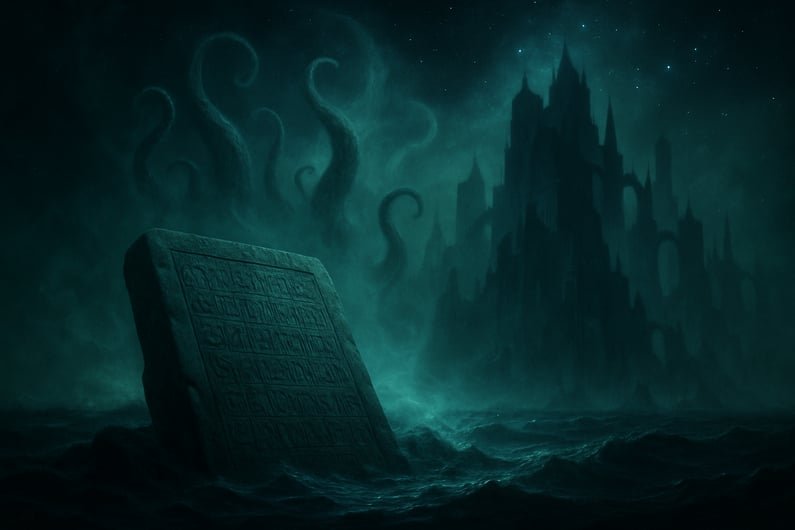
The creation of “The Call of Cthulhu” itself followed a process that would become legendary among horror enthusiasts. Lovecraft claimed the story originated from a vivid dream in which he encountered a massive stone monument covered with indecipherable hieroglyphs. This monument, he later wrote, conveyed “a sense of pedantic single-mindedness and concentrated will infinitely removed from anything in human experience.”
The story’s structure, presented as a scholarly investigation into bizarre events, established what would become the standard template for cosmic horror: the gradual revelation of impossible truths through the accumulation of seemingly unrelated evidence. The narrative unfolds through three distinct episodes: the discovery of Professor Angell’s research notes, the account of Inspector Legrasse’s encounter with a Cthulhu cult in Louisiana, and the horrifying climax involving the temporary rise of R’lyeh itself.
Each segment builds upon the last, creating a mounting sense of cosmic dread that culminates not in traditional resolution, but in the narrator’s growing awareness of humanity’s precarious position in an indifferent universe. The story’s famous opening lines—”The most merciful thing in the world, I think, is the inability of the human mind to correlate all its contents”—established cosmic horror’s central premise: that complete knowledge of reality would drive humanity to madness.
The Mythological Architecture: Building the Mythos
Following the initial success of “The Call of Cthulhu,” Lovecraft began developing what would eventually be termed the Cthulhu Mythos, though he never used this designation himself. The term was coined by August Derleth, Lovecraft’s correspondent and literary executor, who played a crucial role in organizing and expanding the mythology after Lovecraft’s death.
The Mythos grew organically through Lovecraft’s subsequent stories, each adding new elements to the cosmic horror framework. “The Dunwich Horror” introduced the concept of half-human offspring of cosmic entities, while “At the Mountains of Madness” revealed the ancient history of Earth’s pre-human civilizations. “The Shadow over Innsmouth” explored the theme of racial contamination by otherworldly forces, and “The Dreams in the Witch House” delved into the mathematical underpinnings of interdimensional travel.
Central to the Mythos was the concept of the Great Old Ones, a pantheon of cosmic entities that once ruled Earth and now lie dormant, waiting for the stars to align correctly for their return. Cthulhu, though perhaps the most famous, was merely one member of this terrifying hierarchy. The mythology included Azathoth, the blind idiot god at the center of the universe; Yog-Sothoth, the key and guardian of dimensional gateways; and Nyarlathotep, the crawling chaos who serves as messenger between the Great Old Ones and their human cultists.
The Collaborative Expansion: A Shared Universe
One of the most remarkable aspects of the Cthulhu Mythos was its development as a shared fictional universe. Lovecraft actively encouraged fellow writers to borrow elements from his mythology, creating cross-references and expanding the scope of cosmic horror. This collaborative approach was revolutionary for its time, predating the modern concept of franchise world-building by decades.
Writers like Clark Ashton Smith, Robert E. Howard, and Frank Belknap Long contributed their own entities and locations to the growing mythology. Smith’s Tsathoggua, Howard’s references to Nameless Cults, and Long’s Hounds of Tindalos all became integral parts of the Mythos canon. This collaborative expansion gave the mythology a sense of authenticity and depth that no single author could have achieved alone.
The shared universe concept also extended to the creation of fictional texts and artifacts. The Necronomicon, written by the “Mad Arab” Abdul Alhazred, became the most famous of these forbidden tomes, but the Mythos also included the Pnakotic Manuscripts, the Book of Eibon, and Cultes des Goules. These texts served as connecting tissue between stories, creating the impression of a vast, interconnected web of forbidden knowledge.
The Scientific Horror: Cosmic Indifferentism
What distinguished Lovecraft’s cosmic horror from earlier supernatural fiction was its grounding in scientific materialism rather than religious or spiritual frameworks. Lovecraft’s entities were not demons or spirits, but extraterrestrial beings whose advanced science appeared as magic to primitive human understanding. This approach reflected early 20th-century anxieties about humanity’s place in an increasingly vast and impersonal universe.
The discovery of the universe’s true scale, with its billions of galaxies and incomprehensible distances, had profound psychological implications. Lovecraft channeled these anxieties into his fiction, creating entities that embodied the universe’s indifference to human concerns. Cthulhu and the Great Old Ones were not evil in any conventional sense; they were simply so alien that their very existence threatened human sanity.
This philosophical approach, which Lovecraft termed “cosmic indifferentism,” represented a radical departure from traditional horror narratives. Instead of moral conflicts between good and evil, cosmic horror presented amoral conflicts between the known and unknowable, the human and inhuman, the finite and infinite. The result was a form of existential terror that struck at the very foundations of human identity and purpose.
The Literary Legacy: Influence and Evolution
The impact of Cthulhu and the broader Mythos on subsequent horror literature cannot be overstated. The entity’s influence extends far beyond the horror genre, permeating science fiction, fantasy, and even mainstream literature. Authors from Stephen King to China Miéville have acknowledged their debt to Lovecraft’s cosmic vision, while filmmakers, game designers, and artists continue to draw inspiration from the tentacled terror.
The Mythos has proven remarkably adaptable to different media and cultural contexts. Video games like “Call of Cthulhu: Dark Corners of the Earth” and “The Sinking City” have translated cosmic horror into interactive experiences, while tabletop role-playing games like “Call of Cthulhu” have allowed players to inhabit Lovecraft’s nightmarish universe. Board games, from “Arkham Horror” to “Eldritch Horror,” have brought the Mythos to gaming tables worldwide.
Contemporary authors have found new ways to approach Lovecraftian themes while addressing problematic aspects of the original material. Writers like Victor LaValle, Cassandra Khaw, and Caitlín R. Kiernan have created works that maintain the cosmic horror atmosphere while examining issues of race, gender, and identity that Lovecraft himself often ignored or actively disparaged.
The Occult Renaissance: Real-World Mysticism
Perhaps most remarkably, the fictional Cthulhu Mythos has transcended literature to influence actual occult practices. The Typhonian Order, founded by Kenneth Grant, incorporated Lovecraftian entities into their magical system, treating them as genuine cosmic forces rather than fictional constructs. This blurring of the line between fiction and occultism demonstrates the profound psychological impact of Lovecraft’s creations.
Modern chaos magic practitioners have similarly adopted Cthulhu Mythos elements, arguing that the entities’ fictional nature makes them ideal vehicles for magical practice precisely because they lack the cultural baggage of traditional religious symbols. The result has been a feedback loop between fiction and mysticism that continues to evolve and expand.
The Digital Age: Cthulhu in Cyberspace
The internet age has witnessed an explosion of Cthulhu-related content, from elaborate fan fiction archives to interactive websites that present Mythos information as if it were genuine historical documentation. Online communities have collectively expanded the mythology far beyond Lovecraft’s original vision, creating a living, evolving narrative that adapts to contemporary fears and anxieties.
Memes and internet culture have embraced Cthulhu with characteristic irreverence, simultaneously celebrating and parodying the entity’s cosmic terror. This cultural appropriation has introduced Lovecraftian concepts to audiences who might never have encountered the original stories, ensuring the Mythos’s continued relevance in an increasingly connected world.
The Philosophical Implications: Terror and Transcendence
At its deepest level, the Cthulhu Mythos functions as a meditation on the nature of knowledge, reality, and human consciousness. The recurring theme of knowledge as a source of madness rather than enlightenment reflects genuine philosophical anxieties about the limits of human understanding. In an age of information overload and technological acceleration, Lovecraft’s vision of dangerous knowledge feels increasingly prophetic.
The entity of Cthulhu itself represents the ultimate unknowable, a presence so alien that direct contact with it shatters human sanity. This concept has found unexpected resonance in contemporary discussions of artificial intelligence, quantum mechanics, and consciousness studies, where researchers grapple with phenomena that challenge fundamental assumptions about the nature of reality.
Conclusion: The Eternal Dreamer
From its origins in ancient mythological traditions through its crystallization in Lovecraft’s revolutionary fiction to its continued evolution in contemporary culture, Cthulhu represents far more than a simple monster. The Great Old One embodies humanity’s deepest fears about our place in an indifferent universe, our limitations as a species, and the potentially catastrophic consequences of seeking knowledge we are not equipped to comprehend.
The journey from primordial whispers to modern terror reflects our own species’ evolution from primitive mythology to sophisticated horror literature. Cthulhu serves as a dark mirror to human progress, suggesting that every advance in knowledge and understanding brings us closer to confronting truths that may be too terrible to bear.
In the end, perhaps the most disturbing aspect of Cthulhu is not the entity itself, but what it represents: the possibility that our entire conception of reality is a comforting delusion, and that genuine enlightenment would reveal a universe so alien and hostile that madness would be the only rational response. As Lovecraft himself wrote, “We live on a placid island of ignorance in the midst of black seas of infinity, and it was not meant that we should voyage far.”
The Great Old One sleeps still in R’lyeh, waiting for the stars to align and the call to be answered. But perhaps that sleep is humanity’s greatest mercy, for in dreams, even the most terrible truths remain safely distant from our fragile sanity. Until, of course, the dreamer wakes.
LINKS & SOURCES
Cthulhu Mythos – Wikipediahttps://en.wikipedia.org/wiki/Cthulhu_Mythos
Cthulhu – Wikipediahttps://en.wikipedia.org/wiki/Cthulhu
Cthulhu | The H.P. Lovecraft Wiki | Fandomhttps://lovecraft.fandom.com/wiki/Cthulhu
Cthulhu | Description, Origin, & Facts | Britannicahttps://www.britannica.com/topic/Cthulhu
H.P. Lovecraft & the Cthulhu Mythos: Exploring His Horror Legacy | TheCollectorhttps://www.thecollector.com/lovecraft-and-cthulhu-mythos/
The Mythology and Legends of H.P Lovecraft – Dreams and Mythologyhttps://dreamsandmythology.com/mythology-legends-lovecraft/
H. P. Lovecraft – Occult Encyclopediahttps://www.occult.live/index.php?title=H._P._Lovecraft&mobileaction=toggle_view_desktop
The Cthulhu Mythos | Cultist Armouryhttps://cultistarmoury.org/the-cthulhu-mythos/
H P Lovecraft and the Foundations of a Mythos | Flynn Grayhttps://flynngray.wordpress.com/2016/01/17/h-p-lovecraft-and-the-foundations-of-a-mythos/
Cthulhu Mythos Timelinehttp://omnimulti.com/other/cthuchrono.htm