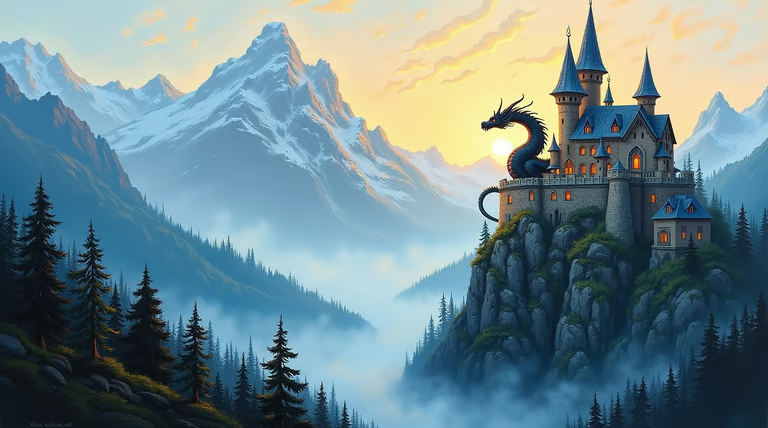
From Primordial Chaos to Modern Fantasy: Dragons Through the Ages
Unravel the epic journey of dragons in fantasy literature, from ancient myth to modern masterpieces. Explore legendary authors, iconic tales, and must-read books that shaped the lore of these mythical beasts.
The Ancient Origins of Dragons Dragons first slithered into human consciousness through the myths of ancient Mesopotamia, where tales like Marduk’s battle with Tiāmat set the stage for dragons as symbols of chaos and cosmic power. The word “dragon” itself, rooted in the Greek drakon, hints at a creature both serpentine and all-seeing, a being that embodies primal forces beyond mortal reckoning.
Medieval Monsters and Mythmakers
The Western dragon’s archetype crystallized in medieval literature, most notably in Beowulf, where the dragon’s fiery wrath and hoarded treasure became symbols of greed and doom. Norse legends contributed Fafnir, a cursed dragon whose tragic tale of greed and transformation still echoes in modern fantasy. Meanwhile, saints like George turned dragons into metaphors for evil, their defeat a stand-in for the triumph of order over chaos.
The Gentle Revolution: Early Modern Dragons
Victorian and Edwardian authors reimagined dragons as more than monsters. Kenneth Grahame’s “The Reluctant Dragon” gave us a poetry-loving, peaceable beast, while E. Nesbit’s magical creatures challenged the idea that all supernatural beings were inherently wicked.
Tolkien’s Smaug and the Birth of Modern Fantasy
J.R.R. Tolkien’s Smaug, inspired by Beowulf and Norse myth, set the gold standard for literary dragons. Smaug’s cunning, greed, and grandeur redefined the genre, making him the archetype for generations of fantasy writers and readers alike.
Dragons as Companions and Sages
The 20th century saw dragons evolve from adversaries to allies. Anne McCaffrey’s Dragonriders of Pern introduced telepathic, world-saving dragons, while Ursula K. Le Guin’s Earthsea dragons embodied ancient wisdom and the mysteries of language itself. These stories challenged the notion that dragons must be slain, instead presenting them as partners and teachers.
Modern Masters and New Frontiers
Contemporary authors have pushed dragon lore into new realms. George R.R. Martin’s dragons in A Song of Ice and Fire are weapons of mass destruction and symbols of lost power. Naomi Novik’s Temeraire series reimagines dragons as sentient participants in Napoleonic warfare, while Christopher Paolini’s Eragon and Robin Hobb’s Dragon Keeper continue to expand the emotional and magical depth of dragon-human bonds.
The Current Renaissance
Recent years have seen a resurgence of dragon-centric tales. Samantha Shannon’s “The Priory of the Orange Tree” fuses Eastern and Western dragon myths in a sweeping epic, while Rebecca Yarros’s “Fourth Wing” delivers a fresh take on dragon-riding academies for a new generation of readers. Dragons remain as captivating as ever—symbols of wonder, danger, and the limitless possibilities of the imagination.
Essential Dragon Fantasy Reading List
- Beowulf — The original Western dragon epic
- The Reluctant Dragon by Kenneth Grahame — The first sympathetic dragon
- The Hobbit by J.R.R. Tolkien — Smaug’s defining role
- Dragonflight by Anne McCaffrey — Dragons as partners
- A Wizard of Earthsea by Ursula K. Le Guin — Dragons as ancient wisdom
- A Game of Thrones by George R.R. Martin — Dragons as world-shapers
- His Majesty’s Dragon by Naomi Novik — Napoleonic dragon warfare
- Eragon by Christopher Paolini — Modern coming-of-age dragon fantasy
- The Priory of the Orange Tree by Samantha Shannon — Global dragon mythology
- Fourth Wing by Rebecca Yarros — Contemporary dragon-rider saga
- Dragon Keeper by Robin Hobb — Dragons reclaiming their heritage
Links & Sources
Dragon – Wikipedia
https://en.wikipedia.org/wiki/Dragon
List of dragons in literature – Wikipedia
https://en.wikipedia.org/wiki/List_of_dragons_in_literature
How Dragons Became a Staple of Fantasy Fiction
https://dragon.university/how-dragons-became-a-staple-of-fantasy-fiction/
The Evolution of the Dragon in Fantasy Fiction: from Beast to Icon
https://www.academia.edu/37747481/The_Evolution_of_the_Dragon_in_Fantasy_Fiction_from_Beast_to_Icon
A History of Dragons in Western Literature – Reactor
https://reactormag.com/a-history-of-dragons-in-western-literature/
Smaug, the Hoarder: What Tolkien Teaches Us About Dragons
https://lanternhollow.wordpress.com/2011/03/29/smaug-the-hoarder-what-tolkien-teaches-us-about-dragons-possession-and-sparkly-things/
J.R.R. Tolkien Gave the World His Childhood Fascination With Dragons
https://www.smithsonianmag.com/smart-news/smaug-dragons-deep-roots-real-mythology-180964935/
The Reluctant Dragon (short story) – Wikipedia
https://en.wikipedia.org/wiki/The_Reluctant_Dragon_(short_story)
Dragonflight (novel) – Wikipedia
https://en.wikipedia.org/wiki/Dragonflight_(novel)
Dragons of Earthsea – Wyrmflight
https://wyrmflight.wordpress.com/2014/07/20/dragons-of-earthsea/
Daniel Falconer: Smaug is the grand-daddy of dragons
https://www.theonering.net/torwp/2014/04/07/88458-daniel-falconer-smaug-is-the-grand-daddy-of-dragons/
Dragon – A Wiki of Ice and Fire
https://awoiaf.westeros.org/index.php/Dragon
Temeraire (series) – Wikipedia
https://en.wikipedia.org/wiki/Temeraire_(series)
Dragon Keeper – Wikipedia
https://en.wikipedia.org/wiki/Dragon_Keeper
Eragon – Wikipedia
https://en.wikipedia.org/wiki/Eragon
The dragon (Beowulf) – Wikipedia
https://en.wikipedia.org/wiki/The_dragon_(Beowulf)
Fafnir | Giant, Dragon, Hoarder | Britannica
https://www.britannica.com/topic/Fafnir
Marduk the Dragon Slayer | EBSCO Research Starters
https://www.ebsco.com/research-starters/religion-and-philosophy/marduk-dragon-slayer
