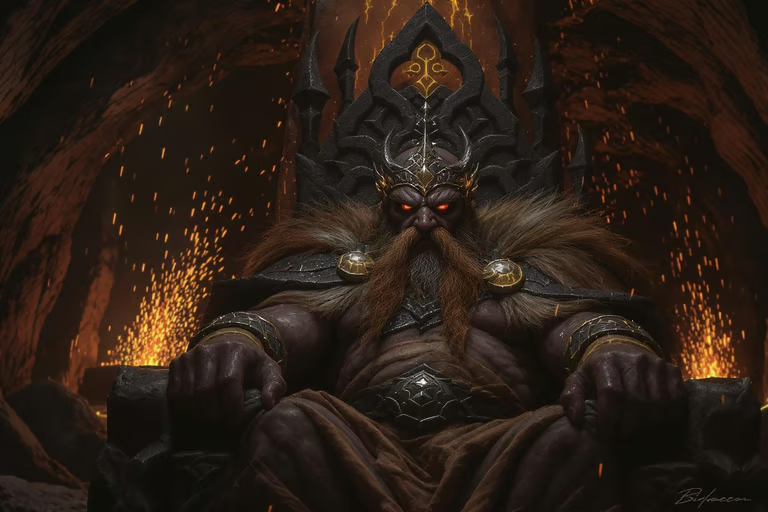
The Anvil of Myth: Dwarven Origins in Ancient Lore
Explore the multifaceted world of dwarves: their mythological roots, craftsmanship, and evolution into fantasy’s most resilient underdog. Discover why these stoic warriors and artisans dominate subterranean sagas.
Dwarves have always been creatures of fire and shadow, their origins steeped in the primordial myths of the North. In Norse cosmology, dwarves—known as dvergar—were said to have formed from the flesh of the giant Ymir, springing forth like maggots from a corpse. These beings were not the jovial ale-swillers of modern fantasy, but enigmatic figures who straddled the boundary between craftsman and trickster, between order and chaos. The Poetic Edda tells of their legendary forges, where they crafted Mjölnir, Thor’s mighty hammer, and Gleipnir, the unbreakable chain that bound the wolf Fenrir. Their realm, Svartalfheim, was a place of shadow and mystery, where darkness shaped their very being, giving them pitch-black skin and a deep aversion to sunlight.
Medieval Christian chroniclers often demonized these figures, conflating them with malevolent spirits. Yet in folk tales, dwarves retained a complex duality: they could curse crops or bless mines, demand tribute or bestow enchanted swords. The 13th-century Þiðreks saga features dwarf-smiths like Mime, whose cursed armor drives heroes to madness—a precursor to the cursed artifacts that would later populate the worlds of Tolkien and other fantasy writers.
Tolkien’s Chisel: Redefining Dwarves for Modern Fantasy
J.R.R. Tolkien transformed dwarves from footnotes to protagonists, weaving Norse tropes into a tapestry of tragic grandeur. His Khazâd were “a tough, thrawn race,” their seven clans founded by fathers carved from stone. Longevity became a burden: a 250-year lifespan meant centuries to nurture grudges, as seen in Thorin Oakenshield’s obsession with reclaiming Erebor. Female dwarves, like Dís, were so rare that outsiders often doubted their existence—a detail that amplified the race’s slow march toward extinction.
Tolkien’s linguistic genius gave dwarves a secret tongue, Khuzdul, inspired by Hebrew, which stood in stark contrast to the flowing Quenya of the elves. This mirrored their cultural ethos: dwarves were builders, not beautifiers, their greatest cities—like Moria—becoming mausoleums of lost glory. Their rituals, like the sharing of bread and salt, were bulwarks against despair, reminders of kinship in the face of endless darkness.
The Forge of Game Design: Dwarves in RPGs and Beyond
Dungeons & Dragons codified dwarves as the ultimate player underdogs. With bonuses to constitution, resistance to poison, and an innate understanding of stonework, they became the party’s anchor—reliable, gruff, and suspicious of flashy magic. Subraces diversified the archetype: hill dwarves as stalwart healers, duergar as psionic slavers in the Underdark, and in games like Dragon Age, lyrium-addicted casteless dwarves mining magic ore at the cost of their sanity.
Video games added new layers to the dwarven identity. Warhammer’s dwarves blend steampunk artillery with Viking fatalism, their Book of Grudges requiring players to avenge every slight. The Elder Scrolls inverted expectations with the Dwemer—a vanished race of philosopher-scientists whose tonal architecture fused magic and quantum theory.
Anatomy of a Dwarf: Biology as Destiny
Fantasy dwarves share core traits honed by underground evolution. Their dense musculature and low centers of gravity make them deadly grapplers, while their infravision or darkvision allows them to navigate the deepest mines—though often at the cost of light sensitivity. Some lore suggests secondary lungs for filtering bad air in mines, and decade-long pregnancies to explain their sparse populations.
Their beards serve both practical and symbolic roles: facial hair stores mining dust as camouflage, while shaving marks shame. In some stories, beard beads encode family history—a wearable genealogy that tells the story of generations.
Societies of Stone: Clans, Craft, and Conflict
Dwarven cultures orbit three axes: mineral wealth, ancestral honor, and survival against existential threats. Their cities are marvels of engineering, with tiered metropolises like Orzammar in Dragon Age, where caste determines altitude. Guilds control every aspect of life, from smithing to brewing, and inter-guild rivalries fuel the plots of many a dwarven saga.
Kinship wars over mine rights are common, resolved through ritualized combat or architectural duels—who can build the better bridge, or the grander hall. Modern fantasy has subverted these tropes in creative ways: desert dwarves using sandstone sintering to create glass citadels, diplomatic dwarves negotiating peace between dragon clans, and even dwarves grappling with gender identity when helmets obscure their beards.
The Dwarven Paradox: Why We Root for the Underdiggers
Dwarves resonate because they embody humanity’s best and worst traits: perseverance versus stubbornness, craftsmanship versus materialism, clan loyalty versus xenophobia. They are the ultimate underdogs, battling dragons, drow, and entropy itself. As Tolkien wrote, “If more of us valued food and cheer and song above hoarded gold, it would be a merrier world”—a critique of industrialization disguised as dragon-sickness.
Links & Sources
- Dwarf (folklore) – Wikipedia
- Dwarves in Norse Mythology – World History Encyclopedia
- Dwarves in Middle-earth – Wikipedia
- Dwarf – D&D 5th Edition Wiki
- Dwarves in Warhammer Lore – Lexicanum
- Reddit Analysis on Dwarven Culture
- Discworld Dwarves – Wikipedia
- Dwemer Lore – The Elder Scrolls Wiki
- Dragon Age Dwarves Analysis – The Fandomentals
- Dwarven Worldbuilding Guide – CBR
- Tolkien’s Dwarves Explained – YouTube
- Norse Dwarves – Vikingr
